Lotus Blooms In Bengal
By Poonam I Kaushish
At the end, it was all about feel good. A six-week long grueling election which culminated in the lotus blooming in West Bengal, Sarma continuing to brew tea in Assam, Vijay rath rolling out in Tamil Nadu and Kerala opting for UDF, all winning tough gladiatorial contests.
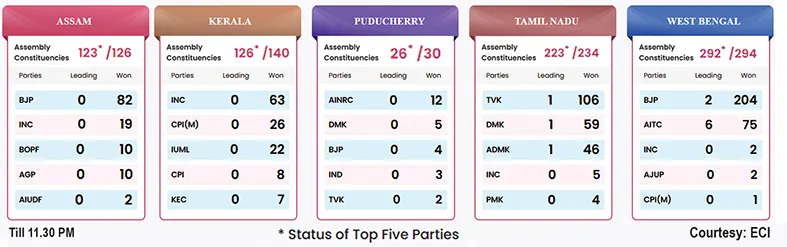
Undoubtedly, BJP made history in Kolkata winning 205 of 294 seats in an intense battle of ideologies, grassroots politics, aggressive promises of doles and development and fresh calls of change with the State on course to see its first Saffron Government since Independence. Mamata’s Trinamool stands defeated “khela to ho gaya iss baar” after 15 years in power, in an election with saw record voters deletion: 89 lakh voters, 11.6% under Election Commission’s Special Intensive Revision.
Winning Bengal is a sweet ideological victory for BJP cementing its electoral dominance across a contiguous region stretching from East to West. The State has long avoided the Hindutva Brigade and boosts Modi’s image halfway through his third term in office.
BJP pitched its aggressive restatement of identity politics and hard borders in contrast to TMC patronage politics, reflecting structural shifts that it built over several election cycles. One, TMC’s anti-incumbency due to long tenure and accumulated grievances. Namely, governance, cut-money, corruption and localised discontent which created openings BJP exploited.
The Party succeeded in converting its vote-share gains into seat competitiveness. Its organisational expansion, once a major weakness, is now sufficiently robust to contest across regions rather than in isolated pockets. Its success can be attributed to its electoral pitch around women-centric incentives and welfare schemes, targeting Trinamool over women safety by highlighting the RG Kar Medical College rape-murder case by giving the victim’s mother a ticket.
Simultaneously, it picked up from Mamata’s 15 years playbook of three Ms – “Ma, Mati, Manush”, which were the cornerstone behind TMC’s three consecutive victories. But this time, her pitch faltered with BJP adding five other key Ms – Muslim, Mahila, Migrants, Matua community and its gigantic poll Machinery which derailed her winning trail.
Over the past decade, BJP has worked to localise its narrative. While its core ideology remains national, its Bengal strategy increasingly invoked regional icons, local grievances and welfare comparisons. This dual strategy, combining national leadership with local adaptation was central to its attempt to break through in the State.
As unlike North-eastern States, West Bengal was a more complex challenge and an ideological no-go zone for the Party since Independence. Congress, Left and TMC have dominated politics by claiming to be custodians of an inclusive secular Bengal — an idea which all claim, is the antithesis of BJP Hindutva — though truth is they have done so by controlling “party society,” a decentralised networks of local strongmen who control all aspects of life and work in the State.
It has dense political culture, strong regional identity and a powerful incumbent in Mamata. The BJP’s approach combined several elements: building a grassroots organisation, inducting leaders from rival Parties, deploying central leadership extensively and reframing political discourse around identity, governance and welfare delivery.
Resulting in a sharp rise in the Party’s vote share in 2019 Lok Sabha elections where it emerged as the principal challenger to TMC, a signal that it had moved beyond symbolic presence to real competitiveness. As West Bengal alongside Tamil Nadu and Kerala was the last frontier for the national political hegemon.
On a high from having its Chief Minister in Bihar, the Party believed it had got the perfect opportunity to breakthrough in its Bengali founder Shyama Prasad Mukherjee’s home ground. Its win marks a striking historical twist and carries a deeper irony: A Party whose ideological lineage birthed in Bengal has finally captured the State after decades of political marginalization.
Down South, the Vijay Rath was a blockbuster like no other. An explosive script which has rewritten political history in Tamil Nadu, the citadel of Dravidian politics for over 50 years, with a binary politics dominated by DMK and AIADMK. Today, winds of change have shattered this bastion with newbie actor-politician 51-year-old actor Vijay’s TVK making a historic debut winning about 106 of the State’s 234 seats —- where the majority mark is 118.
Coming in as the unfancied challenger ‘Thalapathy’ Vijay defeated Dravidian behemoths DMK’s Stalin and AIADMK’s Palaniswami primarily, as he offered something voters have not had in years: change and a new ray of hope. That too, in a State that understood Dravidian identity and had not voted for a non-Dravidian Party in over six decades. The last time was back in 1962 when Kamraj-led Congress won.
His entry into politics was far from smooth. A stampede at his Karur rally which killed 41 followed by divorce from wife, Vijay showed his political prowess by strengthening his Party’s organisational structure and using his star power to sway voters. Declaring BJP as his “ideological enemy” and DMK its “political enemy,” taunting Stalin as “uncle.”
“Politics is not just another hobby or profession for me. It is a quest, a sacred service of the people,” said Vijay in his inaugural speech 2024 announcing TVK’s formation and making clear his Party would debut in 2026 State polls. Adding, “TVK works to advance people-centric politics — for the people, with the people, as one among the people.” It remains to be seen if Tamil Nadu will witness a profound transformation this time?
For Chief Minister Stalin and his DMK it’s a huge debacle as they were seen as favourites having thumped its rival in 2019 and 2024 Lok Sabha and 2021 State polls. AIADMK rudderless since Party icon Jayalalithaa death December 2016 was seen as in a re-building phase, with serious questions over Palaniswami’s leadership. Along-with doubts over his decision to re-align with BJP post its acrimonious split September 2023 given the Saffron Party’s dismal State track record. A political puzzle he has never managed to answer.
The polls played out true to prediction in Assam as BJP returns for its third term. But more, its win is a consolidation of dominance in a Presidential- style poll centred around Sarma, its most effective regional satrap who neutralized BJP’s anti-incumbency due to a weak Congress and fragmented Opposition.
What next? Mamata may have lost but she will be remembered always as a street fighter who single handedly took on rival BJP. A sharp contrast to a once-behemoth Congress which can only preen over its Kerala UDF alliance win, its fourth State after Karnataka, Telengana and Himachal.
With seven States going to polls 2027, time our regional satraps realize it’s only by laying differences aside and bandying together they stand a ghost of a chance to fight BJP. They would need astute political moves combined with election management to counter BJP’s superior war machinery. The elephant in the room is whether Congress is willing to reinvent itself.
Clearly, the polls have ignited a new chingari and shown there are never any full stops in politics. Consequently, power will remain the name of the game, but Party-people chemistry will determine success of Governments. — INFA