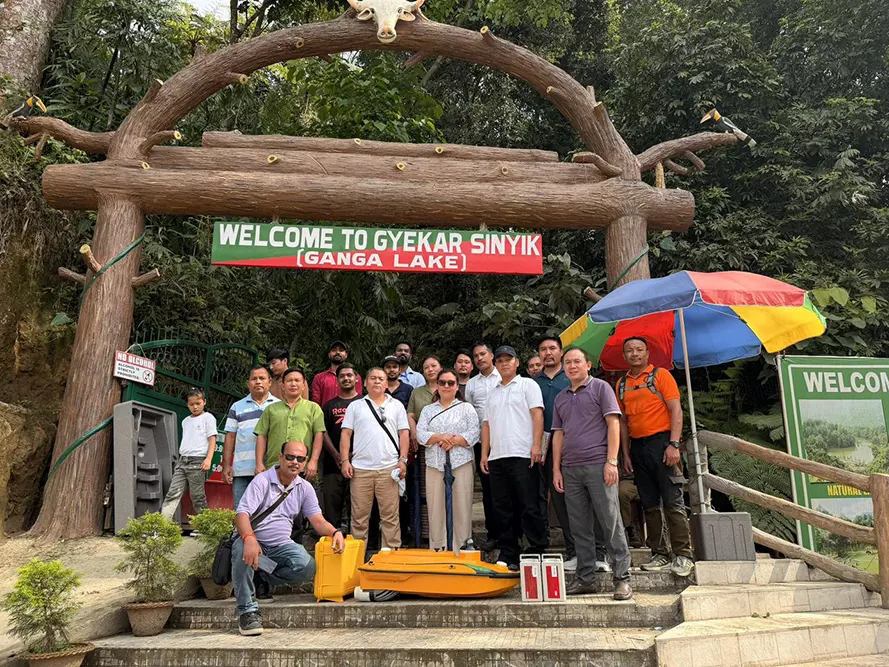
TAWANG, 20 Sep: Arunachal Pradesh State Disaster Management Authority (APSDMA) Deputy Director Dorjee Khandu informed that seven high-risk glacial lakes have been identified in the Mago area in Tawang district, of which six share a common downstream drainage system passing through several villages, including Duri.
Khandu informed this during the launch of an awareness campaign on glacial lake outburst flood (GLOF) risks which commenced at Mago village, with special focus on vulnerable downstream habitations, including Duri village, as well as the Indian Army camp situated in the area.
The State Disaster Management Authority (SDMA), in collaboration with the Tawang District Disaster Management Authority (DDMA) and the State Disaster Response Force (SDRF), has launched the extensive awareness and training programme on GLOF risks for communities living downstream of high-risk glacial lakes in the Mago area in Thingbu circle of Tawang district.
The SDMA DD stressed the need to establish locally suitable and effective early-warning mechanisms, so that alerts can reach every resident on time.
He also emphasised on prompt dissemination of warnings to downstream settlements in the event of a GLOF, particularly as Duri village would be among the first settlements likely to experience the impact of floodwaters.
Referring to recent incidents of devastating flooding in the Himalayan region, Khandu urged the residents of vulnerable locations to remain prepared and, wherever necessary, gradually shift towards safer locations. He emphasised that, although natural disasters of such magnitude cannot always be prevented, preparedness, effective early warning and timely evacuation can significantly reduce the risk to lives and property.
Tawang DDMO Gendan Tsomu urged the villagers to participate in the training with utmost sincerity and make the best use of the lifesaving techniques being imparted by the resource persons.
She further appealed to the participants to share the knowledge and skills acquired during the programme with their family members, friends and the wider community, so that preparedness reaches every household.
Later, the SDRF team led by Sangey Thinley imparted hands-on training in first aid, basic search and rescue techniques, and the proper use of search and rescue equipment. Demonstrations of various rescue equipment were followed by mock drills, providing participants with practical experience in responding effectively during emergency situations.
During the programme, the residents were briefed on the location, altitude and distance of the identified high-risk glacial lakes from their settlements and the potential threats that could arise in the event of a sudden glacial lake outburst.
Senior consultant Dr Bhupen Mili explained the causes and mechanisms of GLOFs, their possible impact on downstream settlements, and the estimated time floodwaters could take to reach Duri village, the Army camp and other vulnerable locations following such an event.
The participants were sensitised to the importance of identifying safe evacuation routes and designated safe locations, following systematic evacuation procedures and developing effective community-level evacuation plans to minimise the risk to human lives and property.
The ongoing awareness and training programme has so far covered residents of Mago village, personnel of the Indian Army and Indo-Tibetan Border Police (ITBP) stationed at Mago, people from the Thingbu Hydel area, and residents of New Maling and Tongsheng villages.
The team will further extend the awareness and capacity-building programme to other vulnerable downstream settlements, including Phonda, Chaksam, Grenkhar, and Dungshengmang villages, with the objective of strengthening community preparedness and building a more resilient response mechanism against potential GLOF emergencies. (DIPRO)