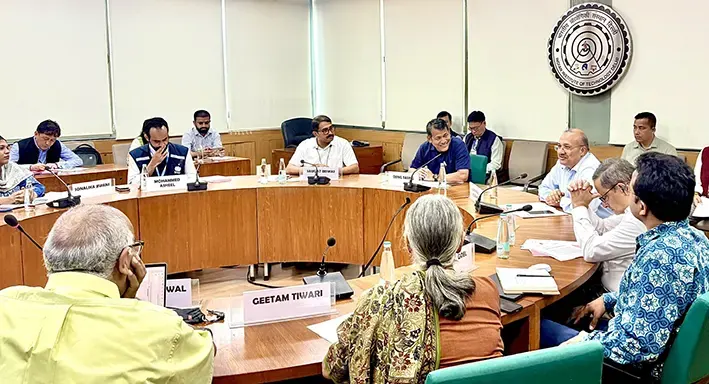

PASIGHAT, 25 Jul: Representatives from government agencies, indigenous communities, research institutions, universities, conservation organisations and civil society have jointly developed a vision and work-plan for a statewide hornbill conservation action plan, with the goal of making Arunachal a ‘Land for Hornbills’ by 2047, during a workshop held here recently.
Arunachal Pradesh is home to five of India’s nine hornbill species – the great hornbill, wreathed hornbill, rufous-necked hornbill, Austen’s brown hornbill, and oriental pied hornbill. Three of these species are globally threatened, while all five are provided the highest level of legal protection under India’s Wildlife (Protection) Act.
Hornbills, particularly the great hornbill, which is the state bird, hold a deep cultural significance for many indigenous communities of Arunachal, and are known as ‘farmers of the forest’ for their critical role in dispersing seeds and regenerating forests.
Despite nearly 80 per cent of Arunachal being under forest cover, many hornbill populations outside protected areas face increasing threats from habitat degradation, fragmentation and hunting.
Recognising the need for landscape-scale conservation, the participants agreed on the importance of supporting indigenous communities to protect their forests, strengthening habitat connectivity, integrating traditional ecological knowledge with scientific research, and fostering long-term partnerships across the state and adjoining transboundary landscapes.
Around 55 participants representing the Forest Department, Arunachal Pradesh State Biodiversity Board, CBOs and indigenous leaders, along with researchers and scientists from Rajiv Gandhi University and the Indian Institute of Science and the Arunachal Pradesh University (APU), besides NGOs, including Ashoka Trust for Environment and Education (ATREE), Wildlife Trust of India (WTI), Arunachal Pradesh Community-led Conservation Forum, alumni of Green Hub and representatives from the Nagaland Forest Department and Nagaland Community-Conserved Areas Forum, and Aaranyak from Assam collaborated to develop a shared vision and draft action plan.
On the first day, the NCF team provided the foundation for the workshop based on their long-term work on hornbills in Arunachal, followed by perspectives and observations from many forest officials, researchers and community members. Over the next two days, through working group discussions, a shared vision and a preliminary action framework was developed.
A smaller drafting group will now refine the document, with the first draft expected by September and the final conservation action plan scheduled for completion early next year, providing a roadmap for coordinated conservation action across Arunachal.
Nature Conservation Foundation executive director Dr Aparajita Datta said that this collaborative conservation action plan would strengthen community-led conservation for hornbills.
PCCF Office Scientific Officer Dr Tajum Yomcha “I am sure that we will have a robust plan for safeguarding our hornbills.”
APU Associate Professor Dr Fames Linggi said: “We often realise the value of our natural heritage only when it is under serious threat. This action plan is an important step towards ensuring that hornbills continue to thrive in Arunachal Pradesh.”
East Siang Wildlife Warden Talut Siram said: “I hope for the early return of hornbills to all areas in Arunachal.”
Ruksar Rukbo, a research scholar at Rajiv Gandhi University, said: “Hornbills need to be protected but we also need to focus on communities and livelihoods and nudge people gently to change their behaviour, rather than strict action.”
Adi Bane Kebang representative Biswajit Tayeng called the workshop a valuable opportunity to learn, exchange ideas, and interact with representatives from different tribes and communities across Arunachal.
“Let’s hope our hornbills will have a happy future,”Itanagar Assistant Commissioner Tamo Dadda said.
The Nature Conservation Foundation (NCF) organised the workshop in partnership with the APU and the Department of Environment, Forests and Climate Change, with technical facilitation from the Zoo Outreach Organisation under the IUCN SSC Conservation Planning Specialist Group process.
The initiative was supported by the Whitley Fund for Nature, the IUCN SSC Hornbill Specialist Group, and the IUCN SSC Conservation Planning Specialist Group.