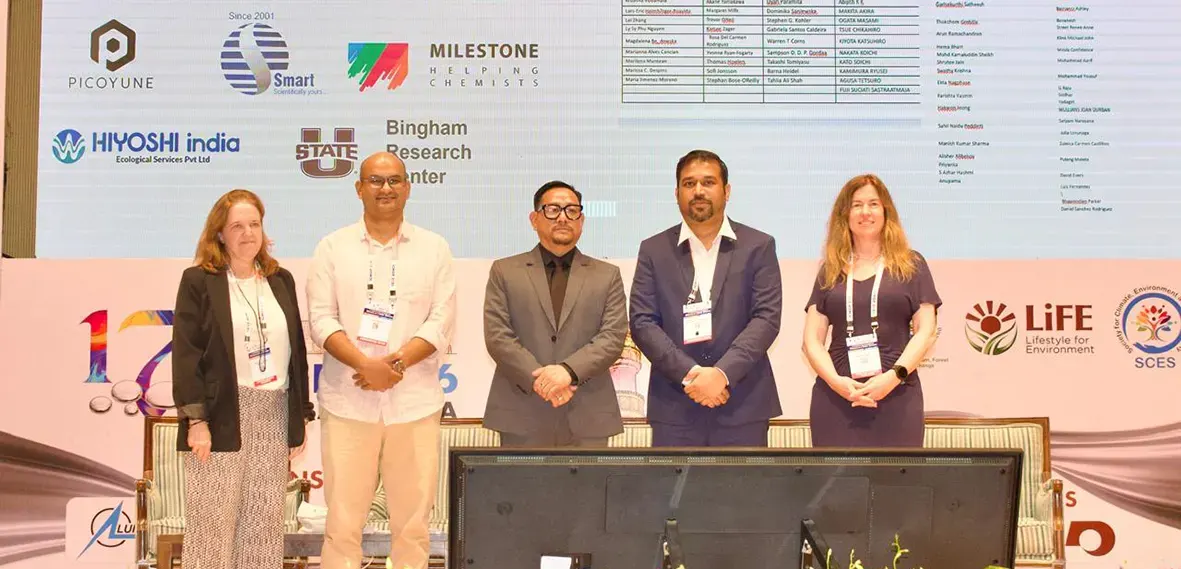
HYDERABAD, 10 Oct: Conservation efforts of the Bugun community to protect the habitat of the rare and endangered Bugun liocichla were highlighted during the 17th International Conference on Mercury as a Global Pollutant (ICMGP 2026), which concluded at the Indian Institute of Technology here on Friday.
Representing Aruna-chal Pradesh at the conference, Gumjum Haider highlighted the importance of community-based biodiversity conservation in the Eastern Himalayas, citing the Singchung Bugun Village Community Reserve, established by the Bugun community to protect the habitat of Bugun liocichla.
He also highlighted community engagement in hornbill conservation in the landscape surrounding the Pakke Tiger Reserve.
The conference saw the participation of major global bodies, including the Secretariat of the Minamata Convention on Mercury, the United Nations Environment Programme (UNEP), and the World Health Organisation (WHO).
Monika Stankiewicz, executive secretary of the Minamata Convention on Mercury, engaged with the scientific community on the relationship between research and international environmental governance.
Eisaku Toda of the Convention Secretariat also contributed to and led several scientific and policy discussions.
A key highlight of the conference was the participation of representatives from Minamata, Japan, including a survivor of Minamata disease, whose testimony served as a powerful reminder of the human consequences of mercury pollution.
The conference also saw the participation of leading scientific journal editors, including Rob Mason, Patricia Forbes, Bryan Brooks and Greg Lowry, alongside engagement from international scientific publishers and instrument manufacturers.
The conference concluded with a valedictory programme recognising scientific contributions, outstanding presentations, institutional partnerships and the efforts of researchers and organisers.
Conference chairs Dr Jagannath Biswakarma of the University of Bristol, United Kingdom, and Professor Asif Qureshi of IIT Hyderabad highlighted the importance of strengthening international scientific cooperation and ensuring that research findings contribute to practical environmental solutions.
The conference provided an international platform for sharing such perspectives and exploring how scientific knowledge and community experience can contribute to more inclusive environmental governance.
Held from 4 to 9 October, the conference brought together leading scientists, policymakers, representatives of international organisations, environmental experts and young researchers from 26 countries to discuss mercury pollution, its implications for human health and ecosystems, and the translation of scientific evidence into effective environmental policies. (DIPR)