[ Bengia Ajum ]
SEIJOSA, 11 Aug: On 6 June this year, a distressed elephant calf was sighted near the Kameng river in the Tippi area of West Kameng district. The female calf had, in all probability, become separated from her herd, and was seen roaming alone.
On being alerted, a joint team from the Khellong Forest Division, Pakke Wildlife Sanctuary & Tiger Reserve, and Tippi Wildlife Range reached the site and safely rescued the calf.
Following standard operating procedures, the forest authorities, along with veterinary and wildlife experts, assessed the possibility of reuniting the calf with a wild elephant herd in the area. However, despite making several attempts, the reunion could not be achieved.
After assessing the situation, particularly the calf's inability to survive independently in the wild due to her young age, the forest authorities decided to shift her to the Seijosa Wildlife Range of the Pakke Tiger Reserve for further veterinary care and rehabilitation.
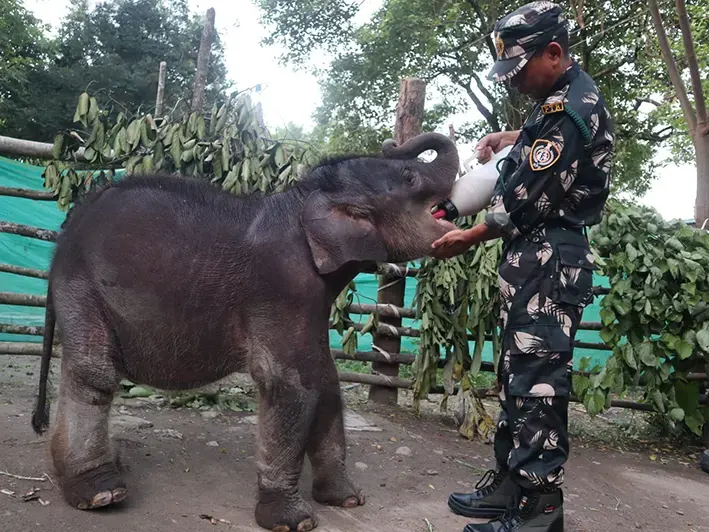
The young calf was later admitted to the Centre for Bear Rehabilitation and Conservation (CBRC) in Pakke Tiger Reserve, where she is receiving specialised care and round-the-clock attention. The CBRC is jointly managed by the Wildlife Trust of India (WTI), the state's Department of Environment, Forest & Climate Change, and the International Fund for Animal Welfare (IFAW).
Since her rescue, the calf has been provided with regular feeding, veterinary care, health monitoring and dedicated attention to help her regain strength and adapt to her new surroundings. Under the guidance of the divisional forest officer of the Pakke Tiger Reserve, and with veterinary support from Dr Panjit Basumatary of the WTI, her rehabilitation is being undertaken through a carefully structured process.
"A crucial role in the calf's recovery has been played by the mahouts and frontline animal-care staff, who have been providing dedicated care round the clock. Their responsibilities include regular feeding, maintaining the calf's daily routine, closely observing her behaviour and health, assisting with veterinary care, and providing constant human attention and reassurance. Their patience, commitment and hands-on involvement have been instrumental in helping the young calf regain strength and gradually adjust to her new surroundings," said Dhawan Kumar Rawat, Divisional Forest Officer, Pakke Tiger Reserve.
The calf is now gradually settling into her new environment.
"The calf is currently under close observation and receiving dedicated care at CBRC. Given her very young age, our immediate priority is to ensure her health, nutrition and overall development. The mahouts and frontline staff have been working tirelessly to provide her with the round-the-clock care she requires. The rehabilitation process will be carefully monitored, and she will be considered for return to the wild only when she is adequately prepared to survive independently," added DFO Rawat.
The rescue and ongoing rehabilitation of the elephant calf demonstrate the importance of timely intervention, inter-agency coordination, and dedicated frontline care in wildlife emergencies, the DFO said.