
[ Dr Biri Arun ]
Few hundreds of jobs offered intermittently by the Arunachal Pradesh Public Service Commission (APPSC) and Arunachal Pradesh Staff Selection Board (APSSB) have been the ray of hope and motivation for many thousands of students of Arunachal to improve the quality of their lives and their societies.
For the past few decades, the executive order to implement 80:20 reservation ratio in all the jobs of APPSC and APSSB, without the mandatory inclusion of (i) ability to speak in any language/dialect of any Scheduled Tribe of Arunachal Pradesh, (ii) Schedule Tribe (ST) Certificate, and (iii) Permanent Resident Certificate (PRC) as some of the minimum essential eligibility criteria/terms/conditions in the recruitment rules for jobs/posts/appointments of APPSC and APSSB have given a free and unreasonable upper hand to the Non-APST candidates who never lived in Arunachal Pradesh even for a day to compete in the recruitments of APPSC and APSSB.
The practice of the aforementioned 80:20 reservation ratio has slowly caused an acute sense of injustice and partiality to be permeated among the college going youths, aspirants and their parents of Arunachal in a cumulative over the years. In this regard representations for scrapping the aforementioned 80:20 reservation ratio and representations for the compulsory inclusion of ST and PRC certificate as some of the essential minimum eligibility criteria for the posts/appointments of APPSC and APSSB were made to the chief minister of Arunachal by various student and youth organisations of the state.
Accordingly, the chief secretary vide F No AR-27012/2/2022-SECT1-AR-Part(2), dated 10 August, 2022, had formed a committee under the chairmanship of Taba Tedir, former education minister and four other IAS officers to examine if PRC certificate can be made a prerequisite for appearing in examinations of APPSC. After about one and half years of exhaustive and thorough research and consultations, Tedir, vide F NoAR27012/2/2022-SECT-1-AR-Part(1)/759, dated 9January, 2024, submitted its report to the chief secretary.
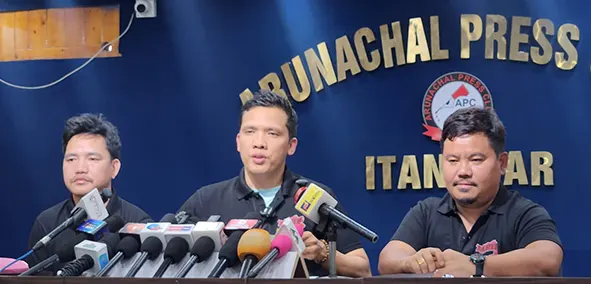
In the absence of any visible decision and action on the part of the chief secretary even after about six months after the date of the submission of the aforementioned report by Tedir, many youth and student organisations had sought permission from district administration to hold a peaceful rally with the demand for immediate disclosure and implementation of the report submitted earlier by Tedir. But the district administration did not grant permission for the rally.
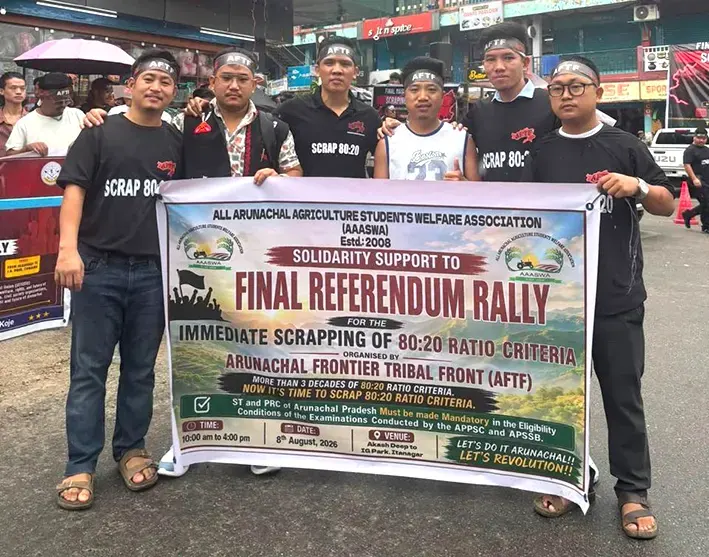
However, on 6 July, 2026, the government formed another six-member high-power committee vide order No AR/135/2026-AR under the chairmanship of Nyato Dukam, Minister of Industries, Skill Development, Labour & Employment, etc, to examine the methodology for 'Abolition of 80:20 reservation ratio and making PRC and APST certificates mandatory in all competitive recruitment process', with the mandated time period of two months to submit its report. However, many youth and student organisations are of the opinion that the formation of the new high-power committee under the chairmanship of Dukam is a delay and diversion tactic of the government for the reasons best known to them. The youth and student organisations are concerned about the age-wise ineligibility incurred by many aspirants due to the delay of the government in taking favourable decision to mandatorily include PRC and APST certificates as some of the essential minimum eligibility conditions for all the competitive recruitments of APPSC and APSSB.
As a result, many youth and student organisations had submitted applications on 31 July, 2026, seeking permission to hold a peaceful rally to demand the scrapping of 80:20 ratio criterion, and their requests were granted.
Interestingly, Dukam, the chairman of the high-power committee vide Memo No AR-33/17/2026-SECT-1-AR(E-Comp.No.326793), dated 3 August, 2026, issued a notice to convene a meeting of the high-power committee, with AAPSU as invitee, on 10 August, 2026.
It appears that the persistent and undying demands of the youth and student organisations are waking the attention and priority of the GoAP from time to time. It also appears that due to other priorities of the GoAP, the government forgets to take a conclusive and time-bound favourable decision to mandatorily include PRC and APST certificates as some of the essential minimum eligibility conditions for all the competitive recruitments of APPSC and APSSB, to cause inadvertent and irreparable harm to many of the aspirants on account of the unstoppable age factor.
As a fellow citizen and a fellow parent, I present before the students, youths, aspirants and the public, some of my personal views on the matter. It is a fact that APPSC and APSSB are items of state list mentioned at List No 41, 7th Schedule of Indian Constitution, and therefore, the GoAP has exclusive power to make laws for all the jobs of the APPSC and APSSB without requiring any interference and approval from the GoI, High Court and Supreme Court.
Article 16 of the Indian Constitution deals with the matter of making laws for public employment. In Article 16(2) of the Indian Constitution, it is very important to note that (i) the ability to speak in any language/dialect and (ii) the backwardness of class of citizen are not included in the list of items on which the Parliament and the legislature cannot make laws to discriminate or declare a person to be ineligible for any public employment. Therefore, as per Article 16 (2) of the Indian Constitution, it is constitutionally valid and permissible for the Parliament and the legislature to make laws to include (i) the ability to speak in any language/dialect of any Scheduled Tribe of Arunachal Pradesh and (ii) backwardness of the people of Arunachal Pradesh as some of the minimum essential eligibility criteria/terms/conditions in the recruitment for jobs/posts/appointments of APPSC and APSSB. The ability to speak in any language/dialect of any Scheduled Tribe of a state, as one of the minimum essential eligibility criteria/terms/conditions in the recruitments has been found to be implemented by the Governments of Manipur, Assam and Mizoram for many decades without any summon orders, whatsoever, either from their high courts or from the Supreme Court of India.
Therefore, it seems that the GoAP has the constitutional ground and precedents to confidently make rules to include 'the ability to speak in any language/dialect of any Scheduled Tribe of Arunachal Pradesh' as one of the minimum essential eligibility criteria/terms/conditions in the recruitment for jobs/posts/appointments of APPSC and APSSB.
In my view, the aforementioned inclusion of the ability to converse in tribal languages will act as a motivation and incentive for many of the youths and aspirants of Arunachal who have never learned to speak in their mother tongue, and this will in turn result in causing many APST people who are expert in their spoken tribal languages to start new tuition centres to impart spoken tribal language knowledge. Further, it will also act as a field levelling factor for non-APSTs to learn the tribal languages of Arunachal from these private tribal spoken language centres. The most important result is that the dying tribal languages of Arunachal will be preserved, promoted and protected by making laws to include 'the ability to speak in any language/dialect of any Scheduled Tribe of Arunachal Pradesh' as one of the minimum essential eligibility criteria/terms/conditions in the recruitment for jobs/posts/appointments of APPSC and APSSB with the goal to elevate the backward class of citizens of Arunachal. This is also in line with the goal of the GoI in projects like NEP 2020, Bhasha Sangam 2018, and ASMITA 2020, where learning in mother tongue have been emphasised, and therefore, it is safe for the IAS officers who are members of the high-power committee to make report in support of making laws to include 'the ability to speak in any language/dialect of any Scheduled Tribe of Arunachal Pradesh' as one of the minimum essential eligibility criteria/terms/conditions in the recruitment for jobs/posts/appointments of APPSC and APSSB.
Therefore, it seems that there is no justifiable ground, whatsoever, for the GoAP to not include 'the ability to speak in any language/dialect of any Scheduled Tribe of Arunachal Pradesh' as one of the minimum essential eligibility criteria/terms/conditions in the recruitment for jobs/posts/appointments of APPSC and APSSB, and accordingly, the GoAP should take time bound decision to make appropriate laws to include 'the ability to speak in any language/dialect of any Scheduled Tribe of Arunachal Pradesh' as one of the minimum essential eligibility criteria/terms/conditions in the recruitment for jobs/posts/appointments of APPSC and APSSB.
As pointed out earlier, in Article 16(2) of the Indian Constitution, it is very important to note that the backwardness of class of citizen is not included in the list of items on which the Parliament and the legislature cannot make laws to discriminate or declare a person to be ineligible for any public employment. This fact implies that the Legislature can make laws to include backwardness of class of citizen of its state as one of the minimum essential eligibility criteria for public employment.
Therefore, the Constitution of India does not prohibit the GoAP from making appropriate laws to include the backwardness of class of Arunachal Pradesh as one of the minimum essential eligibility criteria/terms/conditions in the recruitment for jobs/posts/appointments of APPSC and APSSB. Since all the tribes of Arunachal Pradesh have been categorised as backward class of citizens by the president of India through various Constitution (Scheduled Tribes) Order from time to time, the GoAP has the complete liberty to make appropriate laws to include backwardness of the people of Arunachal Pradesh as one of the minimum essential eligibility criteria/terms/conditions in the recruitment for jobs/posts/appointments of APPSC and APSSB. Therefore, the GoAP should make appropriate laws to include ST certificates of the Scheduled Tribes of Arunachal as one of the minimum essential eligibility criteria/terms/conditions in the recruitment for jobs/posts/appointments of APPSC and APSSB.
Furthermore, Article 16(4) empowers the legislature of Arunachal to make laws for the reservation of appointments or posts in favour of the Scheduled Tribes of Arunachal. In fact, the Government of Manipur, Assam, Mizoram, Nagaland, Sikkim and Ladakh have included ST certificate as one of the minimum essential eligibility criteria/terms/conditions for the jobs offered by them. Therefore, the GoAP has a clear constitutional mandate and the necessary precedents to make appropriate laws for reservation of jobs of APPSC and APSSB by mandatorily including ST certificate as one of the minimum essential eligibility criteria/terms/conditions. As precedents, the Governments of Manipur, Assam, Mizoram, Nagaland, Sikkim and Ladakh have included PRC certificate as one of the minimum essential eligibility criteria/terms/conditions for the jobs offered by them for many decades and their high courts and the Supreme Court have never objected them on the matter.
Therefore, as Arunachal Pradesh is similarly situated with the aforementioned states, the GoAP can safely and confidently makes rules to include PRC certificate as one of the minimum essential eligibility criteria/terms/conditions for the jobs offered by APPSC and APSSB. Like how the Constitution of India has been framed by adopting various features from the constitution of the other countries like UK, USA, Canada, Australia, Germany, Japan, etc, in the same spirit and principle, the GoAP can adopt the aforementioned features of the eligibility criteria of states like Manipur, Assam, Mizoram, Nagaland, Sikkim and Ladakh and make appropriate laws to include (i) ability to speak in any language/dialect of any Scheduled Tribe of Arunachal Pradesh, (ii) Schedule Tribe (ST) Certificate, and (iii) Permanent Resident Certificate (PRC) as some of the minimum essential eligibility criteria/terms/conditions in the recruitment rules for jobs/posts/appointments of the APPSC and the APSSB.
In conclusion, it can be clearly understood that the GoAP has the constitutional ground and the necessary precedents to make rules in favour of compulsory and immediate inclusion of (i) ability to speak in any language/dialect of any Scheduled Tribe of Arunachal Pradesh, (ii) Schedule Tribe (ST) Certificate, and (iii) Permanent Resident Certificate (PRC) as some of the minimum essential eligibility criteria/terms/conditions in the recruitment rules for jobs/posts/appointments of the APPSC and the APSSB. (The writer is an assistant professor at NIT, Arunachal Pradesh)