Missing U In Unity?
By Poonam I Kaushish
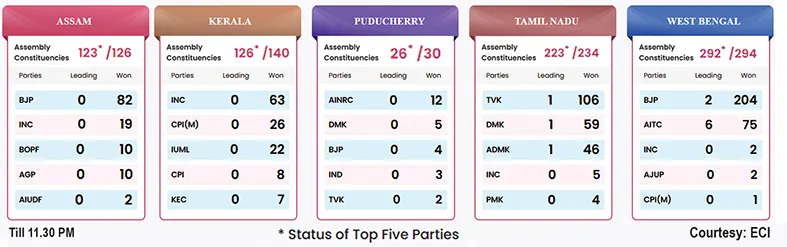
Unity in disunity or disunity in unity? Flummoxed? Certainly, as Opposition fault lines cracked wide open post BJP’s victory and TMC, DMK, CPM’s defeat mingled with despair in the recent State polls. It is easy to slice, dice and analyze if INDIA Bloc has lost its vitality? Has hit its self-destruct button? Are its days numbered? Is time ripe for its epitaph?
Today, the Bloc seems fragmented after defeats in West Bengal, Tamil Nadu and Kerala which might exacerbate it further. At the storm’s centre which is threatening to shred the Bloc apart, is its biggest constituent, Congress. Already, DMK has made plain its distrust calling it “backstabbers” after the Grand Party jumped ship to newbie TVK. More so, as DMK had rewarded it a Rajya Sabha berth last month, resulting it no longer wanting to be seated alongside Congress MPs in Parliament.
Though DMK with 22 MPs hasn’t formally announced its departure from India Bloc, its importance for Opposition unity is not limited to Tamil Nadu alone, as it has consistently been a vocal champion of ideological agendas raised by the Bloc against BJP-led NDA Government over years. If it chooses to distance itself now, it could be the beginning of unravelling of the platform and Congress isolation within the larger Opposition space.
The crisis could not have come at a worse time for Opposition with TMC losing West Bengal, DMK Tamil Nadu and CPM Kerala which have robbed the Opposition of leaders who championed federalism, an issue which united all in Parliament and outside. Both Southern satraps were all for enlarging the federal structure for better federal balance and cultural distinction. A matter, contrary to Congress’s centrist tendencies.
Today, with Kerala under its belt, Congress holds office in three of five Southern States but it is no longer in a pole position nationally. Hence, it should have no issue in demanding more rights for States. But can and will it make a convincing case for federalism the way DMK did?
Also, with footprints of regional Parties shrinking, whereby TDP, JMM and NC are the only ones that run Governments, the crisis of federalism faces the threat of being reduced to an academic debate.
Pertinently the contradictions within India Bloc go back to its formation 2023. The big tent of non-BJP Parties was conceived as a national platform and was accepted from its initiation that Parties would compete at State level while coming together at the national level.
Certainly, it collectively pinned BJP to 240 MPs in 2024 polls, but the implausibility of such a loose arrangement was exposed when regional considerations compelled JD (U) Nitish to abandon the Bloc and shift loyalty to NDA. In West Bengal Bloc members competed and under-cut each other. Many times Abdullah’s NC and other groups warned that the Bloc was sliding towards irrelevance.
In fact, Tamil Nadu’s events have further reinforced the wobbly nature of Opposition unity which functions without a proper coordination team, secretariat or coordinator. In this form at best it can be a nothing but a mere banner for floor coordination in Parliament. Consequently, it has lead to bad blood, disquiet and realignment.
There are strong indicators that the Bloc is facing an existential crisis and could break into two or more formations, giving the Modi-led NDA a distinct advantage and scope for manoeuvring 2029 Lok Sabha polls. Asserted a senior leader, “India Bloc is gone,” thereby sounding the first note of death knell of Opposition unity.
Clearly, a reset would require Congress to prioritise long term coalition building over short-term electoral priorities. The Tamil Nadu events have injected a crisis of confidence and trust within the Bloc that will not be easy to address and overcome. With 7 States set for Assembly elections next year the future looks bleak for Opposition unity.
Paradoxically, the imminent disintegration of Opposition unity brings both joy and grief for the Grand Old Party. The Rahul Gandhi-led Congress has reasons to cheer the downfall of a whimsical and temperamental Mamata and Stalin’s defeat for two diverse reasons. In Bengal, Congress thinks it has a notional chance of revival and is hoping a TMC section ‘comes home.’ Given, daggers are out within State leaders blaming Mamata’s coterie for their downfall. Also things have gone sour between Mamata and nephew-heir Abhishek Banerjee.
Given BJP’s penchant for splitting regional outfits: AAP, Shiv Sena and NCP, Congress feels it’s just a matter of weeks, if not months, before TMC starts seeing a heavy exodus.
There is no gainsaying that political loyalty cannot be static: When people realise that their interests are not being served, the “hegemony” breaks down and loyalty shifts toward new, alternative ideologies. In Tamil Nadu’s context the shift is towards actor Vijay’s ideology of social, secular justice.
It remains to be seen whether Mamata, Arvind Kejriwal and Stalin will now close ranks to punish and isolate Congress. The prospect of an anti-Congress front opening up hinges upon Samajwadi Akhilesh. If the SP supremo decides to side with Mamata and DMK, Congress is bound to suffer a big setback. There is every possibility that the new alliance would try to rope in players such as BJD’s Naveen Patnaik, YSR’s Jagan Reddy and Mehbooba’s PDP.
With UP Assembly polls due next year, the SP Chief has a difficult choice: Go with Congress or alone. With no signs of Mayawati’s BSP joining hands with SP, Akhilesh stands to gain more by aligning with Congress rather than siding with Mamata, Kejriwal, Stalin and Co. Yet, post the Grand Dame ditching DMK, Akhilesh is wary stating, “We are not the ones who leave during difficult times.” As is RJD’s Tejashwi Yadav who had a complicated relations doing business with Rahul.
In this context the disquiet and churn within the Bloc requires a reality check. The biggest problem is not just ideology, but leadership, seat-sharing and regional ambition. Parties like TMC, AAP, DMK, SP, Congress and Left all want space to expand which creates contradictions inside a single alliance.
Yet all is not lost. Indian coalition politics is highly fluid. Alliances often break in one State but continue nationally against BJP. Leaders like Thackeray and Mamata still publicly speak of Opposition unity. However, though strong as an electoral coalition with a common strategy, the Bloc today is badly weakened. As a Parliamentary anti-BJP platform it technically, is still alive. As a future 2029 national front, its fate is uncertain, but it is not dead.
The Opposition will have to find the language and repertoire that can match BJP’s dexterity, multi-vocality, poll fighting mean machine and resources with which it shores up its communication dominance and perceived imagery. Modi has already thrown down the gauntlet by refreshing Hindutva, projecting and redefining nationalism and the country’s self respect.
The big question: Who will take up cudgels against BJP beyond rally slogans? Clearly, in this minefield of contradictions where strategies are crafted with electoral dividends in mind forging a path ahead for Opposition will require foresight, nimbleness and flexibility. So far the Opposition has presented a disunited front amidst unity bonhomie. Nothing more. — INFA