BJP Has Come a Long Way From
By Poonam I Kaushish
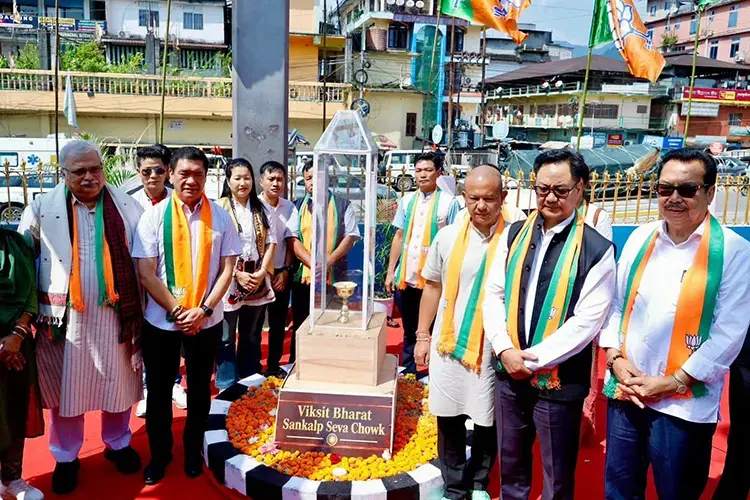
17 September is a red letter day in BJP. When it celebrated the man who has come to personify it. From thousands of Ashirwad ke diyas, maha-aartis in Modi’s honour to a nationwide blitz of Seva Sankalp Abhiyan programmes, conflation of the Party’s achievement with the leader’s success marking his 76th birthday whereby the Prime Minister’s birthday looked less like a personal milestone and more like a political festival.
Undoubtedly there is nothing wrong with celebrating a popular leader. It is not a crime, nor is recognising 25 years of his public life. But when BJP which once celebrated the Party and built its identity around being a “Party with a difference” begins to resemble the very personality-centric politics it once derided, a question begs an answer: Has BJP become so Modi-centric that the Party is slowly becoming the man?
Is it abandoning one of the distinctions that once separated it from Congress? Given it spent decades telling India that Congress had confused the Party with the leader. Has it now begun confusing the leader with Party?
Think BJP/RSS spent decades positioning itself as fundamentally different from the Congress model: Organisation over personality, cadre over charisma and family, ideology over individual, collective leadership over dynastic politics. Former Dy Prime Minister Advani once described BJP’s ability to nurture leaders from within its ranks as what distinguished it from others. He wrote the Party’s strength lay in preparing the next generation, which is what made BJP “Party with a difference.”
Fast forward to September 2026. In today’s BJP Modi’s face is everywhere: Party, Government and leader increasingly presented as one voice and one political brand. He is its central political shorthand. Certainly, his electoral appeal is a political reality dominating political communication. His Government has delivered policies and decisions that supporters regard as transformative. Article 370, expansion of digital infrastructure, welfare delivery and India’s growing global profile are among achievements associated with his leadership.
But a Party is larger than the record of its leader. Or it should be. BJP once said this. So when did respect for a leader become reverence? When did reverence begin to overshadow the organisation itself? What happens when the political spotlight becomes so overwhelmingly concentrated on one individual that the organisation risks becoming the supporting cast?
The irony is hard to miss. BJP asserts celebrations were about “seva”, public service and Prime Minister’s 25 years in public life. And indeed, the month-long programmes include health camps, cleanliness drives, blood donation and outreach around Government schemes.
But symbolism matters in politics. When hundreds of thousands of lamps are lit for one leader’s birthday, when Chief Ministers, Union Ministers and Party leaders participate in elaborate events, when his image becomes the centrepiece of political communication, symbolism goes beyond routine birthday greetings.
It creates a political culture in which the leader increasingly becomes the occasion. And that should make BJP’s old guard uncomfortable. As for decades, its greatest selling point was that it was not Congress. It mocked Congress culture of High Command, personality politics and dynastic reverence.
The Party’s old generation: Vajpayee, Advani, Murli Manohar Joshi, Sushma Swaraj etc represented a collegiate political culture. They could disagree, compete and sometimes even publicly differ without the entire organisation appearing to revolve around one personality. But the Modi-Shah era has unquestionably transformed BJP into a formidable electoral machine.
Yet, power changes Parties. And prolonged power can change them even more. The danger for any successful Party is the leader who wins elections gradually becomes larger than the organisation that produced him.
An academic study comparing the personalisation of Congress under Indira Gandhi and BJP under Modi has found evidence of partial personalisation in both Parties, while also stressing BJP retains significant institutional and organisational structures and its RSS-linked ideological network.
An important qualification. BJP is not Congress of the Indira era. It has a vast cadre network, ideological roots, organisational machinery and leaders across States. It is not a Party without institutions. As those institutions remain strong, hence the question: Can the organisation remain bigger than its most powerful leader?
BJP says yes. After all, Modi cannot remain Prime Minister forever. No leader can. The real test of a political organisation is therefore not how spectacularly it celebrates its incumbent leader but whether it can smoothly produce, accept and empower the next generation. A Party becomes different not by declaring itself different, but by resisting the very political habits it once condemned.
This was once BJP’s boast. It was proud that a karyakarta rose through the ranks. It celebrated organisational continuity rather than political inheritance. It repeatedly contrasted its own cadre-based structure with Parties dominated by families and personalities.
However, if this distinction begins to blur, BJP loses something more valuable than a slogan. It loses its political argument. Ironic, as the Party has often accused Congress of turning political leaders into institutions. Yet the birthday spectacle risks creating precisely the kind of leader-centric political culture that BJP once held up as evidence of what was wrong with Congress politics.
The mirror is now facing BJP. It is not unreasonable to celebrate Modi. It is not unreasonable to acknowledge his extraordinary political longevity. It is not unreasonable for Party workers to admire or worship their leader. But democracy requires a distinction between admiration and institutional dependence.
A healthy Party should be able to say: We respect our leader, but the Party is bigger than the leader. A mature political organisation should be able to celebrate its Prime Minister without making his birthday feel like a national political festival. And a confident leader should not need the organisation to turn admiration into ritual.
Consequently, BJP’s greatest challenge might not come from Opposition. It may come from Modi’s success himself. As, extraordinary electoral success can create extraordinary centralisation. And extraordinary centralisation can eventually weaken the very collective culture that made the organisation resilient.
BJP once said “Party first, self last.” It was a powerful political philosophy. Today, the question is whether that hierarchy still visibly holds. Can it remain a Party bigger than Modi? The answer will not be found in how many diyas are lit, how many rallies are held, how loudly it celebrates Modi or how many birthday greetings pour in.
It will be found when the Modi era eventually ends. Will BJP remain the BJP? Or will it discover that, somewhere along the way, the Party with a difference became a Party built around one man? That is the real birthday question. And unlike the diyas, there is no ritual answer. — INFA