
Editor,
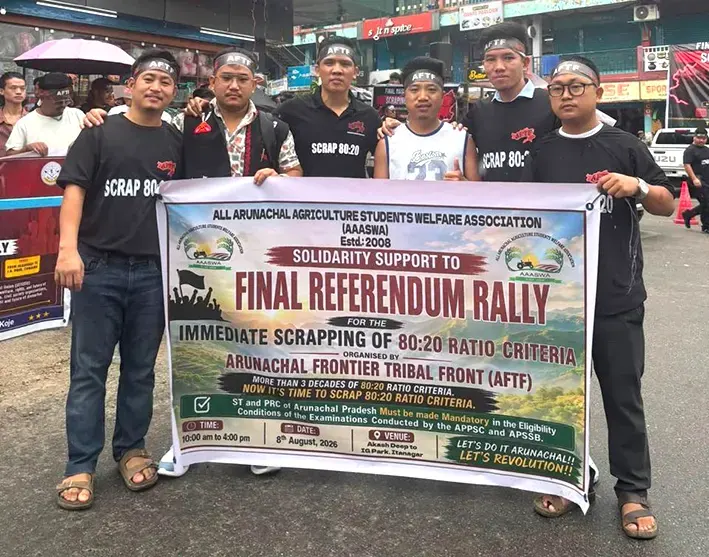
The Arunachal Pradesh government’s decision to set up a six-member committee to review the state’s 80:20 recruitment ratio is a welcome step. It is a direct response to what AAPSU, AFTF, and other indigenous and student bodies have been demanding for years.
Legal experts will no doubt caution the committee, pointing to constitutional provisions and past court rulings that make blanket reservation policies vulnerable to challenge. But there is another constitutional principle worth remembering: only equals should be treated equally. When our youth push for full reservation, what they’re really asking for is recognition of a real gap – the civilisational and developmental distance between Arunachal Pradesh and the rest of the country. With almost no private sector to fall back on, government jobs are not just one option among many here; for most of our youth, they are the only option.
Part of the problem is that Arunachal Pradesh’s constitutional protections are simply weaker than they should be. Article 371(H) does not give us the same shield that Article 371A gives Nagaland or Article 371G gives Mizoram. But that does not mean we are without options – there is still a path forward within the Constitution as it stands.
Articles 14, 16(2), and 16(3) make it hard to simply mandate an APST certificate and PRC for every government job – that kind of blanket rule invites legal challenge. But Article 309, which governs recruitment and service conditions for state and union employees, gives the State Cabinet real room to act. Through it, the government can draft, amend, and notify its own recruitment rules by gazette notification, without waiting on Parliament.
Given that we lack the stronger protections other states enjoy, one practical route is to build a “suitability” clause into recruitment rules – specifically, requiring proficiency in a local dialect. With 26 major tribes and roughly 100 sub-tribes in the state, this could be reasonably tied to the tribes recognised as Scheduled Tribes of Arunachal Pradesh under the Indian Constitution.
This is not without precedent. Assam already requires knowledge of the local language for state jobs. Some national banking exams and central agencies, including the Intelligence Bureau, also test local language proficiency for certain postings. Arunachal Pradesh could adopt something similar – a Roman-script translation test in local dialect for Group C and D posts under APSSB, and a viva voce component for Group A and B posts under APPSC.
Here is the catch: the committee has two months to submit its report, but APPSC and APSSB have several exams scheduled well within that window. Waiting for the committee’s findings and the Cabinet’s eventual decision could easily stretch into several more months, maybe longer. Every week of ambiguity is a week where the rights and prospects of unemployed youth remain in limbo.
That is why the state government should not wait for the full process to play out. The proviso to Article 309 gives the Governor the power to issue binding recruitment rules immediately, ahead of any formal legislation – and that power should be used now, as interim relief, while the committee does its longer-term work.
The youth of this state have placed real trust in a government they see as responsive to their needs. They have waited long enough. Any further delay – even by a week – would be a disservice to that trust, and to their morale.
Yiri Kamcham
Kamcham,
Lower Siang