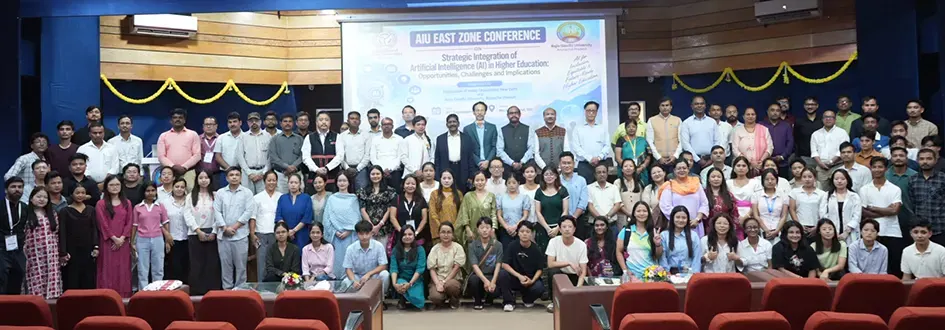
RONO HILLS, 28 Sep: The Association of Indian Universities' (AIU) conference on 'Strategic Integration of Artificial Intelligence (AI) in Higher Education: Opportunities, Challenges and Implications' was jointly organised by the AIU, New Delhi and Rajiv Gandhi University (RGU) here recently.
AIU Research Joint Director Dr Amarendra Pani, who was also the patron of the conference, highlighted the critical role of the AIU in organising such programmes which help universities build new skills sets for the ever-changing challenges in education. He urged the younger generation to embrace AI while keeping fundamental natural and cultural values firmly intact.
NIT Director Prof Mohan Vithalrao Aware touched on various dimensions of AI and emphasised its responsible deployment across developmental sectors. Prof Vithalrao stressed that students and researchers should leverage AI for holistic idea development and performance optimisation, rather than treating it as a substitute for human effort.
He also highlighted the substantial impact Generative AI can have in driving research and development forward.
RGU Vice-Chancellor Prof Shivaraj in his address articulated how AI can be used to harness local community development and sustainable utilisation of local resources. The VC said he envisions RGU becoming an important centre for AI implementation and integration across Arunachal Pradesh. He also cautioned that, even though AI can effectively analyse data and do extensive reporting, it should not assist and not replace human ethical and moral values.
"There is also a rise of digital divide amongst the users with the coming of AI, and it should not make it a limitation; rather, it should democratise the learning ecosystem," he added.
Highlighting the urgency of adapting to rapidly advancing technology, RGU Registrar (i/c) Prof Nabam Naka Hina stated that the technologies in use today will likely become obsolete by the time the younger generation grows up, underscoring the continuous need to evolve.
The technical deliberations began with the first plenary session conducterd by Dr Neeraj Saxena, pro vice-chancellor, JIS University, Kolkata, who emphasised on moving beyond traditional teaching towards critical thinking and inquiry and guiding learners to critically evaluate AI responses while keeping human judgment central.
The second plenary session was conducted by Prof Madhusudhan Mishra from the NERIST, who outlined five levels of institutional AI: experimentation, adoption, integration, governance, and transformation. He highlighted AI's capacity to personalise learning and accelerate research, while reiterating that AI must augment rather than replace human faculty, with privacy, fairness, and accountability remaining paramount.
A panel discussion on the conference' theme was organised, which was moderated by RGU Mass Communication Department Assistant Professor Dr Sunil Koijam, RGU IQAC Director Prof Utpal Bhattacharjee, Prof Madhusudhan Mishra from the NERIST, Prof Mousumi Chaudhari, pro-vice-chancellor of Apex Professional University, RGU Education Department Assistant Professor Dr Nishanth PM, and Apex Bank MD Bittu Kri.
The panellists exchanged valuable insights on the broad implications of AI integration across teaching, research, and administration, and responsible and strategic adaptation and implementation of AI for resource usage and delivery.
The valedictory programme was attended by Dr Gaurav Shukla, vice-chancellor, AISECT University, Jharkhand, and Dr Samit Tiwari, vice-chancellor, Dr CV Raman University, Bihar.