RONO HILLS, 15 Sep: The Women's Studies and Research Centre (WSRC), Rajiv Gandhi University (RGU), organised its second special lecture on 'Social Reproduction and Gendered Work: Reflections of Contemporary Concerns' at the university here on Tuesday.
Delivering the lecture, Deepak Kumar Mishra, professor at the Centre for the Study of Regional Development, School of Social Sciences, Jawaharlal Nehru University, New Delhi, dwelt on debates on social reproduction, drawing on early literature on the social reproduction of labour, the role of unpaid labour to a market economy, and recent theorisations on the crisis of social reproduction, according to a WSRC release.
He said that the reproduction of labour-power and the role of women's unpaid labour in it help unpack the significance of non-economic institutions in the market economy, saying it raises new questions regarding capital-labour relations in the contemporary and globally integrated economy.
Prof Mishra further highlighted the findings from the India Time-Use Survey to explore the gendered division of labour both within households and in the wider labour market and its implications for understanding social transformation.
He explained that women devote more time to unpaid care work compared to men, and contribute significantly to the production of future labour-power for the capitalist economy.
"However, women's contribution remains unpaid," he added.
He argued that society and government should come out with an appropriate policy to provide fair compensation to women for their immense contribution to the sustenance of the market economy through social reproduction.
WSRC Director Prof Vandana Upadhyay spoke about the revival of the centre and its renewed commitment to promote gender research, advocacy, and capacity building.
Prof SK Nayak commended the efforts of Prof Upadhyay and the WSRC for organising the lecture.
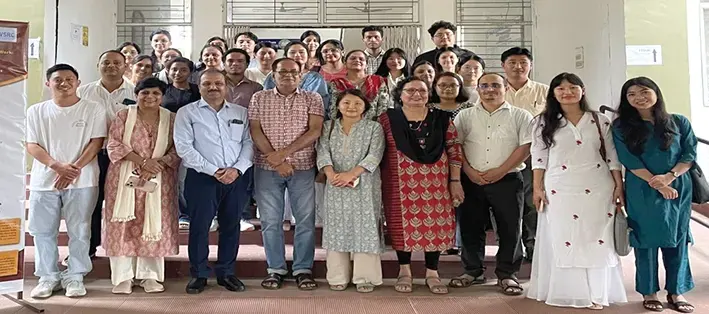
The lecture was attended by Prof Lijum Nochi, Dr Dil Bahadur Gurung, Dr Prasenjit B Baruah, Dr Anup Kr Das, Prof Sarah Hilaly and Dr Zilpha Modi, alongside other faculty members, research scholars, and students.