
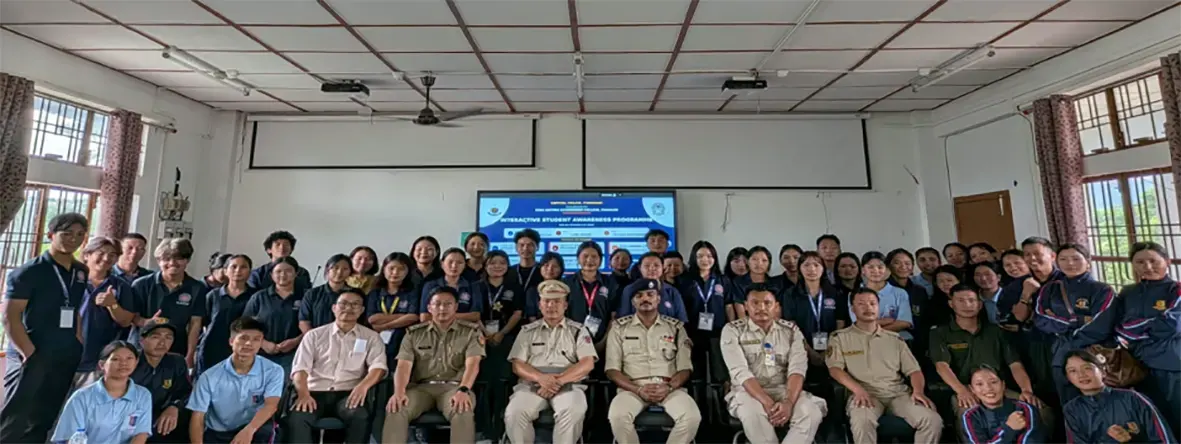
ITANAGAR, 1 Sep: Dera Natung Government College (DNGC), in collaboration with the Itanagar police, organised an awareness programme for college students on 'Cyber Security and Awareness, the NDPS Act and Drug Abuse Prevention, New Criminal Laws, and Police-Public Relations' at the college's auditorium here on Tuesday.
The programme aimed to sensitise students to emerging challenges concerning cybercrime, drug abuse, criminal laws, and the importance of constructive police-public relations.
During the programme, Capital SP Jummar Basar provided an overview of the broader responsibilities of the police in maintaining law and order, preventing crime and ensuring the safety and security of the public.
He highlighted the importance of coordinated efforts between law enforcement agencies and the community in addressing emerging challenges, particularly cybercrime, drug abuse, and other forms of criminal activity.
He also stressed the significance of public cooperation, timely reporting of offences, and responsible civic participation in strengthening the overall security environment.
Speaking on police-public relations, DSP Techi Nega stressed the importance of mutual trust, cooperation and communication between the police and the public.
He encouraged the students to view the police as an important institution for public safety, and to cooperate with law enforcement agencies in preventing crime and maintaining peace and order.
Inspector Sushant Saurabh Jha spoke on 'New Criminal Laws', familiarising the students with the major changes introduced in India's criminal justice system. He mentioned that the Indian Penal Code (IPC), 1860, the Code of Criminal Procedure (CrPC), 1973, and the Indian Evidence Act, 1872 have been replaced by three new laws - the Bharatiya Nyaya Sanhita (BNS), 2023, Bharatiya Nagarik Suraksha Sanhita (BNSS), 2023, and Bharatiya Sakshya Adhiniyam (BSA), 2023, which came into force on 1 July, 2024.
Speaking on 'Cyber Security and Awareness', Sub-Inspector Kipa Robin highlighted the growing risks faced by students in the digital age.
He sensitised the students to common cybercrimes such as phishing, UPI and QR-code fraud, social media impersonation, cyberbullying, stalking, sextortion, and fake job or scholarship offers.
Sub-Inspector Padam Padi addressed the students on the topic 'NDPS Act and Drug Abuse Prevention'. In an interactive session, he discussed the factors that can lead young people towards substance abuse, including curiosity, peer pressure, stress and social situations. He explained that drug abuse can adversely affect physical and mental wellbeing, academic performance, relationships, finances and future prospects.
He also familiarised the students with the practical implications of the Narcotic Drugs and Psychotropic Substances (NDPS) Act, 1985, cautioning them against possessing, carrying, storing, transporting or concealing suspicious substances for others.
Emphasising the importance of early intervention, Padi urged students not to shame those struggling with drug dependence but to encourage them to seek appropriate help and support.
The session also highlighted emergency and assistance helplines, including 112 and 14446 for de-addiction counselling and referral, and 1933 (MANAS) for drug-related matters.