From a Distant Dream to a Beating Heart
In October 2018, two cardiologists Dr. Jagdish Chandra Barkataki, a professor from Guwahati Medical College Hospital and Dr. Rinchin Dorjee Megeji began seeing patients in a department many believed could never exist in Arunachal Pradesh. Eight years on, it holds a State Gold Medal, runs the state's first cath lab, and has earned national accreditation to train the cardiologists of tomorrow.
For generations, a heart attack in Arunachal Pradesh was a race against geography. The nearest facility capable of opening a blocked coronary artery lay hundreds of kilometres away, across roads that twist through hills, river valleys and landslide-prone stretches. Families pooled their savings, hired vehicles, waited for flights, and prayed. Too often, the journey ended before the treatment could begin.
In cardiology we have a simple saying: time is muscle. Every minute that an artery stays blocked, a little more of the heart dies. For the people of our state, time was precisely the one thing that geography refused to give.
It is against this backdrop that the story of the Department of Cardiology at the Tomo Riba Institute of Health and Medical Sciences (TRIHMS), Naharlagun, must be told. It is a story that began quietly in October 2018, and one that, eight years later, still makes those of us who lived it pause and wonder whether it all really happened.
A Beginning with Two
In October 2018, the Department of Cardiology opened its doors as the very first super-specialty department of TRIHMS. It began with just two faculty members, a Professor and an Assistant Professor.
There was no grand inauguration of gleaming machines, no large team, no ready-made infrastructure. There were two cardiologists, a conviction that the people of Arunachal Pradesh deserved specialist heart care at home, and a great deal of work to be done.
Outpatient (OPD) and inpatient (IPD) services were started immediately. Patients who had long travelled outside the state simply to be told what was wrong with their hearts could now be examined, diagnosed and treated in Naharlagun. Word spread quickly, as it does in close-knit communities, and the corridors soon filled with patients from every corner of the state.
Within three months, echocardiography services began. For the uninitiated, an echocardiogram is an ultrasound of the heart: it allows a doctor to watch the heart pumping in real time, to see the valves opening and closing, and to detect holes in the heart, weakened muscle and fluid around it. For a newborn with a murmur, a young woman breathless in pregnancy, or an elderly farmer with swollen feet, this single test often makes the difference between guesswork and a clear diagnosis.
Within a year of its inception, the department established a five-bedded Intensive Coronary Care Unit (ICCU). This was a quiet revolution. An ICCU means continuous monitoring of every heartbeat, dangerous rhythm disturbances recognised within seconds, clot-dissolving therapy delivered without delay, and a dedicated team watching over the most critically ill cardiac patients through the night. Lives that would once have been lost on the highway were now being saved in a bed at TRIHMS.
Those early years were built on long days and improvisation. Space had to be found, equipment requested and justified, staff trained, and systems created from scratch. Every new service was the result of persistence: files pursued, proposals rewritten, and a refusal to accept that a small, young state must always send its sickest patients elsewhere.
The Day the Cath Lab Came Alive
Every cardiologist knows that a department without a catheterisation laboratory can only go so far. Diagnosis and medicines save many lives, but a heart attack caused by a completely blocked artery often needs the artery to be opened mechanically, with a balloon and a stent. A heart with a failing electrical system needs a pacemaker. A child with a hole in the heart may be cured with a device placed through a vein, without a single surgical incision.
The cath lab was always part of the plan, and it would have arrived much sooner had the world not been turned upside down. The COVID-19 pandemic struck just as the groundwork was being laid, and it delayed the establishment of the cath lab by almost three years. Resources, attention and manpower were rightly diverted to the fight against the pandemic, and the cardiology team, too, stood on the front line of that fight. For those three long years, the cath lab remained a dream deferred, kept alive through proposals, meetings and persistent advocacy.
That dream finally came true in August 2023, when a state-of-the-art cardiac catheterisation laboratory was installed and made functional at TRIHMS, the first of its kind in Arunachal Pradesh.
From that moment, the nature of cardiac care in the state changed. Coronary angiographies, angioplasties with stenting, primary angioplasty for acute heart attacks, permanent pacemaker implantations, cardiac catheterisation studies and device closures of holes in the heart, procedures that once required a long and expensive journey outside the state, began to be performed routinely in Naharlagun. A patient having a heart attack could now reach a cath lab within the precious golden hour, rather than within the golden day.
Consider what this means in practice. A man in his fifties feels a crushing pain in his chest in the early hours of the morning. Not long ago, his family would have faced an agonising choice: begin a long journey to another state, or hope that medicines alone would be enough. Today, he can be brought to TRIHMS, taken straight to the cath lab, have the blocked artery opened with a stent, and be recovering in the ICCU within hours, often walking out of the hospital within days. What was once a matter of luck has become a matter of routine.
A Paradigm Shift in Arunachal's Healthcare
The impact of these eight years is best measured not in machines, but in lives. The number of people dying of heart attacks, the number of sudden cardiac deaths, and the suffering caused by conditions ranging from holes in the heart to rhythm disorders requiring pacemakers have all been profoundly affected. Today, more than 90 per cent of cardiac cases, including cardiac interventional procedures, are managed within Arunachal Pradesh itself.
Behind that single figure lie tens of thousands of stories. The department has recorded well over 57,000 outpatient visits, and more than 1,700 critically ill patients have been admitted to its ICCU, with a survival rate above 97 per cent. Each of these numbers is a person: a father who returned to his fields, a mother who saw her children grow up, a child who went back to school.
There is an economic story here too. Every patient treated at home is a family spared the crushing cost of travel, lodging and treatment in a distant city, and spared the anguish of being far from home at the most frightening moment of their lives. Keeping care within the state keeps families together and keeps savings intact.
Equally important has been the growth in awareness. Through regular OPD services, health camps, and public events on occasions such as World Heart Day, the department has worked to teach people to recognise the warning signs of heart disease early, to control blood pressure, diabetes and cholesterol, to give up tobacco, and to seek help without delay. A heart attack treated early is a life saved; a heart attack prevented is better still.
Gold for Service
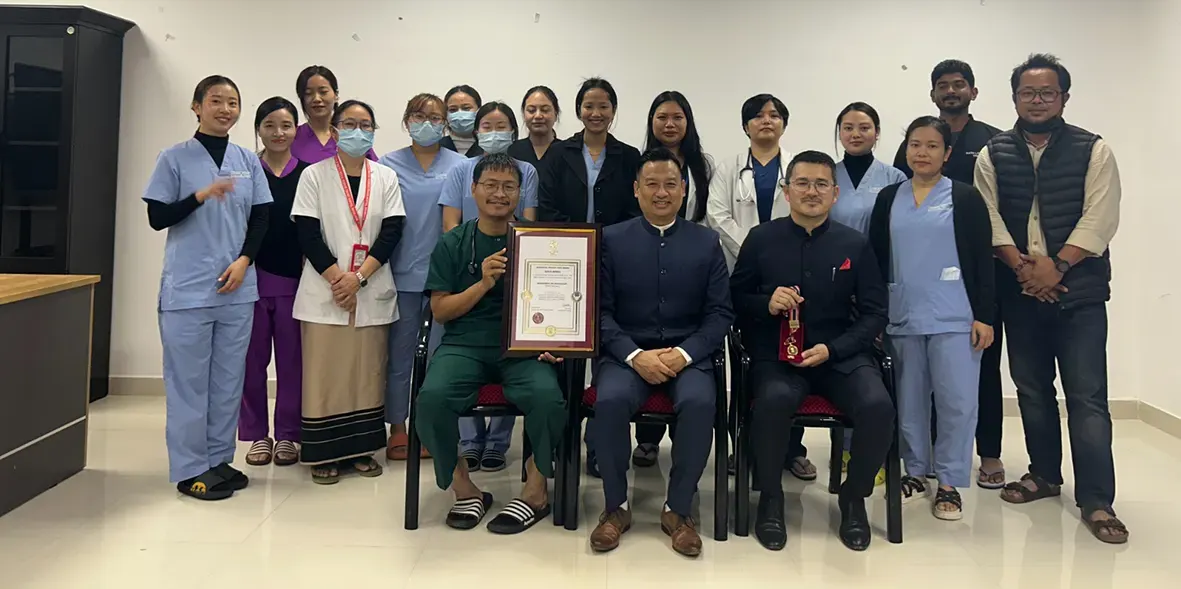
Recognition, when it came, was a source of deep pride for the entire institute. On 20 February 2024, the Department of Cardiology, TRIHMS, was awarded the State Gold Medal by His Excellency the Governor of Arunachal Pradesh for its meritorious services. For a department that had begun with two doctors just over five years earlier, it was a feather in the cap not only for cardiology but for TRIHMS as a whole, and a public affirmation that world-class care could indeed be built on the frontier.
The Team Behind Every Heartbeat
Today, the department has three faculty members, a Professor, an Associate Professor and an Assistant Professor, all DM cardiologists. Just a few years ago, the idea of three DM cardiologists working under the same roof in Arunachal Pradesh would have seemed fanciful. They are supported by five junior resident doctors who form the backbone of round-the-clock care.
But no heart is saved by doctors alone. The department runs a full-fledged cath lab team of skilled technicians and nursing officers, a non-invasive laboratory team handling echocardiography, Holter monitoring and treadmill testing, and a deeply committed team of nursing officers in the ICCU, which has since grown from five beds to eight. It is these men and women, often unseen and rarely celebrated, who sit beside a patient at three in the morning, who prepare the lab in minutes when a heart attack patient arrives, and who hold the hands of frightened families.
Today, the Department of Cardiology, TRIHMS, is the only super-specialty department in Arunachal Pradesh and the adjoining areas of Assam offering fully fledged cardiology services, at par with established departments anywhere in the country.
Teaching the Healers of Tomorrow
If the cath lab was the moment the department came of age, the latest milestone is the moment it began to look beyond itself. On 25 September 2026, the National Board of Examinations in Medical Sciences (NBEMS) accredited the department for the DrNB (Doctorate of National Board) super-specialty course in Cardiology. It is the first such super-specialty course in Arunachal Pradesh, and places TRIHMS among a very small group of institutions in the Northeast entrusted with training cardiologists.
The significance of this cannot be overstated. Specialists trained in a region are far more likely to serve in that region. For the first time, young doctors will be able to become cardiologists right here, learning on the very patients and the very challenges they will one day serve. The department will no longer only treat hearts; it will create the hands that heal them for decades to come.
The Next Chapter: Toward Complete Cardiac Care
The journey is far from over. Some hearts need more than a stent or a device; they need a surgeon. Blocked arteries that require bypass grafting, damaged valves that must be repaired or replaced, and complex congenital defects still compel some patients to leave the state. With the establishment of a Department of Cardiothoracic and Vascular Surgery (CTVS) at TRIHMS, the retention of cardiac cases within Arunachal Pradesh can move from over 90 per cent to nearly 100 per cent. Cardiology and cardiac surgery, working side by side, would complete the circle of cardiac sciences in the state.
A fully established CTVS department would also open the next academic door. With cardiac surgery in place alongside cardiology, TRIHMS would become eligible to start the DM (Doctorate of Medicine) course in Cardiology, adding a second super-specialty training pathway to the DrNB programme and further strengthening the state's capacity to produce its own heart specialists.
A Dream Worth Pinching Ourselves Over
When we look back at these eight years, the word that comes to mind is not achievement but disbelief. To many, the establishment of a cardiology department at all seemed unlikely. Three DM cardiologists under one institute seemed impossible. A fully equipped department with its own cath lab seemed a distant fantasy. And the eligibility to train super-specialists through a DrNB programme was not even part of the conversation.
Yet here we are. It has been nothing less than a fairy tale, and there are still days when we pinch ourselves to be sure it is not a dream after all. If this journey teaches anything, it is that no dream is too big, and no place is too remote, for excellence.
None of it would have been possible alone. It has been built by the steadfast support of the Government of Arunachal Pradesh and the Department of Health and Family Welfare, the vision and backing of the TRIHMS administration, the collaboration of colleagues across every department, the tireless dedication of our residents, nurses and technicians, and above all, the trust of the patients who placed their hearts, quite literally, in our hands. As Helen Keller put it, alone we can do so little; together we can do so much.
The race against geography has not been fully won, but it is no longer a race we are destined to lose. Eight years ago, two doctors began a journey that few believed in. Today, a department beats steadily at the heart of the state's healthcare, and its best chapters are still to be written. (Dept of cardiology and TRIHMS)