Editor,
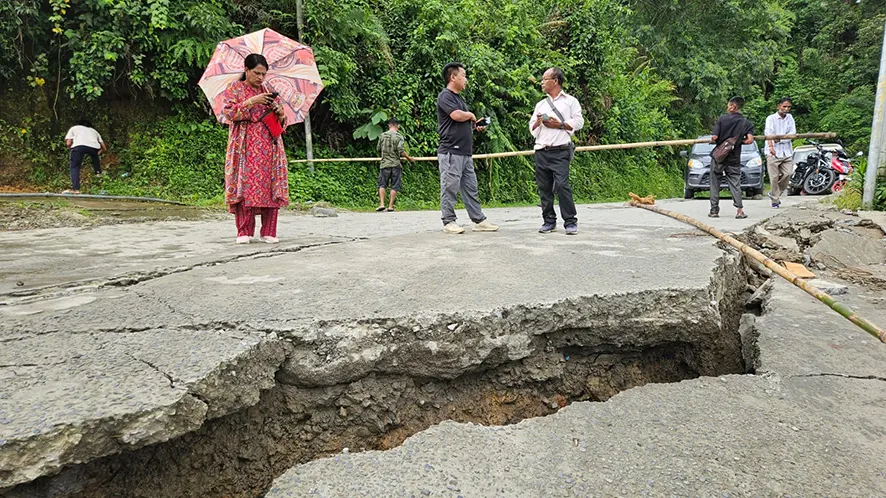
During the monsoon of 2024, a major portion of the road connecting Jollang to Ganga washed away. The administration subsequently closed the route to vehicular traffic. Yet the closure has not eliminated the need for the road. Every day, two-wheelers - many of them ridden by school and college students - continue to use the damaged stretch.
Why? Because the alternative is not convenient for ordinary commuters. Those travelling between Jollang and Ganga have to take the longer route through Chimpu, Chandranagar and Vivek Vihar to reach Ganga and vice versa. The additional distance means more time and more fuel expenses. As a result, people are caught in an uncomfortable choice: take the longer and more expensive route, or take a dangerous road that has officially been declared closed and unsafe for commuting.
This is not simply a problem of inconvenience. It is a question of public safety. If authorities know that people continue to use the damaged road despite its closure, merely putting up a closure notice cannot be the end of the matter. The underlying problem remains: people need to travel, and the road continues to be the shorter and more accessible connection between the two areas.
More than two years have now passed. During this period, residents have reportedly submitted applications and requests seeking action. Yet the road remains in much the same condition. At some point, the question has to move beyond 'When will the road be repaired?' to 'Why has it taken so long?'
Citizens should not have to wait for a fatal accident before a known safety risk receives urgent attention. Nor should an issue have to become a protest, a bandh. Or must a VVIP use this route before action is taken - before it receives administrative priority?
There is another question worth asking. The recent blockage of the Hoj-Potin highway was reportedly resolved within months. If that problem could be addressed within such a period, why has the Jollang-Ganga road remained unresolved for more than two years?
Perhaps the administration has legitimate reasons for the delay. If so, citizens deserve to know what those difficulties are and what the proposed timeline for resolution is.
Silence, however, leaves people with only one conclusion: that their problem is not receiving the attention it deserves.
For the administration, this may be another road project awaiting action. For the people who use it, it is part of their everyday lives.
A student trying to reach college should not have to gamble with his or her safety to save time and money. A worker should not have to spend considerably more simply because a basic road connection has remained unusable for years. And ordinary citizens should not have to repeatedly petition authorities merely to receive an explanation about when a public road will be restored.
The administration should therefore provide a clear public update on the status of the Jollang-Ganga road, explain the reasons for the prolonged delay, and announce a definite timeline for restoration.
A road may be made of concrete and asphalt, but its importance is measured by the lives and livelihoods that depend on it. The people of Jollang and adjoining areas have already waited long enough for an answer.
A concerned citizen