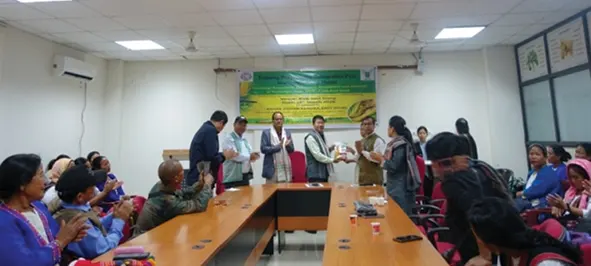

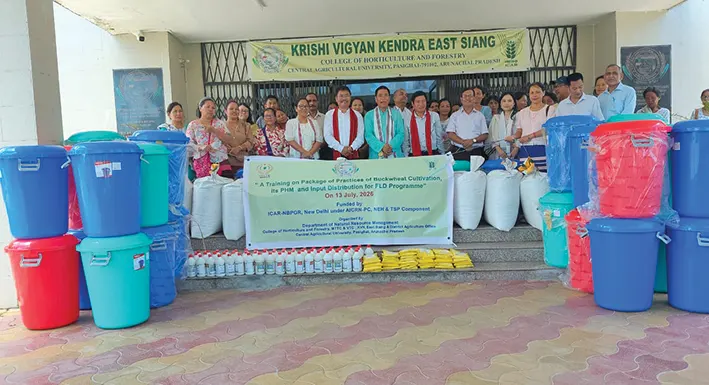
PASIGHAT, 13 Jul: A training programme on ‘Package of Practices for Buckwheat Cultivation and its Post-Harvest Management & Input Distribution under Front Line Demonstration (FLD) Programme’ was organised at the College of Horticulture and Forestry (CHF) here in East Siang district on Monday.
The programme was jointly organised by the CHF, MTTC & VTC, KVK East Siang and the district agriculture office, with financial support from the All India Coordinated Research Network (AICRN) on Potential Crops, National Bureau of Plant Genetic Resources (NBPGR), New Delhi. A total of 30 farmers (27 women and three men) participated in the programme.
The training aimed to enhance the farmers’ knowledge on improved package of practices for buckwheat cultivation, post-harvest management and value addition, while promoting potential crops in Arunachal Pradesh. Agricultural inputs were also distributed under the FLD programme to encourage the adoption of improved production technologies.
Addressing the participants, chief organising secretary Dr P Debnath highlighted the importance of buckwheat as a climate-resilient and nutritionally rich crop for the hill ecosystems of Arunachal. Agriculture Development Officer Aido Moyang emphasised on promotion of buckwheat through scientific nutrient management and convergence of research and extension activities.
AICRN on Potential Crops principal scientist Dr SK Yadav emphasised the role of underutilised crops in ensuring climate resilience, nutritional security and livelihood enhancement in the Northeastern Himalayan region. District Agriculture Officer Dana Moyang highlighted the importance of quality seed distribution and scientific cultivation practices for improving farmers’ livelihoods.
The programme was attended also by state BJP vice president Dunguli Libang and Bharatiya Kisan Morcha East Siang district unit president Kaling Jamoh, who appreciated the initiative and emphasised the importance of scientific farming, value addition and institutional support for strengthening rural livelihoods.
CHF Dean Prof L Wangchu highlighted the immense potential of buckwheat as a climate-smart and high-value crop for improving food, nutritional and livelihood security in the Himalayan region.
The technical session comprised expert lectures by scientists from the CHF, NBPGR, and the Pasighat Agriculture Department, covering scientific cultivation practices, soil health management, integrated crop management, genetic resources, value addition, post-harvest management, and vermicompost-based nutrient management for sustainable buckwheat production.