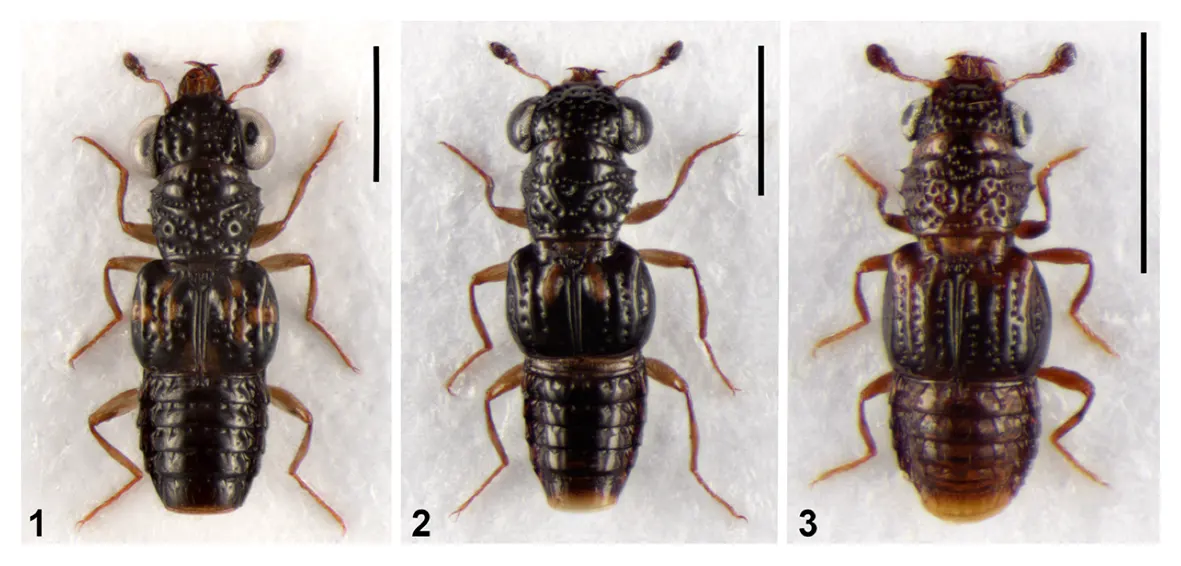

ITANAGAR, 29 Aug: In a landmark scientific achievement, an Indo-German research team has discovered 15 species of Stenus beetles, new to science, in the waterfalls and forests of Arunachal Pradesh, one of the world's richest biodiversity regions.
This marks one of the largest recent additions to the insect fauna of the Eastern Himalayas, bringing the total number of Stenus species recorded from the state to 103. It includes 21 species new for India and 44 new for Arunachal.
The results have been formally published in Linzer Biological Contributions, in the research article 'Steninae from Arunachal Pradesh, India', authored by the eminent taxonomist Dr Volker Puthz.
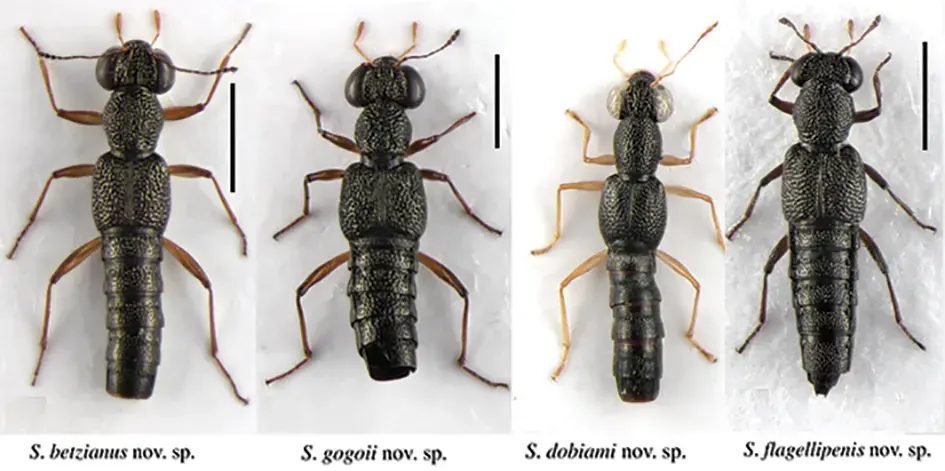
Some of the newly discovered beetles have been named in honour of researchers who played a key role, including Prof Oliver Betz and Tobias Mainda from the Institute of Evolution and Ecology, University of Tübingen, Germany, as well as Dr Hiren Gogoi, Dobiam Tagam, and Sonu Singh from Rajiv Gandhi University's (RGU) zoology department.
The new species Stenusgogoii, S dobiami, and S sonui recognize the dedication of RGU's entomology team, while S oliver and S tobias honour their German collaborators.
The research team expressed heartfelt gratitude to the indigenous communities who supported their work in remote mountainous regions. These included the Nyishi community of Pakke-Kessang; Sherdukpen and Bugun communities of the Eaglenest region, West Kameng; and the Memba and Adi communities of the Shi-Yomi region. Their commitment to protect Arunachal's biodiversity was described as "indispensable" to the success of the project.
The journey began in 2021 when Prof Oliver Betz, a world-leading expert on rove beetles, contacted RGU to explore the insect diversity of Arunachal. This led to an official memorandum of understanding between RGU and the University of Tübingen in May 2023, supported by the German Research Foundation (DFG) and permissions from the National Biodiversity Authority and the PCCF wildlife, Arunachal.
Between December 2024 and March 2025, researchers conducted four extensive field expeditions across Pakke-Kessang, West Kameng and Shi-Yomi. The team collected specimens using aspirators, sieves and sweep nets, many of which turned out to be species previously unknown to science.
The newly recorded species, just 1.9-6.5 millimetres long, belong to the genus Stenus of rove beetles. Rove beetles are one of the world's most diverse groups of insects, with more than 63,000 known species spread across nearly 4,000 genera. They live on every continent and in nearly every habitat. Many are tiny predators equipped with shortened wing covers and strong jaws that help them hunt. They've been evolving for more than 200 million years. Scientists say this long history makes them an important group for understanding how insects diversify and adapt to changing environments. They have big eyes and special abdominal glands that produce chemical mixtures used for defence, fighting microbes, and even helping the beetles glide across water. They typically live in damp places such as stream edges, swamps, bogs, wet grasslands, and moist leaf litter.
Most Stenus species catch small prey like springtails and aphids using a unique extendable 'tongue-like' mouthpart that snaps out to grab their targets. Former Dianous species hunt differently: they use their jaws and lack the extendable mouthpart, often showing other traits such as smaller eyes or tufts of hairs on the abdomen. Stenus is not only the largest genus of rove beetles - it is one of the largest genera of animals on Earth.
India had around 167 described species, according to previous scientific reports. Researchers believe that many more species await discovery in Arunachal and hope the success of this Indo-German collaboration will inspire renewed efforts in biodiversity exploration across the region.