[Badak Yomgam]
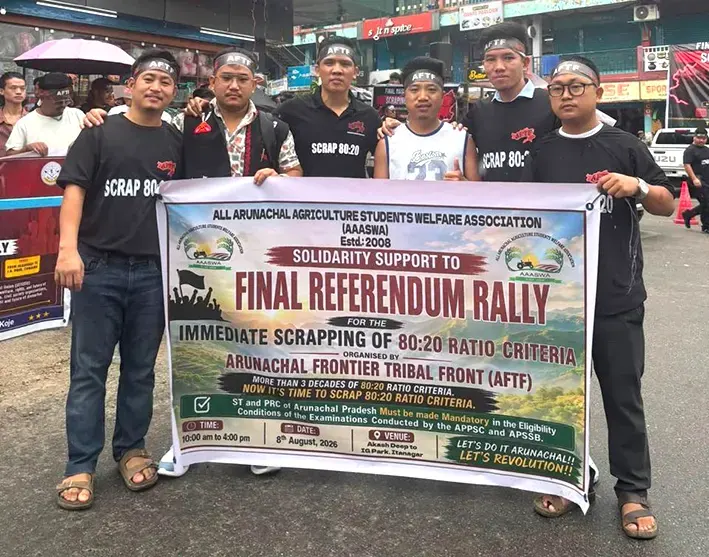
The Arunachal Pradesh Government has officially constituted a High-Level Committee to examine the feasibility of major structural changes to its state recruitment policies. The committee is tasked with evaluating the potential abolition of the existing 80:20 reservation ratio in competitive examinations and exploring the legalities of making Permanent Resident Certificates and Arunachal Pradesh Scheduled Tribe certificates mandatory for all state recruitment processes. The high-level panel is chaired by Industries, Skill Development, Labour, and Employment minister Nyato Dukam. It comprises senior officials representing the departments of Home, Law, Personnel, Social Justice, Empowerment and Tribal Affairs, and Administrative Reforms & Training. Additionally, the president of the All Arunachal Pradesh Students’ Union, or a designated representative, has been included as a special invitee to offer a civil society perspective.
According to the official order issued by the Department of Administrative Reforms & Training, the committee has been handed a multi-pronged mandate. It will thoroughly examine the constitutional and legal consequences of the proposed changes, study the recruitment and registration frameworks currently utilized by neighboring Northeastern states, review the findings and recommendations of a previously established High-Level Committee on the matter, and formally consult the state’s Advocate General for comprehensive legal guidance. The state government has directed the committee to compile its findings and submit a definitive report within a strict timeline of sixty days.
While the initiative aims to address long-standing public demands regarding indigenous job security, a closer analysis of the committee’s structure and mandate reveals several critical administrative and legal gaps. A glaring operational defect is the total exclusion of the Education minister and senior officials from the Higher and Technical Education departments. Because the education sector accounts for a massive portion of all public sector employment and acts as the foundational pathway for state-level human resources, ignoring this department detaches policy formulation from actual execution. In addition, directing the panel to model its framework after neighboring states is highly risky. Many neighboring states in the Northeast have faced severe social unrest, ethnic friction, and prolonged legal battles over their own flawed residence laws and reservation structures. Copying frameworks from states that are themselves legally vulnerable could import those exact instabilities into Arunachal Pradesh.
The order also instructs the new committee to review the findings of an earlier investigative panel. This recycling of evaluation bodies raises questions of administrative redundancy, suggesting the move may serve as a stall tactic to delay a definitive political stance on highly sensitive issues. In addition, restricting the student union leadership to a special invitee status means they lack voting power or core drafting authority. Since student bodies are the primary drivers of these socio-political demands, keeping them on the margins risks producing a final report that lacks genuine grassroots consensus. Finally, completely abolishing the twenty percent open category and enforcing strict indigenous certification mandates directly challenges Articles 14, 15, and 16 of the Indian Constitution, which protect the equality of opportunity in public employment. Expecting a panel to safely navigate these monumental constitutional hurdles in just sixty days increases the likelihood of a rushed, legally fragile framework that may easily fail its first challenge in court.
Because a direct, uncompromising abolition of the 80:20 ratio heavily collides with Article 16 of the Indian Constitution, any total reservation policy passed by the state executive would face immediate judicial gridlock. The Supreme Court’s historical legal precedents suggest an absolute ban on non-indigenous applicants would be struck down swiftly, freezing state recruitment and inadvertently worsening the youth unemployment crisis.
Comparative Legal Precedents on 100% Reservation:
To understand why an absolute blockade on open categories fails judicial scrutiny, one must look at how similar attempts by other states were categorically struck down by the courts:
Andhra Pradesh (Chebrolu Leela Prasad Rao v. State of AP, 2020): The undivided Andhra Pradesh government issued a notification providing 100% reservation for Scheduled Tribe (ST) candidates for teacher posts in tribal “Scheduled Areas.” A 5-judge Constitution Bench of the Supreme Court quashed it, ruling that 100% reservation is arbitrary, unfair, and deprives Scheduled Castes (SCs), OBCs, and open-category candidates of their due opportunities.
Jharkhand (Satyajit Kumar v. State of Jharkhand, 2022): The Jharkhand government attempted to reserve 100% of certain public sector jobs (like school teachers) exclusively for local residents of 13 Scheduled Districts. The Supreme Court declared this unconstitutional, reaffirming that the opportunity for public employment cannot be denied to other citizens based purely on residence.
Chhattisgarh (2022): The Chhattisgarh High Court similarly struck down a state notification that created 100% reservation for local residents in public posts within tribal-majority Scheduled Areas, citing the Supreme Court’s strict ban on absolute reservation blocks.
Therefore, the high-level committee’s ultimate challenge is not determining if the youth need job protection, but crafting a legally sound mechanism to deliver it. Instead of attempting to unilaterally rewrite federal reservation limits, the government can achieve the exact same socio-economic objective by subtly shifting its strategy from altering reservation quotas to strictly modifying eligibility criteria. To successfully protect the local job market without inviting destructive court challenges, the panel can deliberate on a series of multi-pronged administrative solutions.
Rather than legally deleting the twenty percent open category, the state can regulate who is permitted to enter it. By making a strictly verified Permanent Resident Certificate mandatory, and redefining their guidelines to link eligibility strictly to ancestral land records and local lineage, the open pool naturally tightens. Because non-tribal entities are already restricted from owning land in Arunachal Pradesh under regional customary laws, a stringent, land-tied certificate mandate across all recruitment tiers would organically restrict the candidate pool to indigenous populations and deeply verified, long-term residents.
Following successful precedents set by other states, which effectively filtered out non-state applicants via regional language benchmarks, Arunachal Pradesh can introduce similar prerequisites. Mandating a highly rigorous, compulsory qualifying examination on state history and indigenous cultural heritage, while providing local tribal dialects as an option, for all competitive exams creates a natural filter. On paper, the examination remains open to all Indian citizens to satisfy Article 16; in practice, only candidates born, raised, and educated within the unique cultural landscape of Arunachal Pradesh would possess the capability to pass.
For a permanent and legally secure shield, the state can supplement local administrative rules with federal advocacy. The state assembly can utilize the committee’s findings to pass a unanimous resolution requesting the Parliament of India to exercise its unique powers under Article 16(3). By lobbying New Delhi for a special residential employment exemption, Arunachal Pradesh can seek a permanent, Parliament-backed amendment that legalizes its specific job protections once and for all. The formation of this high-level committee represents a high-stakes balancing act between intense grassroots socio-political pressure and rigid constitutional boundaries. If the panel relies on conventional methods, the resulting policy risks collapsing under judicial scrutiny. However, by transitioning from a vulnerable strategy of total reservation to a sophisticated framework of stringent localized eligibility, the Arunachal Pradesh Government can effectively secure the state’s economic future for its indigenous youth while keeping its recruitment machinery fully operational and safe from legal intervention. Ultimately, if the government overlooks these critical administrative loopholes and legal strategies, it will signal a clear lack of genuine political will to implement real change, suggesting that this committee is merely a tactical delay to prolong the issue rather than a sincere effort to protect the future of our own people. (The contributor is an independent writer)