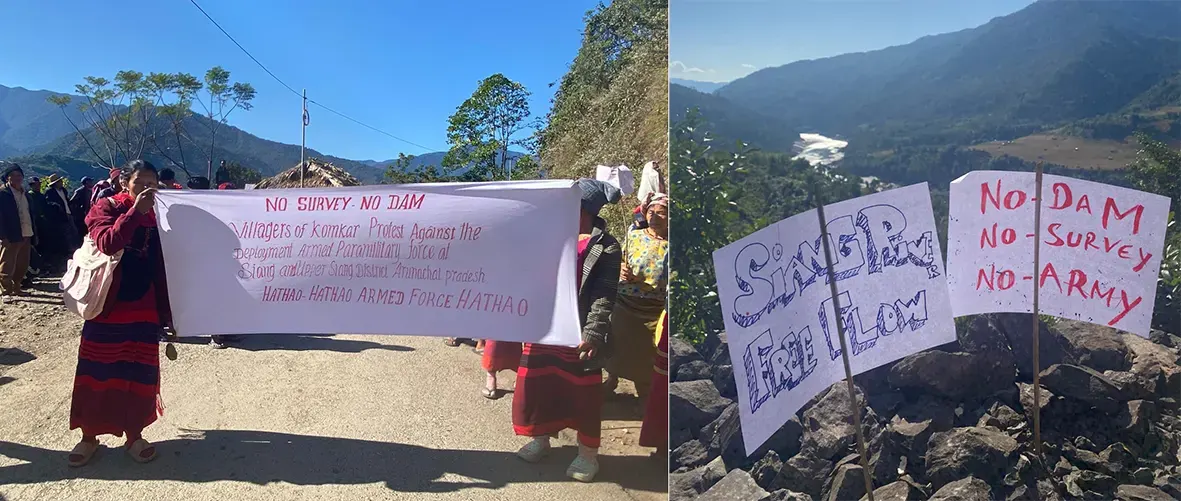
ITANAGAR, 6 Oct: Former chief minister Gegong Apang on Tuesday demanded immediate withdrawal of the PFR survey for the proposed Siang Upper Multipurpose Project (SUMP) and a declaration from the government cancelling the project in the greater interest of the people living along the Siang River.
Expressing serious concern over the Centre and the state government's move to go ahead with the pre-feasibility report (PFR) survey, Apang said the SUMP, planned as a mega dam, would completely destroy areas along the Siang River, which is the home of Adi civilisation.
"The rich history, heritage and culture of the Adi community will be completely erased if a mega dam is constructed over the Siang River," he said.
Stating that the recent actions of the central and the state governments reflect their anti-people attitude, Apang said: "They appear to have decided to push the people living along the Siang River out of the area and make them refugees."
The former chief minister said he was unhappy and disturbed by the recent happenings related to the PFR survey and had gone to Yingkiong recently to support the ongoing agitation.
Apang said he learnt from the media that the chief minister and his colleagues visited the protest site and faced stiff opposition. He alleged that the chief minister, deputy chief minister, ministers and MLAs are misleading people by saying the PFR survey does not mean construction of the dam.
"They are trying to mislead the people by saying that the PFR survey does not mean construction of the dam. But the fact is that the local people are totally against construction of the dam. Therefore, there is no need to undertake the PFR survey," he said.
Apang added that the chief minister is also trying to make the people understand that the dam is necessary to control water flow from dams being built in China. "But he is unable to give any solution to the damage and loss to the indigenous people that will be caused after huge areas of along the Siang are submerged," Apang said.
The former chief minister said the Siang area never witnessed such a civil unrest in the past.
"The Siang valley has been a very peaceful area since the independence of India. The culture and heritage of this region cannot be allowed to be destroyed in the name of constructing a mega dam," he said.
"Recently we have seen clashes between local people and paramilitary forces. It should be understood that all land in the Siang area is the traditional property of the local people. They have customary ownership rights over the land. If anyone wants to use them for some purpose, they must take permission from the owners," Apang said.
He said that, since the central paramilitary forces never took permission to set up camps on lands owned by the local villagers, it is natural that they would get angry over such unauthorised occupation. While opposing such unauthorised occupation of tribal land and condemning the harassment of innocent villagers of Riga, Komkar, Geku and Yingkiong, Apang said, "It is very sad to see thousands of women protesting continuously against the PFR survey and proposed mega dam.
"The government must honour their demand," he said.
He questioned leaders of the state, especially those who are elected from the Siang region, whether they are not concerned about protecting their native land from destruction due to dam construction.
"If they support the dam project, they should publish a white paper on their justification for their support for the project," he said, calling upon the elected representatives to come before the agitating public of Geku and Komkar area and explain how they would protect the people, their history and heritage once a huge reservoir is created because of the mega dam over the Siang River, which will submerge most of the important areas along the Siang River.
He alleged that the government is not listening to the voice of the people and has decided to build the dam by using force on indigenous people.
"They have no regard for the Constitution of India," he said.
Apang said he has served a legal notice to the Centre and the state government against the PFR activities but has received no reply, which he said shows arrogance and acceptance of his allegations.
The former chief minister said that, having been in politics for more than 50 years, he had groomed most of the leaders who are now in power.
"Today I regret that the political leaders whom I groomed for the future of our state have decided to destroy the Siang valley civilisation. Today they are going against the wishes of majority of the people to serve the interests of industrialists from outside the state at the cost of the future of the local people," he said.
He criticized minister Ojing Tasing, MLAs Alo Libang, Oni Panyang and Ninong Ering, and MP Tapir Gao for openly supporting the dam, saying they were acting "as if they are agents of some industrial group" and had forgotten they are answerable to the people.
"The prime minister of India, home minister and the power minister of India are pretending to be unaware of the protests.
"Chief Minister Pema Khandu and Deputy Chief Minister Chowna Mein are leaving the people of Siang valley and the Adi community in particular to suffer forever and lose their ancestral homeland in the process," Apang said.
"Union minister from the state, Kiren Rijiju, who was supposed to raise the voice of the people before the union government, remained silent," the former chief minister said.
He said that the elected representatives should honour the customary laws and rights of the people.
"Since ours is a tribal state, the government cannot suppress the customary rights of the people. The land along the Siang River belongs to the indigenous tribal people. The government has no right to go against the wishes of the people," he said.
Reiterating his demand for an immediate withdrawal of PFR activities and permanent cancellation of the SUMP, Apang also demanded adequate financial compensation for families in Geku, Komkar, Riga and Yingkiong, who he said have faced harassment due to the situation, unauthorized occupation of land and deployment of PFR machinery.