[Marina Dai]
GEKU, 23 Sep: Tension is visible in Geku and Komkar as the state government pushes to move ahead with the Pre-Feasibility Report (PFR) activities for the proposed Siang Upper Multipurpose Project (SUMP).
The PFR activities have not started yet at the proposed dam sites (Begging, Dite Dime and Uggeng), but the tension surrounding the proposed work is already visible on the ground.
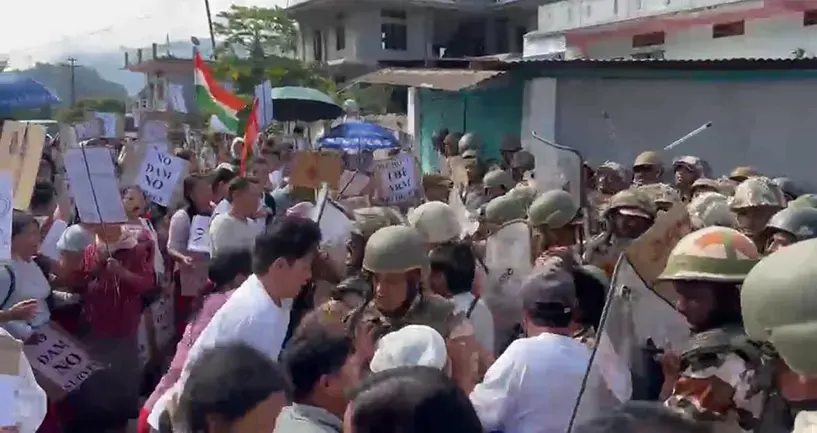
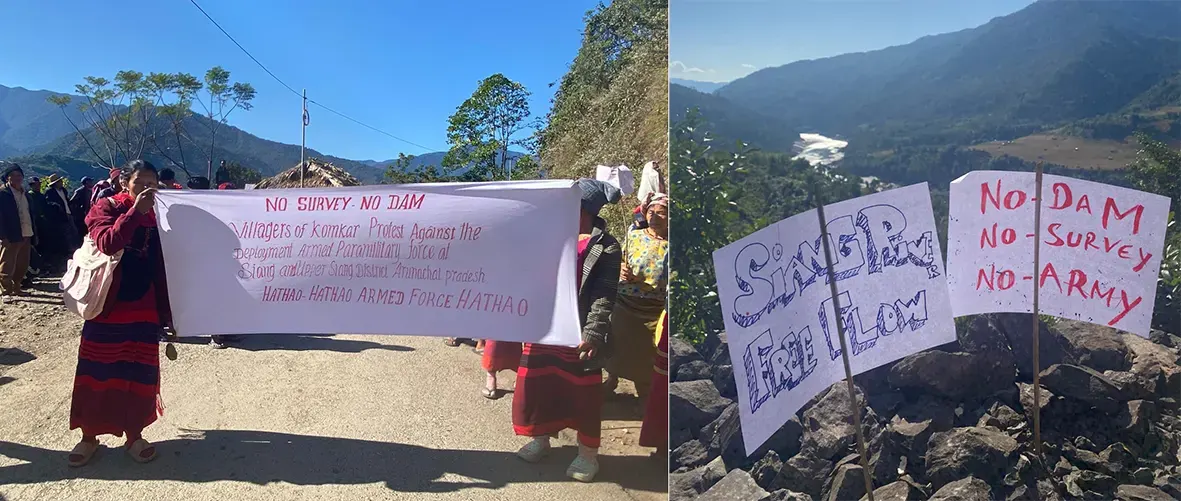
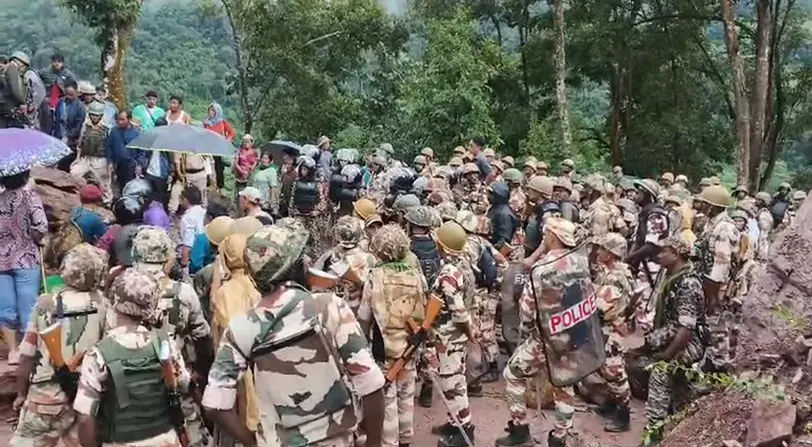
On Wednesday, villagers in Komkar blocked the road leading towards Konggong Lingkok, locally known as Uggeng, one of the proposed dam sites, to prevent the movement of machinery for the proposed PFR activities. Villagers said they would not allow machinery to be taken to the proposed site. This follows a similar protest on 14 September, when villagers from Komkar and other villages gathered at Uggeng to oppose the proposed PFR activities.
Konggong Lingkok is situated along the Siang River, around 6 km from Komkar. The road towards the proposed site has been developed recently and has now become a point of protest for villagers opposing the proposed PFR activities.
Speaking at the blockade site in Komkar, an elder said the road was blocked after repeated objections to the proposed PFR activities, which, according to him, had not been heard.
"How many times have we refused? Despite refusing repeatedly, they refuse to listen. Today, a huge crowd of citizens came out and blocked the road," he said.
"When the public says no, it means no," he said, adding that the concerns of families living on both banks of the Siang should be considered before any further attempt to move ahead with the project.
He also criticised statements made by Chief Minister Pema Khandu, MLA Ojing Tasing and MP Tapir Gao regarding the proposed project, saying residents felt their elected representatives were not listening to them.
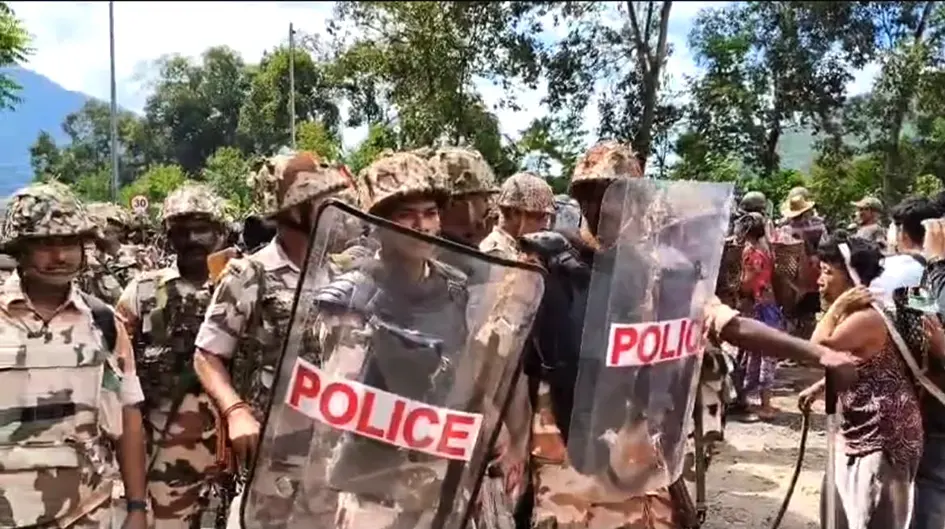
Fear and insecurity have set in among villagers living along the Siang River as they pointed to the presence of security personnel in and around the town. They said security personnel have been staying in places including the tourist lodge, hydropower office, office quarters, Geku Town Club, Giidi Notko and the court office buildings. Villagers also informed that APST buses operating between Geku, Katan and Yingkiong are being used to transport security personnel.
For villagers who depend on the bus to travel to Yingkiong, the headquarters of the area, the issue has added to their difficulties, they said.
"We don't like the amount of police and armed forces that are currently in our town. We don't want them in our land," a 55-year-old man from Geku said.
He said armed forces had been present in the area for around two years. Currently, in Upper Siang district, the forces are being stationed in Geku and Yingkiong and deployed to maintain law and order in the area during the PFR activities at Uggeng.
The presence of armed forces has become one of the major concerns among villagers as the government prepares to push forward with the PFR process.
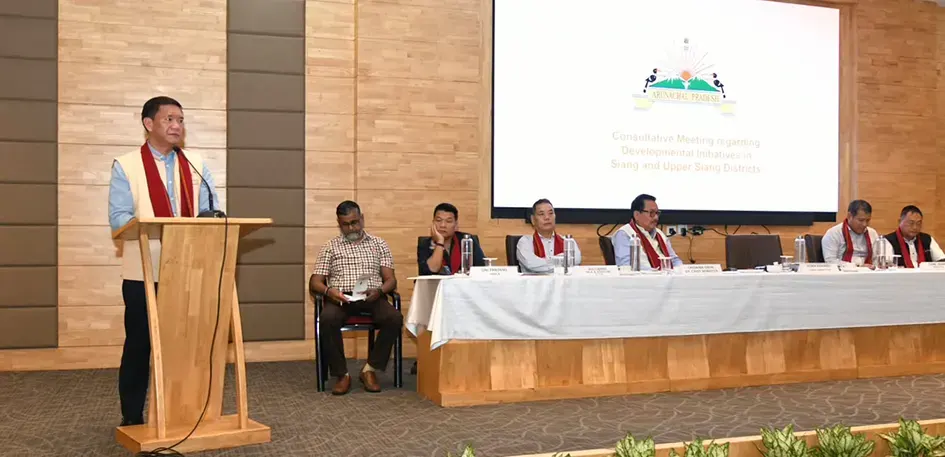
As per recent news reports, Chief Minister Pema Khandu has maintained that there has been no forceful deployment of armed forces in connection with the proposed SUMP and has invited individuals and organisations with concerns to approach the government for clarification and dialogue.
He has also announced that he would visit Siang and Upper Siang districts to meet people and discuss the project.
But villagers in Geku said the proposed visit has created apprehension.
A 40-year-old woman said the villagers did not want the dam in their area.
"We don't want the CM to visit our village here if his motive is to construct the dam," she said.
Another woman, 38, said villagers were prepared to resist any attempt to bring machinery to the proposed site.
"The police and authorities will try to stop us, but we're ready to fight against them too. Confrontation might start if they arrive," she said.
One of the major questions being raised in the supposedly project-affected villages is about the documents signed in support of the PFR. Several households in the affected areas have purportedly signed MoUs supporting the PFR process. The government has cited these agreements as evidence of support for the preliminary process. But the villagers interviewed during the ground visit said the matter was not so simple.
A 60-year-old resident of Komkar, who did not want to be named, said he had signed a document in Yingkiong and received Rs. 2.5 lakh.
According to him, the money was related to agriculture and horticulture benefits, and he did not understand the document as an agreement to support the construction of the dam.
Other villagers also said some people had signed documents believing they were related to livelihood schemes and were not fully aware of their connection with the PFR.
A copy of an MoU relating to Begging village, seen by The Arunachal Times, shows that the wording of such documents can be significant.
The MoU, dated 19 August, 2025, was specifically for the Pre-Feasibility Report of SUMP. It said that the villagers would cooperate with the government in carrying out the PFR.
Article 2.5 of the document states that cooperation by the likely project-affected families in conducting the PFR and implementing special development packages is considered an agreement by the likely project-affected families for implementation of SUMP. A separate consent document attached to the MoU authorises survey, investigation and PFR activities.
The MoU and consent document are from Begging village and not from Geku or Komkar, which could not be obtained yet.
Tasik Pangkam, advisor to the Siang Indigenous Farmers Forum (SIFF), said people need proper technical information about the project before the government moves ahead with the PFR. He questioned where people would be rehabilitated if the project eventually displaces them and what would happen to their agricultural land and customary areas.
Pangkam also said technical information has never been provided by competent technical agencies and adequate village-level consultation had never taken place either.
Meanwhile, an elder in Geku said that while the government describes SUMP as a project of national interest, many people living along the Siang feel they are being subjugated in the name of national interest.