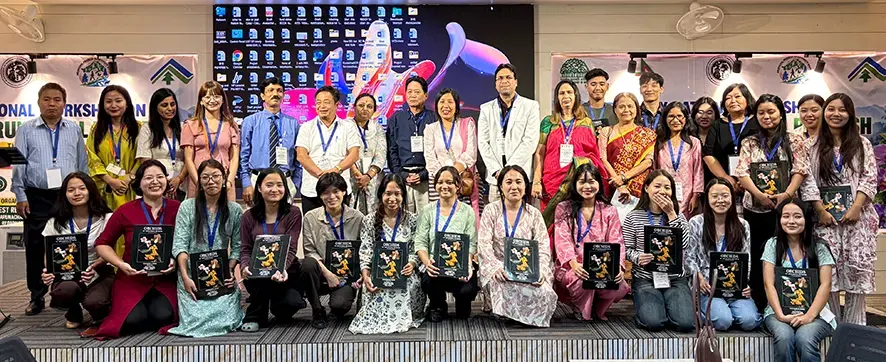
ITANAGAR, 6 Oct: The Arunachal Pradesh State Council for Science & Technology (APSCS&T) organised a state-level orientation workshop on National Children's Science Congress (NCSC) activities here on Monday.
Centred around the focal theme 'Science and Innovation for Sustainability', the workshop aimed to equip and sensitise district coordinators, science communicators, and educators to organise district-level science congresses and drive widespread student participation across the state. Representatives from 23 districts, including teachers and district officials overseeing science popularisation initiatives under various deputy directors of school education (DDSE) offices, attended the technical sessions.
The workshop built upon a preliminary online training session conducted on 23 September for district and assistant coordinators across the state.
Addressing the participants, APSCS&T Director CD Mungyak emphasised the critical role of scientific temper and grassroots-level innovation among young learners. An introductory brief outlining the workshop's roadmap was presented by APSCS&T Deputy Director Dr Pakngu Lombi.
The programme featured specialised technical sessions led by resource persons, focusing on the sub-themes of 'NCSC 2026: Application of Indian Knowledge System for Sustainability (Sub-theme 5)' deliberated by Dr Joram Aku, Scientist-B, DBT-APSCS&T Centre of Excellence for Bioresources and Sustainable Development (BRSD), Kimin. A session on 'Energy, Food, Agriculture & Health (Sub-themes 2 & 4)' was conducted by Gem Peri, education officer, Arunachal Pradesh Science Centre (APSC), focusing on the framework of 'Explore, Experiment, Enhance & Evolve (E4)'.
'Waste Management & Water Conservation (Sub-themes 1 & 3)' was addressed by Yumbi Bijum Yomgam, Scientist-C, APSCS&T, detailing the 'R5' strategy (reduce, reuse, retrieve, redesign & recycle), alongside water harvesting and recycling methodologies.
Operational framework for districts was conducted in the second technical session by Dr Pakngu Lombi, NCSC state coordinator, who detailed the operational duties of district coordinators, district officials, district organising committees, and district academic coordinators to ensure effective execution at the school and district levels.
The sessions concluded with an interactive feedback and experience sharing segment, followed by a valedictory programme that included the distribution of participation certificates.