
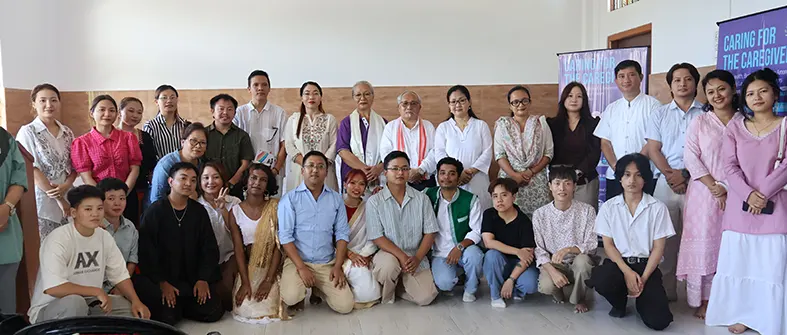
NAHARLAGUN, 4 Jul: The AP QueerStation, in collaboration with Oju Mission and The Calm Space, organised ‘Caring for the Caregivers’, an invite-only programme dedicated to promoting conversations around mental health, burnout, and resilience among community leaders, caregivers, frontline workers, and changemakers, here on Saturday.
The programme brought together psychologists, journalists, police personnel, environmentalists, activists, development practitioners, and social workers to reflect on the importance of caring for those who spend their lives caring for others.
Addressing the gathering, Oju Mission chairperson Anya Ratan shared her personal journey as a caregiver and the realities of leading a care institution. Reflecting on years of service, she spoke about the emotional, financial, and personal challenges that often remain unseen by society. Recalling the difficulties faced during the Covid-19 pandemic, she described the uncertainty of ensuring the safety and wellbeing of the children under her care, and acknowledged the timely support extended by well-wishers and volunteers during that period. She said that, while the challenges were immense, they strengthened her commitment to continue serving others with compassion. Urging the participants to become changemakers, she reminded everyone that caring for others must also include caring for oneself.
Women’s rights activist Jarjum Ete highlighted the immense pressures faced by those working in the social sector, particularly women leaders who have devoted decades of their lives to serving communities. She observed that caregiving often involves navigating criticism, emotional exhaustion, and societal expectations, yet it is compassion, resilience, and a strong sense of purpose that enable caregivers to continue their work.
Stressing the importance of self-care, she reminded the participants that caregivers frequently neglect their own wellbeing while looking after others, and urged them to prioritise both their physical and mental health, so they can continue serving their communities with strength, empathy, and resilience.
Arunachal Pradesh State Commission for Protection of Child Rights (APSCPCR) member Niri Chongrowju thanked the organisers for creating a meaningful platform to discuss mental health, inclusivity, and the wellbeing of caregivers. Speaking on the rights and dignity of transgender persons, he highlighted key legal and policy developments, including the Transgender Persons (Protection of Rights) Act, 2019, the National Council for Transgender Persons, the SMILE scheme for livelihood support, the National Portal for Transgender Persons, and awareness initiatives undertaken by the Government of India to address social stigma and promote inclusion.
Emphasising that every individual deserves equal dignity, respect, and opportunities, he urged society to uphold the rights of all people, regardless of their gender identity.
The first panel discussion, moderated by Wanggo Socia, featured Indu Chukhu, Inspector Rina Sonam, advocate Ebo Mili, Tadak Nalo, and Sawang Wangchha, each sharing personal reflections from their respective professions.
Senior journalist Indu Chukhu spoke about the emotional demands of journalism in Arunachal Pradesh, where journalists often work with limited resources while reporting on tragedies, conflicts, and sensitive issues. She highlighted the importance of acknowledging the mental toll such responsibilities can have, and encouraged greater conversations around mental wellbeing within the profession.
Itanagar Police Station Officer-in-Charge, Inspector Rina Sonam, reflected on the emotional burden carried by police personnel, who regularly witness crimes, violence, and human suffering. She spoke about the challenge of balancing empathy with professional responsibilities while maintaining emotional resilience in the line of duty.
Environmental activist Ebo Mili emphasised that mental health is just as important as physical health. He noted that ignoring emotional wellbeing can have consequences as serious as untreated physical illness,and encouraged activists and community leaders to build genuine resilience rather than pretending to be emotionally strong.
Social activist Tadak Nalo shared his own experience of neglecting mental health until it affected his physical health and work. He stressed the importance of maintaining a healthy balance between body and mind, adding that conversations such as these help normalise discussions around mental wellbeing.
Representing the LGBTQIA+ community, Sawang Wangchha, founder of AP QueerStation, spoke about the emotional impact of discrimination, bullying, and the constant struggle for acceptance faced by LGBTQIA+ individuals. He questioned the continued restrictions on blood donation by gay and bisexual men, urging society to rely on scientific evidence rather than prejudice.
Referring to examples from the animal kingdom, he challenged the misconception that diverse sexual orientation and gender identities are ‘unnatural’. He spoke also about the importance of asking for help,and acknowledged Oju Mission for consistently providing safe and inclusive spaces for vulnerable communities.
During the discussion on safe spaces, the panellists reflected on what helps them maintain their emotional wellbeing. While some found comfort in family, friendships, silence, and personal reflection, Sawang highlighted the importance of community spaces where LGBTQIA+ individuals can exist with dignity, acceptance, and a sense of belonging.
The second panel discussion, moderated by Tomo Habung, brought together mental health professionals Dr Yuma Narah, Dr Leeyir Ete, Dr Tadar Amar, Mayuri Handique, and Pimpy Tachung.
Dr Yuma Narah spoke about burnout, healing, and resilience, emphasising that healing cannot happen in isolation. Reflecting on her research with LGBTQIA+ communities, she shared the challenges of working with marginalised groups and the resilience required to continue despite criticism and resistance. She reminded the participants that resilience is not about suppressing emotions but about learning to grow through adversity with support from others.
Clinical psychologist Dr Leeyir Ete explained the difference between depression and burnout, noting that while burnout is often linked to prolonged external stress, depression may stem from deeper internal struggles. She encouraged participants to understand that resilience does not mean suppressing emotions, but rather developing healthy ways of expressing and processing them.
Creative professional Dr Tadar Amar highlighted the role of creativity and art in promoting mental wellbeing. He spoke about the value of art therapy and creative expression as tools for healing, encouraging the participants to seek professional counselling whenever emotional struggles become overwhelming.
Mental health professional Mayuri Handique discussed the impact of chronic stress on the body and mind, explaining how prolonged stress can eventually lead to burnout. She encouraged the participants to recognise early warning signs and reminded everyone that resilience is not only about pushing forward but also about knowing when to pause, rest, and recover.
Clinical psychologist Pimpy Tachung reflected on the human side of mental health professionals, acknowledging that psychologists are not immune to emotional pain. She explained that while clinical psychologists do not prescribe medication, they provide professional assessment, diagnosis, and therapy that help individuals better understand themselves and develop healthier coping strategies.
Concluding the sessions, Wangchha expressed gratitude to Anya Ratan and Oju Mission for consistently opening their doors to vulnerable and marginalised communities. He noted that ‘Caring for the Caregivers’ was intentionally organised as an invite-only gathering to create an intimate, safe, and meaningful environment where participants could openly share their experiences and learn from one another.
Sawang also thanked the Mariwala Health Initiative (MHI) for supporting the programme and making such an important conversation possible.
The programme concluded with a collective commitment from participants to continue fostering safe spaces, promoting mental wellbeing, and recognising that caregivers, too, deserve care, support, and compassion.