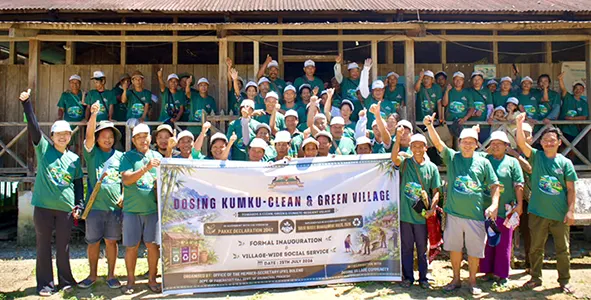
BOLENG, 26 Jul: The ‘Dosing Kumku Clean & Green Village Mission’ was inaugurated on Saturday in Dosing village in Boleng circle of Siang district, marking the beginning of a community-led initiative to transform the village into a model of cleanliness, environmental stewardship and sustainable rural development.
The inaugural programme was attended by Boleng Circle Officer Kali Mara, PR Member-Secretary Niyang Pertin, members of the Dosing Social Welfare Society (DSWS), gaon buras, PRI members, members of self-help groups, youth representatives, and villagers.
A major highlight of the programme was the formal operationalisation of the Dosing Kumku Clean & Green Village Mission through the constitution of a dedicated mission committee which shall serve as the nodal body for planning, coordinating, implementing and monitoring all mission activities.
Following the inauguration, villagers from all sections of the community participated in a village-wide social service, jointly cleaning public spaces, roadside drains and common areas.
The mission is being undertaken by the office of the Boleng PR member-secretary, and facilitated by the Pakke Declaration secretariat cell under the Department of Environment, Forests & Climate Change. The initiative seeks to translate the strategies outlined in the Pakke Declaration, 2047 into practical and measurable actions at the village level while advancing the objectives of the Solid Waste Management Rules, 2026 through scientific waste management, environmental stewardship and community participation.
The Pakke Declaration, 2047, adopted by the Government of Arunachal Pradesh, provides a comprehensive roadmap for achieving climate resilience and sustainable development through a whole-of-government and whole-of-society approach. Organised around five broad thematic pillars – environment, climate resilient growth, health and well-being, sustainable and adaptive living, and evidence generation and collaborative action – the declaration encourages localised action and convergence of government programmes to promote environmentally responsible and climate-resilient communities.
The Dosing Kumku Clean & Green Village Mission represents a significant step towards localising these strategies at the village level. While biodegradable waste generated in rural households is traditionally managed through composting and livestock feeding, the management of plastic and other non-biodegradable waste continues to remain a major challenge. In the absence of organised collection and disposal systems, plastic waste is often burnt or indiscriminately dumped, leading to environmental pollution and long-term ecological concerns.
Dosing village also faces challenges such as open roadside drains, the absence of household and community dustbins, free movement of stray pigs and cattle within residential areas, and the need for greater environmental awareness and civic responsibility.
To address these challenges, the district administration has initiated a series of measures under the mission. Directions have been issued for prohibition of free-roaming stray livestock within the village, and the mission committee will work in close coordination with village institutions to facilitate its implementation.
An exposure visit to the Pangin Clean Model Village has also been planned to enable village representatives to study successful community-led initiatives and adopt suitable best practices.
The mission envisages a series of integrated interventions, including installation of bamboo dustbins at every household, source segregation of waste, scientific management of plastic waste, plantation drives, environmental awareness campaigns, and convergence of government schemes. In addition, the PR member-secretary’s office has conceptualised an integrated livelihood, sustainable mobility and waste management initiative, under which the phased introduction of a dual-purpose electric rickshaw is proposed for plastic waste collection and sustainable rural mobility.
The Dosing Kumku Clean & Green Village Mission is envisioned as a community driven framework for translating the strategies outlined in the Pakke Declaration, 2047 into meaningful action at the grassroots through institutional convergence, behavioural change and active citizen participation. By integrating environmental conservation, climate resilience, sustainable livelihoods and participatory governance into everyday village life, the mission seeks to demonstrate a replicable model of sustainable rural development. (DIPRO)