
ITANAGAR, 5 Jun: The World Environment Day (WED) was celebrated across the state on Friday.
In Lower Subansiri district, over 5,000 saplings were planted across five forest ranges by the Forest Department to mark the WED.
Deputy Commissioner Oli Perme commended the initiative and praised the department’s officials and local communities for stepping up to enhance the valley’s green cover, and for their effort to protect the valley’s delicate ecosystem.
The scale of the initiative was highlighted during a central commemorative event held at the district dairy farm in Siiro. This year’s celebrations, held under the global theme ‘Inspired by Nature, For Climate, For Our Future’, was spearheaded by the Department of Environment, Forest and Climate Change’s Hapoli Forest Range, under the leadership of Divisional Forest Officer Tilling Takar, working hand-in-hand with the Department of Animal Husbandry, Veterinary & Dairy Development.
Turning environmental awareness into immediate action, volunteers and forest officials completed the mega plantation drive across the Hapoli Forest Division.
During the gathering in Siiro, speakers reflected on the shared duty of every citizen to safeguard Ziro’s unique ecological heritage. The event highlighted how sustainable dairy, mindful agriculture, and everyday eco-friendly habits are no longer just choices but necessities to ensure a healthy, thriving future for the generations to come.
The Anjaw Krishi Vigyan Kendra (KVK) celebrated the World Environment Day in Matiliang village.
During the programme, which witnessed the participation of 15 farmers, farmwomen and rural youths from the village, KVK Head Dr Debasis Sasmal said that nature provides effective solutions to many environmental challenges, and encouraged farmers to integrate climate-resilient agricultural practices to safeguard productivity and environmental health.
Land and water management engineering expert Ugarsain Sangwan highlighted the importance of environmental conservation and emphasised on recycling and reuse of plastic bottles to reduce plastic pollution and protect natural resources.
He encouraged the participants to adopt eco-friendly practices in their daily lives and contribute towards a cleaner environment.
Agronomist Khoisnam Naveen conducted a technical session on recycling of agricultural waste for sustainable agriculture. He explained how crop residues and other farm wastes can be effectively converted into compost and organic manures, thereby improving soil health, reducing environmental pollution, and promoting sustainable farming practices.
The programme also highlighted the objectives of the nationwide Khet Bachao Abhiyan, which promotes soil health conservation, balanced use of fertilisers, natural resource management, and climate-resilient agricultural practices.
The participants were encouraged to adopt environmentally sustainable farming methods to safeguard agricultural land and ensure food security for future generations.
Agriculture field assistant Khogro Gam emphasised the vital role of community participation in environmental conservation.
The Eco Club of Dera Natung Government College (DNGC) Itanagar, in collaboration with the college’s geography department and the NCC’s DNGC unit (1 APBn), celebrated the World Environment Day under the theme ‘Awareness Campaign and Public Interactions’.
Despite disruptions to normal activities in the ICR, teachers and students participated enthusiastically in the programme, demonstrating their commitment to environmental conservation and sustainable development.
Faculty members, students, NCC cadets, and Eco Club volunteers actively took part in the celebration.
DNGC Principal Dr MQ Khan emphasised the urgent need for environmental conservation, biodiversity protection, and responsible utilisation of natural resources. He encouraged students to adopt environmentally sustainable lifestyles and contribute actively towards building a cleaner, greener, and more sustainable future.
A major highlight of the programme was a plantation drive conducted on the college campus. Participants planted and adopted 60 saplings, comprising ornamental plants, flowering trees, and shrubs, thereby reaffirming their commitment to environmental conservation and campus greening initiatives.
In West Siang district, the World Environment Day was celebrated at Nikte Kodum circle under the initiative of the North East Foundation for Health, Education & Livelihood Skills (NE-HEALS), in collaboration with the district administration and the Ubu Welfare Society.
As part of the celebration, a river cleaning drive was conducted along the Hu River, followed by a tree plantation programme at the Government Secondary School in Nikte and the circle office in Nikte Kodum.
Aalo Forest Division DFO Gopin Padu provided saplings for the plantation drive.
The World Environment Day was observed across Upper Subansiri district on Friday with all gram panchayats conducting special gram sabha meetings with focus on awareness regarding the Solid Waste Management Rules, 2026 and the Swachh Gaon, Surakshit Jalvayu campaign.
In Tani-Tator IV gram panchayat, the special gram sabha was attended by ZPC Jyoit Jeram, Gusar ZPM Yalar Riddi, DPDO Tanam Kyali, and Circle Officer Nikrun Bui.
During the meeting, awareness was created on proper waste management practices, cleanliness, and the role of the community in protecting the environment.
The DPDO appealed to the villagers to follow the solid waste management guidelines in letter and spirit and actively participate in maintaining cleanliness in their respective villages.
The ZPC and the ZPM assured of their support towards community-led initiatives aimed at improving sanitation and environmental protection.
A significant resolution adopted during the gram sabha was to work collectively towards making Belo the cleanest village in Arunachal Pradesh.
In Anini in Dibang Valley district, the Anini Forest Division celebrated the WED with a plantation drive and conducting awareness programme on environment and climate change.
Trees were planted to promote environmental conservation and reinforce the importance of collective action in combating climate change.
MLA Mopi Mihu, DC Bekir Nyorak, DFO Taluk Rime, and SDO Lijum Ete also joined the celebration and highlighted the need for sustainable development, protection of natural resources, and active public participation in preserving the rich biodiversity of the district.
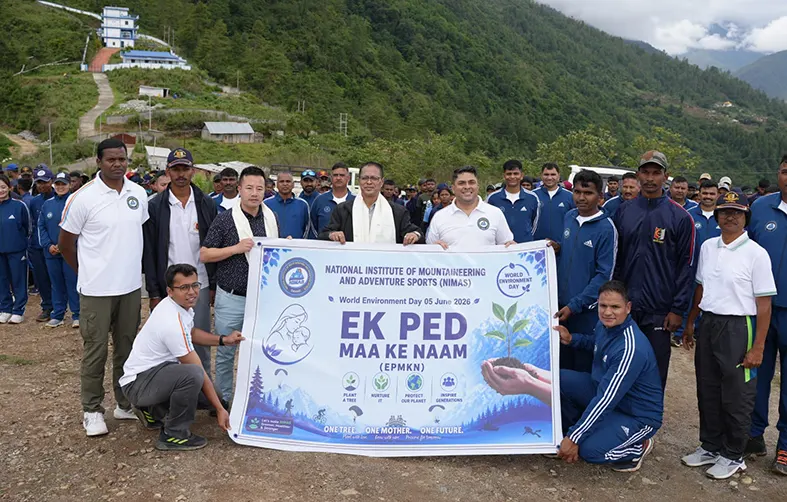
Dirang (West Kameng)-based National Institute of Mountaineering and Adventure Sports (NIMAS) launched a massive plantation drive under the ‘Ek Ped Maa Ke Naam’ campaign on Friday.
Over 1,300 indigenous and fruit-bearing saplings, including peach, plum, litchi, walnut, orange, deodar, and pine, were planted across the NIMAS campus and surrounding areas.
Staff of the institute and NCC cadets participated in the plantation drive.
West Kameng DC Dr Dilip Kumar and Dirang ADC Choiki Dondup also joined the plantation drive.
The DC emphasised the importance of collective environmental responsibility to mitigate climate change and environmental degradation.
NIMAS Director Col Ranveer Singh Jamwal highlighted the significance of the initiative.
“As NIMAS completes 13 years of its journey, we wanted to celebrate this milestone by giving back to the land that has nurtured us and enabled our growth,” he said.
“The plantation of 1,300 trees is our humble contribution towards environmental conservation and a greener future. Through this initiative, we hope to inspire our youths and the larger community to become active custodians of nature,” Col Jamwal said.
The DC also attended a special gram sabha held at Pedung village to commemorate the WED.
The DC highlighted the significance of the WED as a global movement to raise awareness and inspire action for the protection of the environment. He stressed the need for active community participation in preserving forests, water resources, and biodiversity, particularly in ecologically sensitive regions such as West Kameng. He called upon the villagers to adopt sustainable practices and contribute towards building a greener and cleaner future.
2 Arunachal Scouts Commanding Officer Col Parikshit Das reiterated the Indian Army’s commitment towards environmental protection and community engagement. He highlighted the importance of maintaining ecological balance, and encouraged citizens to contribute towards conservation efforts through responsible and sustainable practices.
During the meeting, discussions were held on environmental protection, sustainable natural resource management, afforestation, solid waste management, and the role of local communities in safeguarding the environment.
The programme was followed by a plantation drive in Pedung village.
The programme was attended also by District Panchayat Development Officer Ashok Tajo, Town Magistrate Phuntso Tashi, HoDs, the GPC, panchayat leaders, GBs and villagers from Pedung.
Special gram sabhas were also conducted across various administrative circles of Papum Pare district to mark the WED.
The gram sabhas were conducted in Mengio, Banderdewa, Batt Ganga, Doimukh, Parang, Toru, and Leporiang with active participation from panchayat representatives, village elders, youths, women groups, and members of the public.
The gram sabhas focused on key issues, including environmental protection, cleanliness, solid waste management, plastic reduction, water conservation, and sanitation, District Panchayat Development Officer Tame Yajum said.
The initiative was undertaken in coordination with village-level panchayat functionaries to promote environmental awareness and encourage community participation in conservation activities.
Cleanliness drives and plantation programmes were organised in several locations.
The North East Foundation for Health Education and Livelihood Skills (NEHEALS) initiated a river cleaning and plantation drive at the Hu River, Nikte, in collaboration with the Nikte (Kodum) administrative block, Ubu Welfare Society (UWS) and Ubu Bango Students’ Union (UBSU).
Around 72 volunteers, comprising NEHEALS members, representatives from the Nikte (Kodum) administrative block, members from UWS and UBSU, local GB and PRI members, and residents, participated in the cleanup and plantation drive.
They collected around 200 kg of waste and cleared debris across a 4-km stretch of the river, reducing pollution threats to downstream communities.
Saplings were planted along the riverbanks and at nearby public areas to restore riparian vegetation, prevent soil erosion and enhance local biodiversity.
“Community engagement combined with institutional support is vital for preserving our rivers. Today’s initiative demonstrates our shared commitment to a cleaner, greener Nikte,” Nikte CO Hento Riba said.
A plantation drive was also conducted at the proposed orchid sanctuary-cum-botanical garden in Darak in West Siang district, organised by the Darak Tourism and Social Welfare Foundation in collaboration with the Along Forest Division, Aalo.
Darak Circle HGB Debi Potom highlighted the significance of the WED and encouraged all participants to continue supporting the nationwide campaign, ‘Ek Ped Maa Ke Naam’.
Panchayat leaders, members of market committee, students, members of the Darak Mahila Samithi, government employees and NGO volunteers enthusiastically participated in the plantation programme.
In East Siang, a district-level meeting was held on the implementation of the Solid Waste Management (SWM) Rules, 2026 and directions issued by the Supreme Court at the DC’s conference hall in Pasighat on Friday as part of the WED celebration.
During the meeting, it was informed that the Pasighat solid waste management plant, launched in 2025, has a processing capacity of 32 metric tonnes per day, while the town currently generates around 14 metric tonnes of waste daily. Around 10-12 waste collection vehicles are deployed every day for waste collection and transportation across Pasighat.
The meeting reviewed key provisions of the SWM Rules, 2026, including mandatory four-stream waste segregation of wet, dry, sanitary and special-care waste, responsibilities of bulk waste generators (BWGs), public awareness initiatives, infrastructure development, and enforcement mechanisms.
It was informed that BWGs must ensure segregation at source, establish waste-processing facilities, or obtain extended bulk waste generator responsibility certificates where applicable, and register on the centralised online portal for real-time reporting and accountability.
The meeting also discussed the governance framework envisaged under the SWM Rules, 2026.
It was informed that monitoring committees will function at the state, district and block/gram panchayat levels to oversee implementation and compliance. The district administration will conduct periodic reviews of local body performance, ensure accountability among stakeholders, and promote convergence between rural and urban areas for effective waste processing and management. The governance mechanism aims to strengthen coordination, monitoring and transparency in solid waste management across the district.
Chairing the meeting, Deputy Commissioner Sonalika Jiwani emphasised the goal of achieving 100 per cent scientific waste management in the district.
She highlighted the importance of source segregation, community participation, and behavioural change among citizens.
Speaking on the occasion, Mebo MLA Oken Tayeng stated that the district should embrace the new regulations positively and work towards effectively implementing them.
Pasighat East MLA Tapi Darang emphasised the need for stricter control over plastic waste and littering.
Meanwhile, the Spearhead Division under the Spear Corps conducted a massive tree plantation drive on the bank of the Siang River to mark the World Environment Day.
During the programme, a variety of saplings were planted along the riverbank to stabilise the soil against the region’s heavy seasonal rainfall.
The Arunachal Pradesh University (APU) in Pasighat observed the World Environment Day by organising a plantation drive under the ‘Ek Ped Maa Ke Naam’ campaign, in pursuance of directives issued by the University Grants Commission (UGC).
Vice-Chancellor Dr Milorai Modi and Registrar Narmi Darang attended the event and actively participated in the drive along with faculty members and employees of the university. Approximately 100 ornamental and fruit trees were planted on the occasion, contributing to the green cover of the campus.
In a parallel initiative, the APU Students’ Union also organised a plantation drive, during which around 50 saplings were planted by the union.
The NSS Cell of Rajiv Gandhi University (RGU) in Rono Hills also celebrated the WED, in collaboration with the sanitary section of the university, by organising a plantation drive on the university campus under the broad parameters of Mission LiFE (Lifestyle for Environment).
The plantation programme was attended by RGU Vice-Chancellor (i/c) Prof SK Nayak, Registrar Dr NT Rikam, officers of the university, faculty members, staff, NSS volunteers, and students.
The vice-chancellor motivated the students to imbibe environment-friendly approach in the life and be mindful while utilising the resources.
Dr Rikam urged the students to maintain the NSS Park and the coffee plantations “in such a way that they provide a static value and platform for learning, especially among the students.”
IISYD Deputy Registrar Gomar Basar highlighted the importance of imbibing environment-friendly actions in one’s daily life. He emphasised the immense potential of coffee cultivation in Arunachal Pradesh, noting that many parts of the state possess ideal climatic conditions for coffee cultivation – a fact that remains largely unknown to many people.
NSS Programme Officer Dr Tage Monju informed that the NSS Cell, with active cooperation of the sanitary section, has established a one-hectare coffee orchard within the RGU campus as part of the World Environment Day celebration.
“In addition, a litchi orchard has also been created within the university premises,” Dr Monju said.
She stated that the NSS Cell remains committed to environmental conservation and strives every year to undertake meaningful initiatives that contribute towards a greener and more sustainable future.
Sanitary Inspector Likha Talin expressed happiness over collaborating with the NSS Cell for the noble cause of environmental protection. He extended special appreciation to the sanitary workers of RGU whose contributions often go unnoticed despite being vital to the functioning and cleanliness of the university.
The WED was celebrated also across Lower Siang district through a series of plantation drives, cleanliness campaigns, and environmental awareness activities organised by various departments, organisations, and community groups.
In Likabali, the Likabali Forest Division organised a large-scale plantation drive in Gogar, where around 400-500 teak saplings were planted.
The Nari subdivisional administration marked the occasion through a series of environmental activities across the subdivision. Social service and cleanliness drives were conducted in township areas, villages, and market areas with the involvement of government departments, village welfare societies, and local residents.
A major highlight of the celebration in Nari was the Dobu River cleaning drive, which saw the participation of over 100 volunteers. The drive was conducted in collaboration with the North East Foundation for Health, Education & Livelihood Skills (NE-HEALS), supported by the Bogum Ao Foundation and Nari Village Welfare Society, in coordination with the Forest Department. Approximately 70 kilograms of waste were collected from the riverside during the campaign.
Another plantation programme was organised at Koyu assistant commissioner headquarters in collaboration with NE-HEALS, during which around 100 saplings were planted.
The celebrations across Lower Siang district witnessed enthusiastic participation of government officials, PRI members, gaon buras, youth leaders, village welfare societies, students, and local residents. (With inputs from DIPROs)