TribalBookworms
[ Dr Bompi Riba ]
The Canadian indigenous poet, Frank Conibear in his poem ‘Artifacts’ questions if history can discover the whole truth through material evidences only.
He does not dismiss the importance of written records and archaeological findings, but he is of the opinion that the conventional historical approach often tends to overlook the lived community memories of the people in the present times as secondary evidence. He acknowledges that artefacts do reveal important aspects of the community history but they cannot completely reveal the belief system, emotions and values of the same. He highlights the paradoxical situation of how, despite the living memory of the people – preserved through oral narratives, traditions, cultural practices and personal recollections that sustains the existential meaning of a community’s past which is the source of its identity – the fixed records of archaeological artefacts and historical documents are often considered authentic proof of civilisation.
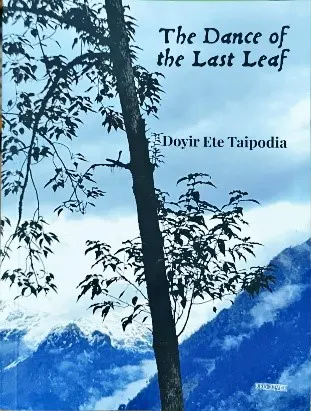
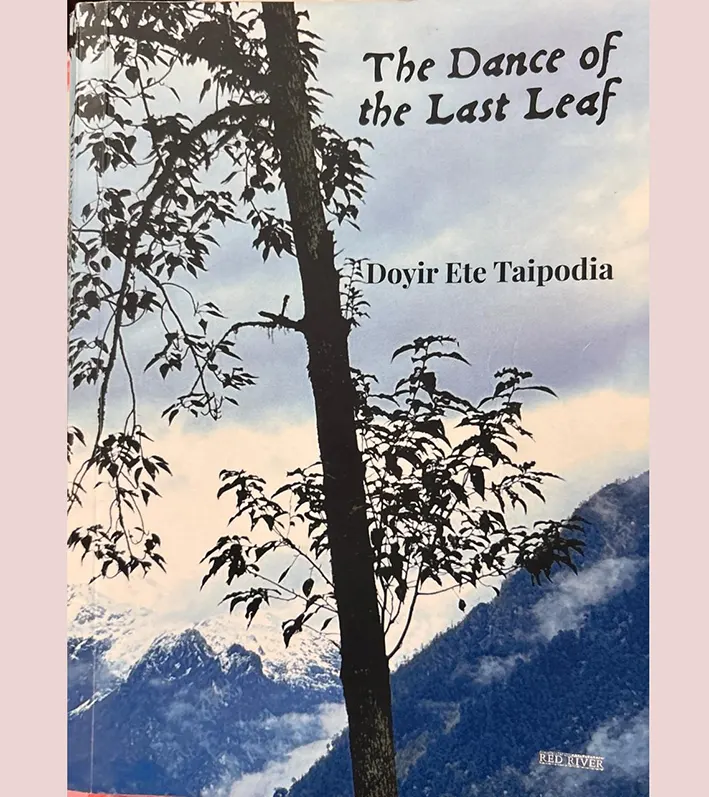
Doyir Ete Taipodia opens her debut collection, The Last Leaf with the poem ‘Lost Words’, which challenges this position by exposing how a tribal society is often seen as lacking by the literate culture which tends to question the authenticity of oral traditions and recognises only written records.
She begins by stating that “Our oralities are dismissed as hearsay,” mainly because of the lack of evidence in the form of a script. In the footnote to the poem, she explains that in Galo tribe, the written script is called Boi Bola. She provides a gist of the folk memory of how Abo Tani, the progenitor of the Tani tribes of Arunachal Pradesh, in a tragicomedy situation, eats the dried animal-skin, which consisted the knowledge of script, out of hunger or by mistake. According to the folk belief, the gift of script was given to Abo Tani by a benevolent spirit. She emphasises on how the indigenous communities, marked by the absence of their script, are forced to defend their history through their memories and stories.
From the western model of archaeological studies, the lack of script can be interpreted as no material evidence, but from the indigenous perspective, the fact that the story of the lost script exist is an evident of cultural artefact. This poem raises a pertinent question that does not ask as to where the script is but why the story about the script has survived. Like Conibear, Doyir Ete highlights the significant role played by the elders and shamans in forwarding the cultural knowledge across generations. It is to be noted that the poem does not really attempt to prove the physical existence of the script, but it draws attention towards the cultural anxiety created by the marginalisation and dismissal of indigenous knowledge due to the absence of the same. The poem evidently reflects on the two types of preservation, viz, the scribal culture of the historians and the oral culture of the community, and emphasises on how the latter is evidence of the resilience of indigenous memory and epistemology.
The title poem, ‘Last Leaf’ is a reflective appropriation of O Henry’s popular story but can be reimagined within the narrative of indigenous framework. On the surface level, it seems like a metaphorical meditation on loss, emotional devastation and the fragility of human relationship. But it makes a compelling reading when it is situated within the contemporary socio-political context marked by the division because of the ongoing debate surrounding the APFRA (Arunachal Pradesh Freedom of Religious Act) in Arunachal.
In popular sentiments, usually trees are used as symbols for a community’s connection to its roots. The expression used for the roots to describe the emotional state of the speaker represents a sense of pain where her death can also be read as a metaphor for the numbness that comes with the severing of the sense of belonging, cultural intimacy and the resultant loss of memory. The roots may also symbolise contemporary indigenous youths who are alive and yet deprived. It is in this line – “You survived but could not thrive on a foreign soil, uprooted by a gust of ill-timed prayer, like a promise that lovers make so untrue, yet so tender ” – that she voices her angst regarding the condition of the roots that are parched as a result of the absence of the native soil, which represents home and culture.
The “foreign soil” can literally be related to the act of migration or it can be understood metaphorically, as an act of assimilating into dominant cultures. The phrase “ill-timed prayer” is in fact interesting for it suggests, along with multiple interpretations, the possibility of the gradual rupture in the society that was brought apparently by forces that appeared benevolent or necessary like modernisation, education or conversion. Through this poem, she laments the consequential alienation from the ancestral ways of living through which men shared common kinship with nature. She might not have outrightly condemned these changes, some of which must have also been inevitable, but she acknowledges their sincerity and complexity at the same time.
Subsequently, the poet voices her anxiety as she witnesses the transformation of her society in the poem, ‘Crossroad’, where she addresses how generations of inherited culture have been relinquished by her people for Sunday masses and prayer beads. She attempts to negotiate the tension between indigenous belief system and Christianity in her ‘Native Tongue’. She does not simplify this difference in plain binaries. One can also notice that she does not outrightly criticise Christianity, as mentioned above, but she highlights the paradox of conversion, which according to her, is creating a new kind of a community that displaces the ancestral traditions. She also uses the indigenous terms like nyibo, dere, Tango, Jesse Kore, Kipu, and bipuin the poem with the intention of projecting the idea of how native tongues are repositories of memory and cultural continuity. While the message in the poem is loud and clear, it seems to give away its lyrical quality occasionally to cultural documentation. Maybe this is intentional on the part of the poet, but this hinders the realisation of a sustained poetic experience.
Another poem with the same thematic concern is ‘Past’, where the poet states bluntly that before the fraction was caused in her community by Christianity, her people shared the same origin. She alludes to the indigenous cosmology, according to which everything has originated from a cosmic womb. This cultural vision is powerful as it suggests that everyone was united until Christian concepts and binaries like ‘heaven-hell’, ‘blessed-condemned’, ‘believers-non-believers’, and ‘blessings-curses’ broke the primordial unity. Thus, the poem reflects on the cultural conflict that our state is facing now.
There are many interesting poems in this collection,such as ‘The Youngest’, based on a Galo folktale about a conjugal relationship between a girl and a python; ‘Our Journey’, that talks about ‘Golo-Yorbo’, the ancestral place of origin according to the Galos and ‘Gomku’, which is an archaic language used only by the priests. While most poems in the collection, such as ‘Yearning’, ‘Shaman’, ‘Ai Agam’, ‘Mopin’, ‘Amin’, and ‘Igi’ describe the traditional and cultural practices of the Galo tribe, viz, marriage, shamanism, festival, food habit and the tribal way of life; the poem ‘December’ localises Christianity in the City of Bricks, viz, Itanagar. It is to be noted that the approach of the poet in most poems set in contemporary times is observational. This poem is also not different and there are lots of visual images like ‘gold stars’ and ‘twinkling faith’ that serve both as religious symbols and the economic status of the houses of the Christian people living in Itanagar.
The poet observes that faith seems to transcend economic inequality in the capital city as Christmasstars hang brightly even from the roof of humble houses too. She also acknowledges that Christianity is no longer foreign to the natives as the procession of the locals singing carol represents how this religion is not exactly replacing but inhabiting the indigenous space. Rainer Maria Rilke in his ‘Letters to a Young Poet’ explains that a poet’s imagination can find art even in the most ordinary experiences. The poem ‘December’ is basically an ordinary observation but it succeeds in transforming a familiar moment into an evocative reflection on identity and cultural change.
Apart from poems dealing with cultural conflicts as the main subject, there are interesting poems on diverse subjects, such as ‘Squirrel’ that reflects on cultural tension caused by the tradition of hunting among the tribals despite the legal bans. This poem is elegiac and it laments for the vanishing wildlife. It is actually a beautiful recounting of an ephemeral encounter that makes the poet ponder over the subject of irreversible loss with the death of the Tibetan flying squirrel. One of my favourites in the collection is ‘Lady of the Meat Stall’, which presents the harsh working condition of a meat-seller, with a powerful image of her chopping meat while breast-feeding her baby at the same time. This image suggests the survival, resilience and tough life of a working class woman. The emotional potentiality of this poem is very high, but it remains unrealised mainly because of the poet’s position as an observer who predominantly records moments and that prevents her from being deeply reflective. However, it is also to be noted that the choice of words like ‘tousled stall’ for an ‘untidy stall’ and expressions like ‘prodding like scalpels’ to describe the staring eyes of the butcheress present the different positions of the two women. The poet observes from a position of privilege and the meat-seller becomes an object of emphatic speculation as she remains a passive character without any discernible voice.
Another poem worth mentioning is ‘City of Bricks’, where the poet, instead of monuments, statues or official buildings, opts for everyday eateries as contemporary landmarks of the capital city, Itanagar. This approach represents a people-centred view of the city. The poem contrasts between the new eateries, representing changing social patterns against the dead-old clock-tower and the squalid market area. Usually, a clock-tower stands as a heartbeat of the town, but in this case, it represents lost relevance of the temporal rhythm of the town. Ironically, the tower that the poem is referring to has been non-functional since the day of its inception. Isn’t it interesting? Then, there is a poem, ‘Old Villages’, the title of which is deceptively simple but the content is actually powerful. It talks about migration, depopulation, modernisation and the changes that are happening in the villages. The images of the abandoned jhum fields, baskets of homegrown produce, an unopened mobile phone, and the lingering routines of the old represent the discontinuity of intergenerational transition.
In conclusion, it would be right to claim that Doyir Ete Taipodia’s The Dance of the Last Leaf is an important contribution to Arunachali poetry. Her poems explore varied themes that include indigenous cosmology, memory, religious transformation and everyday life. Her voice is distinctive mainly because of her commitment to preserving and presenting the lived experiences of her people, but sometimes that tendency to document competes with the lyrical aspects of poetry, thereby hindering the realisation of the poems’ full poetic potentialities. (Dr Bompi Riba is an assistant professor in the English department of RGU. She is also a member of the APLS and Din Din Club)