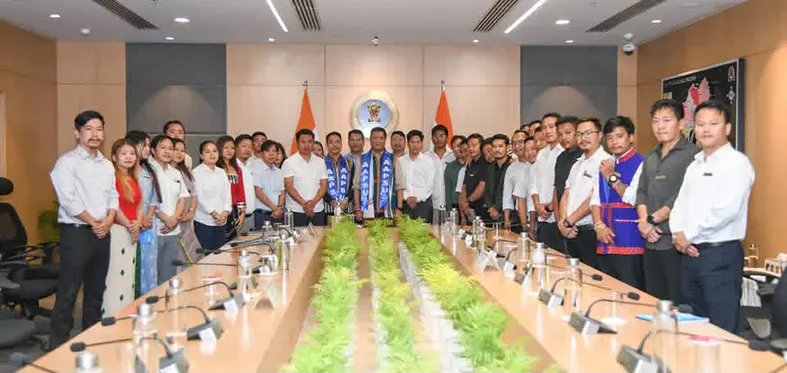

ITANAGAR, 1 Jun: The All Arunachal Pradesh Students’ Union (AAPSU) has firmly rejected the position taken by Assam-based Takam Mising Porin Kebang (TMPK), opposing the application of the Inner Line Permit (ILP) system to the Mising community in Arunachal, asserting that the ILP is a non-negotiable constitutional and legal safeguard that applies uniformly to all non-Arunachal Pradesh Scheduled Tribe (non-APST) individuals, without exception.
AAPSU president Meje Taku, in response to the TMPK’s statement, said the union holds deep regard for the Mising community’s historical association with the region and acknowledges the genuine bonds they share with several tribes in Arunachal. However, he said, those bonds cannot be the basis for exemption from a legal framework that exists to protect the indigenous peoples of the state.
“The Inner Line Permit system is not a matter of sentiment or community preference – it is a constitutional and statutory protection guaranteed to the indigenous peoples of Arunachal Pradesh. No community, regardless of its historical ties or ethnolinguistic affinities, can claim exemption from a rule that applies equally to all non-APST persons entering and residing in this state. AAPSU’s position is unambiguous: ILP is mandatory for all non-APST, and this is final,” said Taku.
AAPSU underscored that the ILP system in Arunachal is not an arbitrary administrative instrument but is rooted in a robust framework of constitutional and statutory protections. The Bengal Eastern Frontier Regulation, 1873, under which the ILP derives its authority, was retained and strengthened precisely to protect the indigenous character of the state. Article 371(H) of the Constitution of India further confers special responsibilities upon the governor of Arunachal with respect to law and order, reinforcing the state’s unique constitutional status. “Together, these provisions form an architecture of protection that AAPSU considers sacrosanct and indivisible,” the union said.
While the TMPK has cited the Mising community’s ethnolinguistic proximity to tribes such as the Nyishi, Adi, Galo, Apatani, and Tagin, and their historical presence in districts including East Siang, Lower Siang, Namsai, and Papum Pare, the AAPSU drew a careful distinction between historical presence and legal status.
“We do not deny the historical and cultural bonds between the Mising people and the tribes of Arunachal Pradesh. These bonds are real and they deserve acknowledgement. But historical affinity is not a legal category. The ILP framework is clear: if you are not an APST, you require an Inner Line Permit to enter and reside in this state. This is the law,” Taku said.
Taku also appealed to all individuals and organisations – particularly certain sections within both the states who have been speaking on the matter in ways that risk inflaming public sentiment – to exercise restraint and responsibility in their public utterances. “While healthy democratic debate on issues of identity and rights is welcome, we caution that insensitive and inflammatory speech on matters as delicate as community relations can disturb the peace and harmony that the people of Arunachal Pradesh, including our Mising neighbours, have long shared. We appeal to all stakeholders to speak with sensitivity, with awareness of ground realities, and with full consciousness that words spoken carelessly in public spaces can wound communities and fracture bonds that have taken generations to build,” he said.
The AAPSU also cautioned that granting ILP exemptions to any community on the basis of historical and ethnolinguistic arguments would set a dangerous precedent, given that multiple communities across the Northeast share cross-border ethnic and cultural ties with the tribes of Arunachal. “If historical ties become the criterion for ILP exemption, then the entire purpose of the permit system collapses. We cannot allow a precedent that unravels a protection that has stood for over 150 years and that every tribe of this state depends upon,” Taku said.
The AAPSU reaffirmed that its position carries no animosity towards the Mising community, which, the AAPSU said, it regards as a proud indigenous people with a rich cultural heritage of their own. The union expressed hope that the TMPK and all stakeholders concerned would engage constructively within the existing legal framework, rather than seeking exemptions that the law does not provide for.
The AAPSU simultaneously urged the Government of Arunachal Pradesh to ensure that ILP enforcement remains robust, impartial, and uniformly applied across all districts of the state.