
Efficacy of Protest Movements
By Dhurjati Mukherjee
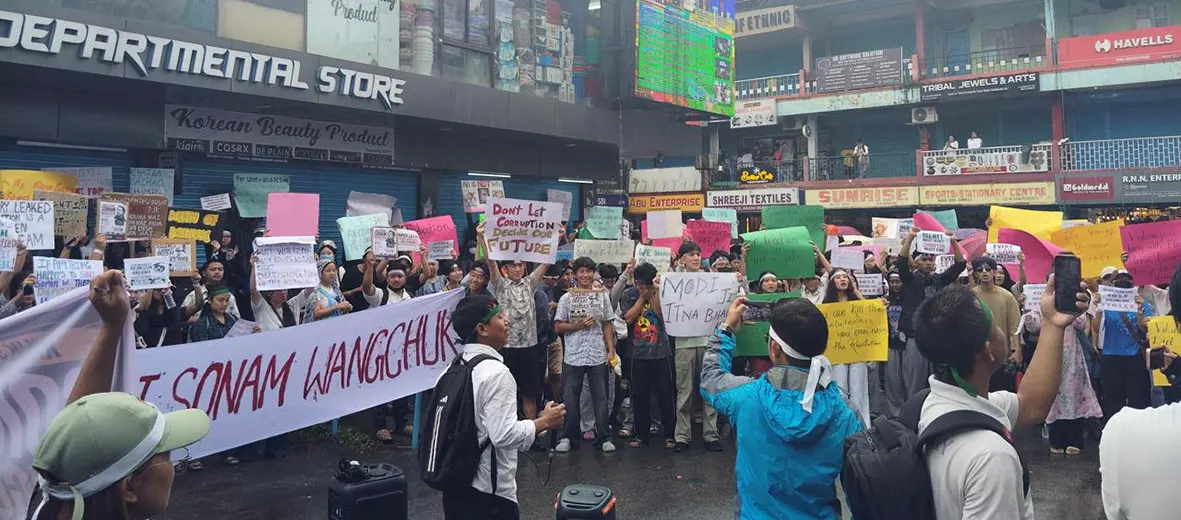
The ongoing movement by the Cockroach Janata Party (CJP), culminating in Monday’s ‘Chalo Sansad’ (march to Parliament), is in some repeats a sequel to the Anna Hazare movement that gripped the country’s capital, Delhi in 2011. While the CJP has mobilised the youth by demanding accountability and sweeping reforms following the NEET examination leak, Anna’s Jan Lokpal Andolan was a non-violent mass movement against corruption, seeking an independent Lokpal to investigate corruption in public life. It was rooted in Gandhian satyagraha.
The State’s response to public protests has, however, remained largely detached and dismissive. This pattern has been evident across major agitations—from demonetisation and the anti-CAA protests to the farmers’ movement and the wrestlers’ protests. Successive governments have shown little inclination to engage meaningfully with protesters or address their concerns through dialogue. Invoking the hoary imagery of Gandhian satyagraha, Anna cast his campaign as a second struggle for India’s liberation against a corrupt political class.
Such a populist insurrection would have little hope or success was it not for the decisive intervention of certain social factors. Prominent civil society members including retired judges, academics and military officers lent moral credibility to the movement. Also educated middle-class youth mobilised through fledgling social media platforms to support the cause.
Delving into the problem, it’s seen that broad-based political mobilisation as a means of protest is essential for a democracy. It was Mahatma Gandhi who introduced the idea of satyagraha to make the notion of protest more meaningful and effective. Protest in the Gandhian scheme had at least three dimensions – purpose, commitment and effect. This means that protest as satyagraha must be carefully organised to assert a thoughtful demand. The Gandhian influence on forms of collective action continues to survive after independence.
Even though electoral politics emerged as the defining future of the political system in India, political parties did not give up the idea of social action. In a way, electoral action was seen merely as a tool to achieve wider transformation from a variety of ideologically vantage points. Notably, there were two crucial developments in the 70s related to protest politics. A new kind of peoples’ movement emerged in the country. The movement against displacements, Dalits and adivasis struggles for equality and dignity and the women’s movement against various forms of patriarchal dominance and exploitation redefined the nature of protest politics in a significant manner.
Around the same time, the anti-Emergency protest paved the way for a number of civil liberty organisations to emerge. Jayaprakssh Narayan’s famous movement against Indira Gandhi’s authoritarian politics was a crucial mobilisation against the State, more so because it was a non-party political formation. The politics of protest found a new meaning and dimension during this phase. Protest became a technique to demonstrate the stated objectives and larger goals of the movement in such a manner that the people could be sensitized for mobilisation purposes.
The 1990s was a watershed era. Non-governmental organisations emerged at the grassroot level which defined the nature of non-party political formulations. The NGOs did not replace the peoples’ movement rather they created and shaped an issue-based discourse in which all the stakeholders operated. Steadily the peoples’ movements lost their mobilisational capabilities. This deviation also helped organisations like the VHP to occupy the social arena completely.
Analysts have pointed out that the fundamental difference between the India of the earlier movements and that of 2026 is the ground on which political legitimacy is contested and maintained have shifted altogether. Political scandals threaten to be a destabilizing ‘crisis of legitimacy’, precisely when the actions of the ruling party are seen to violate the established normative framework of legitimate rule in the country.
Under the Modi government, the old skin of liberal developmentalism has been replaced by the more robust legitimizing ethos of Hindu nationalism. This transformation was symbolically consecrated on 24 January 2024 with the inauguration of the ram temple, which the RSS chief, Mohan Bhagat described it as India’s ‘real independence day’.
As pointed out earlier, the social and economic dimension of the protests, highlighting the life and livelihood concerns of the masses, has been lost in a new nationalism propagated on the lines of Hindutva. The merging of religion with politics has put issues of unemployment and underemployment, labour rights, farm distress, child malnutrition etc. on the backbencher, which indeed is deplorable. Genuine peoples’ grievances on socio-economic issues got sidelined as the party in power did not tolerate any resistance against the establishment. The authoritarian tendencies have continued stifling the voices of the masses against their problems, pertaining to livelihood issues and the pro-rich policies of the government Added to this, the policies and programmes of the government favouring the upper echelons of society have gone unchallenged.
The rights of the people are obviously more important than their religion and religious practices. The authoritarian tendencies have continued stifling the voices of the masses against their problems, pertaining to livelihood issues and the pro-rich policies of the government. Meanwhile, the Opposition also was not allowed to raise protests against issues like autonomy of institutions and the trend towards centralisation, stifled nature of public protest.
Gandhi wanted to involve the people at the grassroot level in the development process so their needs and demands are looked at by the State. But it cannot but be admitted that as long as Hindu nationalism constitutes the main pillar of the legitimacy of the Indian State, the negotiating space between State and society would remain lopsided.
This needs to change for any effective social movement to fructify and highlight the economic challenges facing the masses. The likes of Jayaprakash Narayan, Anna Hazare and even Baba Amte and Medha Patkar, to name a few will remain embedded in history for their spirited quest and endeavor to bring about a social transformation in line with Gandhi’s thinking. Their decentralised struggle giving primacy towards the quest for a, equitable and inclusive social order through peoples’ struggle will be emulated and discussed for years to come, not just in India but also in other countries as well.
In a democratic set-up and in a country like India, the thrust should be on people and their problems rather than on extraneous issues, which the present dispensation has been trying to promote to divert attention from socio-economic and environmental issues. It’s time the young generation takes up the mantle of gearing society through protest movements, as is presently happening with the CJP. — INFA