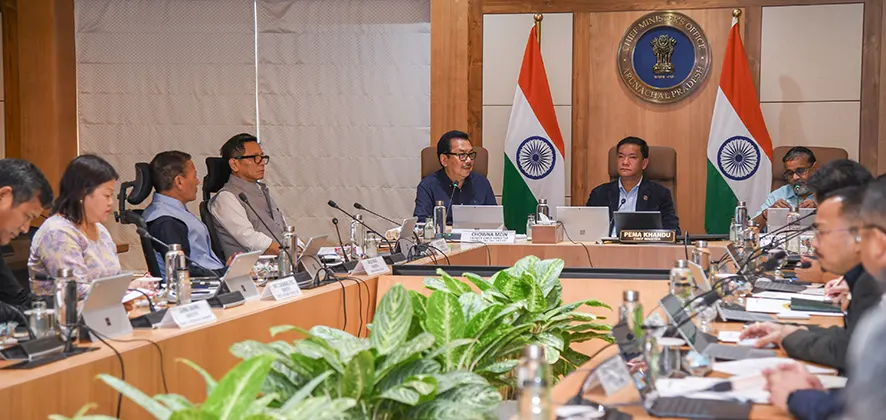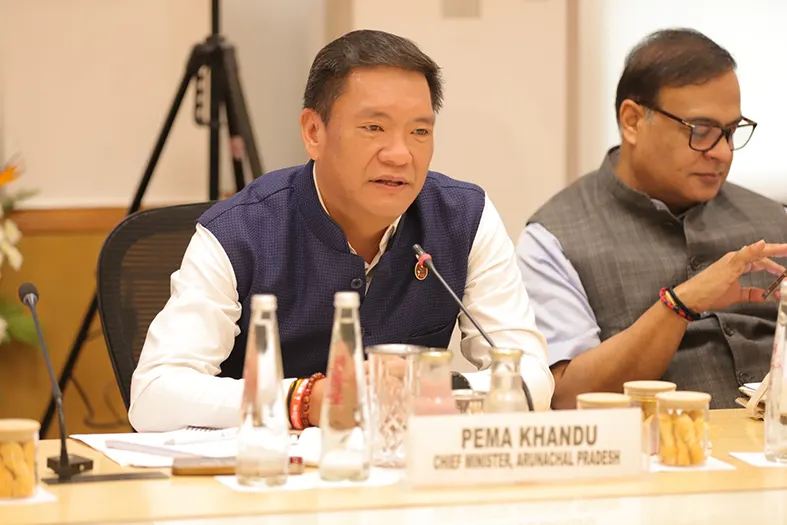
ITANAGAR, 10 Jun: Chief Minister Pema Khandu hailed Prime Minister Narendra Modi’s 12 years in office as an era of transformative governance, visionary leadership and unprecedented development that has fundamentally changed the trajectory of Arunachal Pradesh and the Northeast region.
Congratulating the prime minister on completing 12 years in continuous service, making him the longest-serving elected head of government in the history of independent India, with over 4,399 consecutive days in office, Khandu said Modi’s leadership has been defined by selfless devotion, bold reforms and an unwavering focus on citizen’s welfare and ease of living.
In a letter addressed to the prime minister, the chief minister acknowledged the sustained support, guidance and commitment extended by the government of India towards the development of the state.
Recalling the transformation witnessed since 2014, Khandu said that Arunachal Pradesh has moved from decades of strategic neglect and developmental isolation to becoming an important contributor to India’s growth story.
Highlighting the expansion of connectivity infrastructure in the state during the past 12 years, Khandu said, “Prior to 2014, Arunachal Pradesh had less than 1,000 km of national highways. Today, the state has over 4,060 km of national highways, while nearly 14,000 km of roads, including innumerable bridges, are under construction across the state.”
He also highlighted infrastructure projects like the Trans-Arunachal Highway, Frontier Highway, Sela Tunnel and Nechiphu Tunnel, saying these projects have significantly improved year-round connectivity to remote border areas while strengthening national security and economic integration.
The chief minister also cited the transformative impact of the Bogibeel bridge inaugurated by Modi in 2018, which has drastically cut travel time between Arunachal Pradesh and the rest of the country.
Highlighting advances in air connectivity, Khandu said the operationalisation of Donyi Polo Airport and expansion of flight services from airports such as Ziro, Tezu and Pasighat have brought Arunachal Pradesh into the mainstream of national connectivity.
The chief minister hailed Modi’s “Act East Policy,” which, he said, recognised Arunachal Pradesh not merely as a border state but as a strategic gateway and civilisational frontier of India. He said sharing international borders with Tibet, Bhutan and Myanmar and possessing over 1,080 km of international boundary, Arunachal Pradesh has emerged as a key pillar of India’s strategic and developmental vision.
He also welcomed the dedicated scheme announced in the Union Budget 2026-27 to develop Buddhist circuits in six Northeastern states. The chief minister said it would strengthen conservation of monasteries, promote cultural heritage and attract visitors from across India and abroad.
The chief minister said that Arunachal Pradesh has witnessed transformative progress in every sector under Modi’s leadership.
He noted that schools across the state are being upgraded through the PM SHRI programme, educational reforms are being driven by the National Education Policy, and farmers are receiving direct income support under the PM-KISAN scheme.
He said that nearly two lakh families in the state are benefiting from health insurance coverage of Rs. 5 lakh each under the Ayushman Bharat-Pradhan Mantri Jan Arogya Yojana. He also highlighted the ongoing construction of the State Cancer Hospital at Itanagar with support from the government of India.
The chief minister said under the Pradhan Mantri Awas Yojana and Swachh Bharat Mission, nearly 50,000 houses and toilets have been constructed in the state, improving living standards and ensuring dignity for thousands of families.
“Under the Jal Jeevan Mission, piped drinking water has reached 100 per cent of households, while the Saubhagya scheme has ensured electrification of all villages in the state,” Khandu said.
He also credited the Prime Minister’s focus on border development for bringing unprecedented momentum to the Vibrant Villages Programme, under which infrastructure, connectivity, banking services and livelihood opportunities are being expanded in strategically important border villages such as Kibithoo, Tuting and Zemithang.
Khandu also highlighted the growing importance of the hydropower sector under Modi’s leadership.
Referring to Arunachal Pradesh’s estimated hydropower potential of over 58,000 mw, he noted that several long-pending projects have received renewed attention and policy support.
He said the 2,000 mw Subansiri Hydroelectric Project, which had remained stalled for years, has been revived and partially commissioned, while the 2,880 mw Dibang Multipurpose Project, India’s largest hydropower project, is progressing towards completion by 2032.
Khandu further recalled that the Union Cabinet under the prime minister’s leadership approved the construction of the Tato-I, Heo and Tato-II hydroelectric projects in 2024 and subsequently approved the Kamala and Kalai-II Hydroelectric Projects in April 2026.
“Together, these five projects will generate 3.9 gw of hydropower capacity and attract investments of approximately Rs. 52,000 crore into the state,” the chief minister said.
He also appreciated Modi’s emphasis on governance reforms, transparency and ease of living.
“Initiatives such as direct benefit transfer, transparent recruitment systems, digitisation and citizen-centric governance have strengthened accountability and transformed public service delivery,” Khandu said.
Referring to the PM’s recent launch of the GST Bachat Utsav in Itanagar, Khandu described it as another milestone in the reform journey aimed at empowering citizens and improving economic participation. (CM’s PR Cell)