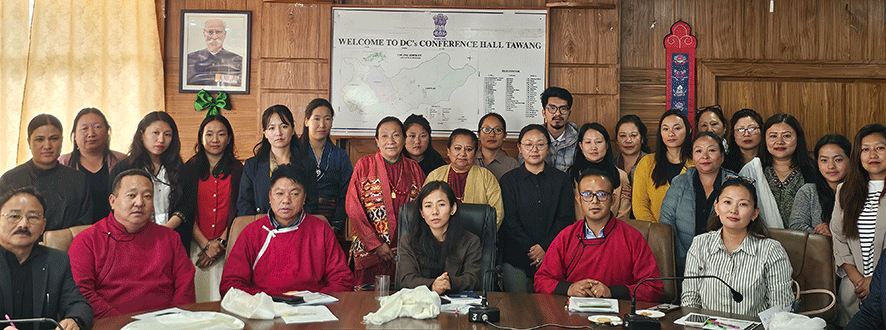
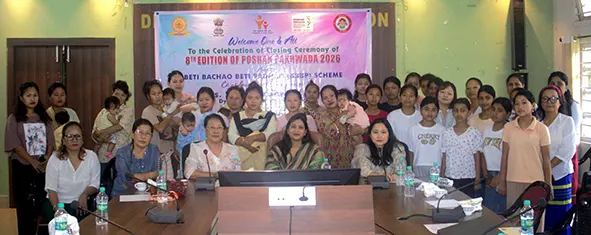
ROING, 19 Sep: A District Level Steering Committee (DLSC) meeting on the Lakhpati Didi initiative was held here in Lower Dibang Valley district on Thursday.
The meeting brought together representatives of various departments and institutions to review the progress of the initiative and strengthen convergence support for women entrepreneurs and self-help groups (SHGs).
The Roing ArSRLM district mission manager presented an overview of the Lakhpati Didi initiative, its progress in the district and the roles of the DLSC. The district currently has 411 mobilised SHGs with 3,189 members, including 1,444 identified potential lakhpati didis (PLDs) and 161 declared lakhpati didis. A total of 40 lakhpati didi CRP-EP cadres have also been deployed.
The meeting highlighted various livelihood activities being undertaken by SHG members and potential lakhpati didis, including organic ginger and turmeric processing, cold-pressed mustard oil, handloom and tailoring, vegetable aggregation, Dambuk Mandarin orange cultivation and value addition, poultry, piggery, honey and apiculture, and cultivation of temperate fruits such as kiwi, apple, plum and walnut.
Two declared lakhpati didis were felicitated during the meeting for their achievements and livelihood activities. Amme Linggi of Kebali village, associated with Bipa CLF, has diversified her income through community cadre services, including Bank Sakhi, BC Sakhi, FL-CRP and master book keeper roles, along with a petty shop and piggery unit. Her reported annual gross income is Rs 3.19 lakh, with a net income of Rs 2.21 lakh. Okoli Tayeng of Jia village, associated with Bodum PLF, has developed a dairy enterprise supplying milk to 10 families, along with organic vermicompost production and seasonal piggery. Her reported annual gross income is Rs 3.40 lakh, with a net income of Rs 2.60 lakh.
A convergence session was also held with representatives from Agriculture, Horticulture, Animal Husbandry & Veterinary, Textile & Handicraft, and Industries Department, the ARCS, NABARD and KVK. Various schemes and support mechanisms were discussed, including farm mechanisation, mushroom and honeybee units, vermicompost, livestock activities, traditional textile and handicraft support, food processing, CLF registration and working capital support, enterprise development, rural mart and rural haat, as well as technical training in poultry, piggery, vermicompost and mushroom cultivation.
The Lower Dibang Valley deputy commissioner highlighted the One District One Product (ODOP) initiative and the potential of Roing as an important market hub. Emphasis was placed on value addition, processing, branding, packaging, marketing and market linkages for local products.
The meeting concluded with a commitment from the departments concerned, DMMU, BMMUs and CLFs to facilitate eligible PLDs and SHGs in accessing relevant schemes and strengthening their livelihood activities.
In Lohit district, the first meeting of the District Level Steering Committee (DLSC) under the Lakhpati Didi initiative was held in Tezu on Friday, under the chairmanship of the deputy commissioner.
The district mission manager member secretary briefed the gathering on the formation of the committee and the vision of the initiative. A detailed overview of the Lakhpati Didi concept was presented, highlighting the goal of enabling SHG women to achieve sustainable annual household incomes exceeding Rs 1 lakh through diversified livelihood interventions.
Addressing the gathering, the deputy commissioner emphasised the significance of the initiative as a transformative step towards women-led economic empowerment. He noted that the ArSRLM's grassroots approach, working closely with community institutions, has created strong foundations for livelihood development. He urged all departments to actively collaborate and ensure effective convergence to achieve the targets.
The member secretary presented the current status of SHGs in Tezu and Wakro blocks, including data on potential lakhpati didis, targets, and the role of trained community cadres such as Bank Sakhis, Livelihood Cadres, and CRP-EPs.
Success stories of local SHG entrepreneurs were also shared, reflecting the growing impact of the initiative in the district.
Representatives from various line departments highlighted key schemes and convergence opportunities. The Agriculture Department promoted the Arunachal Bee and Honey Mission, while the Horticulture Department suggested short-duration crops, floriculture, mushroom cultivation, and vermicomposting. The Tourism Department encouraged SHG participation in homestays under schemes like Deen Dayal Swavalamban Yojana, alongside market platforms such as the Mishmi Cuisine and Culture (MC2).
Inputs were also shared by the Fisheries, Veterinary, Industries, Textile & Handicrafts, and Cooperative Departments, emphasising livelihood options such as fishery, livestock, sericulture, food processing, and dairy cooperatives.
The lead bank manager stressed the importance of financial discipline and credit linkage, while the block development office highlighted convergence through wage support under the MGNREGA for asset creation.
During the programme, two successful SHG members were felicitated as lakhpati didis - Jasem Lap from Khoraliang village for her weaving enterprise, and Ritalu Kri from Pomliang village for her food processing activities.
Zilla parishad members appreciated the progress made by the ArSRLM and highlighted the growing role of women in economic activities, urging continued focus on financial literacy and loan repayment discipline. (With DIPRO input)