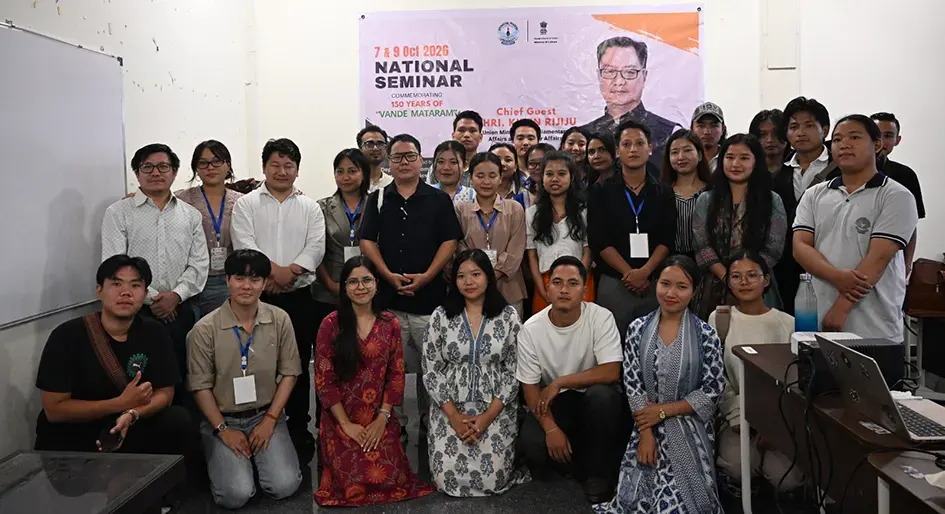
PASIGHAT, 9 Oct: The month-long celebration of Vande Mataram@150 at the Arunachal Pradesh University (APU) here in East Siang district concluded with a national seminar featuring 95 paper presentations in both online and offline mode on Thursday.
Addressing the valedictory programme, APU Vice-Chancellor Prof Ashan Riddi stressed on documentation and digitalisation as key to institutional growth, and called for decentralised and participatory administration. Prof Riddi also set a target of at least 3,000 student enrolment for the university.
Terming Union Minister Kiren Rijiju's visit to the campus a "blessing in disguise," he said the minister assessed firsthand the existing infrastructure and requirements, "which would help the university project its needs more effectively."
The 2-day national seminar organised as part of the VM150 celebrations brought together scholars, researchers and students to deliberate on issues ranging from literature and media to indigenous knowledge, technology, ecology and sustainable development.
The offline segment was held under the themes: economics, commerce, maths, agriculture & management, science, environment, health, indigenous knowledge & technology, language, literature, media, AND history & frontier narratives.
The online segment had themes on Vande Mataram, history, literature, gender & cultural memory, education, pedagogy, law, psychology & nation-building, media, journalism, AI, digital technology, frontier identity and society, ecology, economy, and tourism & sustainable development.
Delivering the offline plenary speech on 'Contemporary Poetry, Media and Nation Building' Assistant Professor Dr Arundhati from the Hindi Department of Satyawati College, University of Delhi, underlined the role of ethical, people-oriented journalism in upholding democratic values and nation-building.
Citing Hindi literary journals like Hans and Saraswati, she said periodicals have fostered social awareness and national integration by giving space to diverse voices. She noted that both contemporary poetry and journalism depend on accessible, everyday language to engage the public and promote critical reflection.