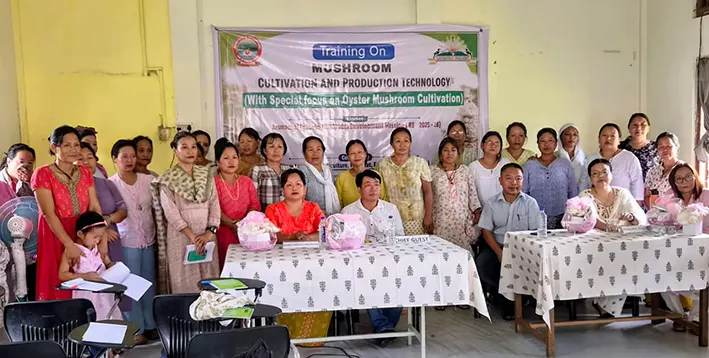

KYIDPHEL, 21 Jul: In a step towards promoting sustainable livelihoods and enhancing farmers’ income, a mushroom cultivation training programme was organised by the Horticulture Department here in Tawang district on Tuesday.
A total of 59 farmers from Kyidphel block participated in the programme, conducted under the state government’s Mushroom Mission initiative.
Addressing the participants, District Horticulture Officer (DHO) Koncho Gyatso highlighted the vision and objectives of the Mushroom Mission, and urged the farmers to sincerely adopt scientific cultivation practices. He emphasised that mushroom cultivation is a low-investment, high-return enterprise with immense potential to generate sustainable income and improve rural livelihoods.
Kyidphel Assistant Commissioner Sange Norbu encouraged the farmers to embrace modern scientific farming techniques to enhance productivity and double their income. He proposed adopting a pilot village model for mushroom cultivation, expressing confidence that the success of one village would motivate and inspire other villages across the block to adopt the initiative.
Speaking on the occasion, Kyidphel ZPM Tenzin Monpa said that government welfare initiatives can achieve their true purpose only through active public participation. He urged the farmers to make optimum use of the training and support provided by the government, adopt scientific farming methods, and “transform agriculture into a sustainable and profitable livelihood.”
The technical sessions featured practical demonstrations on oyster mushroom cultivation by DHO Gyatso, covering substrate preparation, spawning, cultivation techniques, and harvesting. Lumla BMMU block coordinator Tenzin Yangzomconducted a comprehensive session on shiitake mushroom cultivation, familiarising the participants with scientific cultivation practices and the commercial potential of the high-value crop.
To facilitate immediate adoption of the technology, the participating farmers were provided with mushroom spawn, enabling them to begin cultivation in their respective villages. (DIPRO)