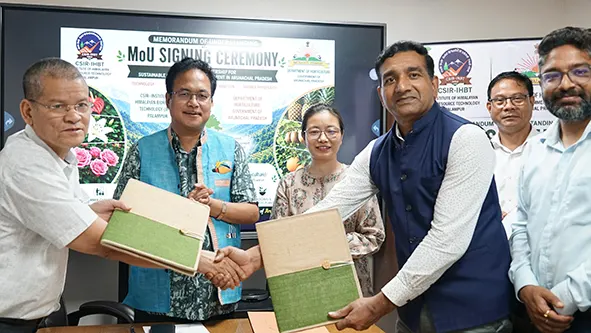

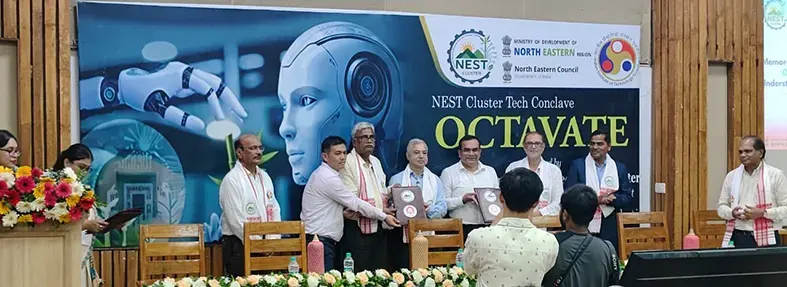
NIRJULI, 14 Aug: The North Eastern Regional Institute of Science and Technology (NERIST) and the North Eastern Science and Technology (NEST) Cluster IIT Guwahati, signed a memorandum of understanding (MoU) during OCTAVATE-Conclave 2026, held at IIT Guwahati from 10-12 August.
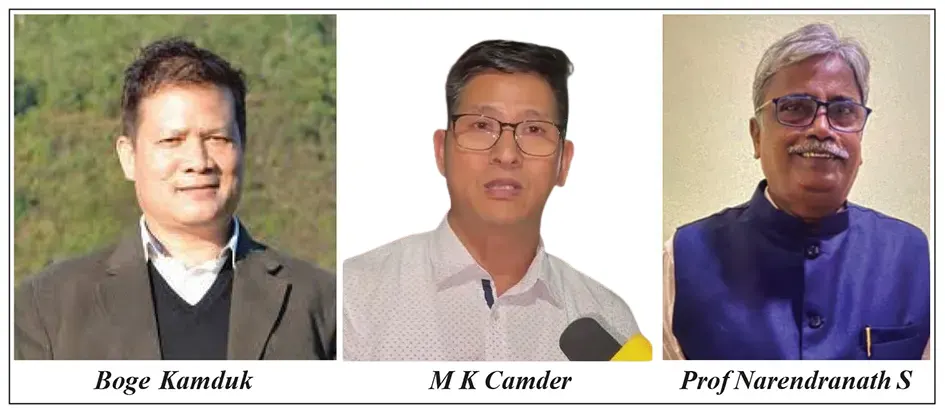
The MoU was exchanged in the presence of NERIST Director Prof Narendranath S, marking an important step towards strengthening institutional collaboration in technology, innovation, skill development, entrepreneurship and technology dissemination for the Northeastern region.
The NERIST, as one of the 16 spoke institutes of the NEST cluster, participated in the three-day conclave with a delegation comprising 10 students and two faculty members - Dr Dhiraj Kr Yadav and Dr P Devachandra Singh.
The delegation participated in the technology expo, national hackathon and innovation challenge, and poster presentation. At the expo, the NERIST showcased drone technologies, highlighting applications in agriculture, infrastructure inspection, survey and mapping, disaster management, security and surveillance, and logistics, along with 3D dental printing, demonstrating the potential for high-precision, customised and cost-effective dental appliances and prosthetics with local healthcare impact.
The showcase received the 'best expo stall award' among the participating NEST spoke institutes, marking a significant achievement for the NERIST. The students also participated in the hackathon and poster presentation, while the conclave featured technology sessions, entrepreneurship activities, policy dialogue, networking, and industry-academia-government interactions. The hackathon addressed regionally relevant challenges across grassroots technologies, semiconductors and artificial intelligence, bamboo-based technologies, entrepreneurship/skill development, and biodegradable and eco-friendly plastics.
During a panel discussion on science, technology and innovation in Northeast India, Prof Narendranath was one of the panellists. He highlighted the prevailing preference among many students for government jobs and the tendency to confine aspirations and opportunities to their native regions.
He emphasised the need to broaden this outlook by recognising the vast opportunities in entrepreneurship, innovation and technology-led enterprises. He also stressed the importance of convergence among academia, government, industry, researchers, entrepreneurs and other stakeholders towards a common goal for building a stronger regional innovation ecosystem.