[ Prem Chetry ]
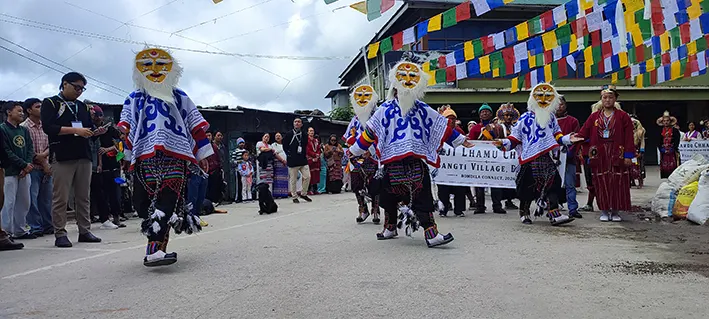
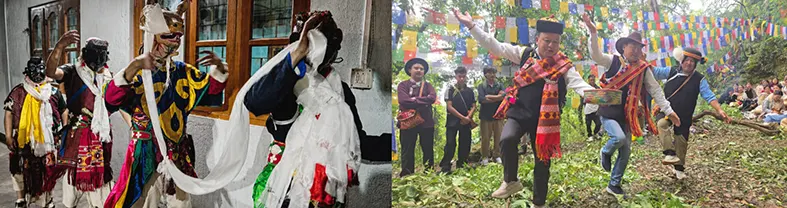
SHERGAON, 6 Jun: The traditional masked dance-drama is deeply rooted in age-old sacred custom and tradition that binds nature, spirituality, and humanity together – values that have never been swayed by modernisation.
Dorjee Khandu Thungon, executive engineer in the Department of Urban Development Agency in Bomdila and a resident of the picturesque village of Shergaon in West Kameng district, is determined to pass on this rich cultural heritage of his ancestors to the younger generation.
“Our customs and traditions must remain alive for centuries to come. We must pass on our cultural heritage to the younger generation,” he said.
Thungon himself imparts training in this traditional dance to young people, including his own son, who is a college student.
Nechin Dombo Lagang is a sacred deity shrine nestled atop a hill where people seek blessings for prosperity, wellbeing, and the birth of a son or daughter. Nechin Dombo Lagang, also known as Kro, is the place where devotees offer prayers and where the deer hunters’ masked dance begins, and concludes back in the village.
During the auspicious month of Saga Dawa, after the month-long recitation of sacred texts – Kangyur and Tengyur – on the seventeenth day of the fourth month of the Buddhist lunar calendar, devotees undertake a sacred procession to Nechin Dombo Lagang. Amid the rhythmic sounds of cymbals and drums, ritual dances, and prayers, they offer fruits and other edible offerings to the deity, symbolising the harmonious bond between spirituality and nature.
On this day, a masked dance featuring a deer, a hunter father (Apo), and his sons – Mlengchung Khaw, the elder, and Mlenching Chan, the younger- is performed in Kro, and concludes in Champu Blang, the community house in the village, on the 19th day.
The dance depicts an episode in which a deer is captured and brought before the villagers and a lama. Upon observing the deer, the lama senses that it is no ordinary animal for killing and eating.
“It possesses special powers to bless humanity. Let it go unharmed,” the lama advises the hunter. The hunter is then instructed to liberate the deer through Tsethar – a life liberation ceremony.
“You may encounter many difficulties along your journey. Hunters and other negative forces may come across your path,” the hunter cautions the deer. He then advises it to take a route passing through Nati Kho, a river, before proceeding to Janda Phow Sowthang, a small hilltop, then to Sartogombu, a larger hill or mountain, and finally to Sharphu, the highest mountain and the ultimate abode, where it will be safe and protected by the deities.
Through this deer dance, the entire episode of the life liberation ceremony and the hunter’s conversation with the deer is vividly portrayed.