Monday Musing
[ Amar Sangno ]
They say history does repeat itself. Sometimes it is not as kind as we expect it to be.
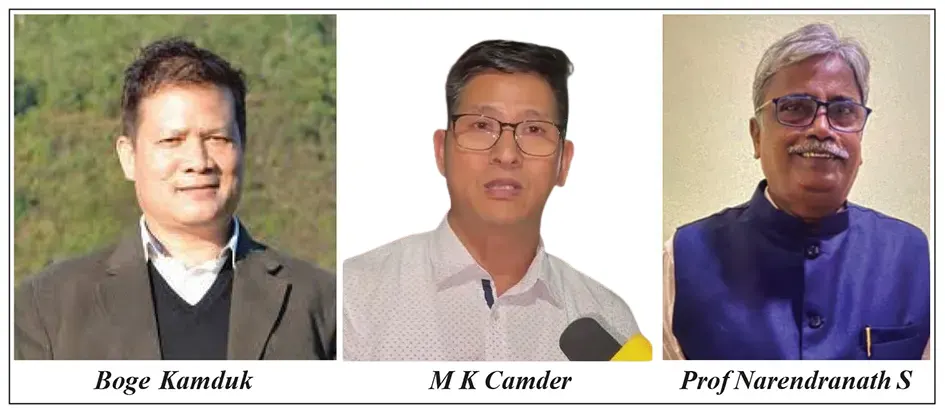
The recent episode of the forced resignation of North Eastern Regional Institute of Science and Technology (NERIST) director, Prof Narendranath S, following the suspension of two officials – registrar MK Camdir alias Mai Ranjit, and assistant registrar Doge Kamduk on 29 May – reminds one of the premier technical institute’s history of its first director, Prof PR Sengupta, who had served the NERIST for four outstanding years from 11 July, 1983 to 25 July, 1987.
Prof Sengupta’s departure from the NERIST was surrounded by controversies. It is said that he was ousted by then student unions amidst institutional politics instigated by the then dean, Prof Saxena, when he attempted to stop the growing corruption under Prof Saxena. Prof Sengupta had to resign and moved to the US, and in the following years, Prof Saxena was sacked from the job on corruption charge.
Whenever the NERIST faced institutional and administrative crisis in the past, Indian Administrative Officers (IAS) were called in to rescue the institution.
After Prof Sengupta’s unceremonious exit, two IAS officers – R Narayanaswami and SR Arya – were made director, and later, Tabom Bam also became the temporary director from 27 April, 1995 to 31 July, 1995.
The NERIST has a longstanding history of institutional politics, a quest for power and money, nepotism and manipulation, and abuse of power leading to endemic corruption. For keener eyes, its past history of institutional politics is akin to the epic HBO fantasy drama series Game of Thrones.
After Prof Sengupta, many more directors came and went. However, if we look closely at the incumbency board, most of the casualties of internal politics were efficient directors who strived to take the NERIST to newer heights of academic excellence. A glaring example is the then director, Prof Samudra D Phukan, who allegedly faced non-cooperation and systematic boycott by his own colleagues and staffers, forcing him to leave the institution. Later, he went on to become chairman of the North Eastern Council.
Coming back to the episode of Prof Narendranath’s forced resignation, it allegedly has a direct link to the suspension of Camdir and Kamduk, who were suspended in connection with alleged irregularities and manipulation of the recruitment rules of 2022 for non-teaching staffers of the institute.
“The controversy surrounding the new director’s alleged forced resignation did not emerge overnight. It began after the SUN issued an ultimatum, following which the director, with support from the ministry, initiated stringent action,” said Banta Natung, a research scholar and former SUN president.
“In the process, alleged irregularities linked to registrar MK Camdir surfaced. Many directors before him remained silent or avoided confrontation, and those who tried to take firm action reportedly faced pressure that ultimately led to their premature exit from the institution,” he added.
Many alumni believe that crisis and corruption made inroads into the NERIST long ago. However, it has worsened ever since the locals (Arunachalis) got into administration.
It is quite evident that the local officers started using student unions for their vested interests, putting the institution’s interests at stake. This culture has affected the NERIST a great deal, as the institute was without a regular director from 2014 to 2018. The representation submitted by the SUN on 17 November, 2025 had highlighted the NERIST’s current plight, which needs urgent attention from both the Centre and the state.
Academic institutions often experience significant decline or damage due to internal politics, factionalism, corruption, mismanagement, and related issues. Many prestigious universities across the world have experienced this already. The NERIST is facing a similar fate, caught in the crossfire of internal politics. The onus is on the state and the Centre to bring reforms in the institution, or let internal politics, like parasites, permeate the NERIST and eat away at its academic environment.