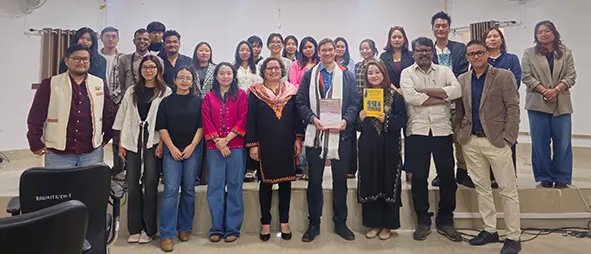
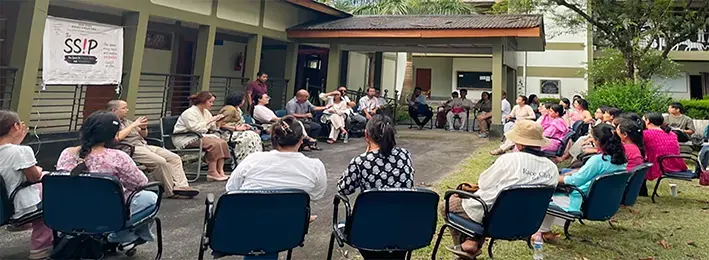
RONO HILLS, 24 Aug: The Social Science Research Scholars' Forum (SSRSF) under the faculty of social science (FSS) of Rajiv Gandhi University (RGU) hosted the second session of its informal discussion series, 'SS!P (Space for Sharing Ideas and Perspectives)', on 21 August at the lawn area of the Arunachal Institute of Tribal Studies (AITS), RGU.
The session, titled 'Between Linguistic Diversity and Linguistic Homogenisation: Language, Script, and Tribal Identity in Contemporary Arunachal Pradesh', drew enthusiastic participation of faculty members, research scholars, and students across disciplines.
The session was led by AITS Assistant Professor Dr Lisa Lomdak, whose research focuses on field linguistics, endangered language documentation, and tribal language pedagogy in Arunachal. She was joined in the discussion by AITS Assistant Professor Dr Wanglit Mongchan, Prof Sara Hilaly from the history department, Dr Nani Umie from the sociology department, Dr David Pertin, Dr Tarun Mene, Dr Kakali Goswami, and several other faculty members from across disciplines.
The discussion opened with making a nuanced distinction between language and dialect and why one should be cautious of labelling their mother tongue as dialect or language. Mother tongues spoken by the tribes of Arunachal are fully developed systems with complex grammatical structures, which are of much interest to the world of linguistic studies. Citing recent linguistic studies carried out by renowned linguists from across the world interested in Trans-Himalayan (Tibeto Burman/Sino Tibetan) languages, a brief mapping of the state's major linguistic groups was done, ie, Tani, Mishmic, Hrusso, Tai-Kadai, Kho-Bwa, Bodish, Lolo-Burmese, Sal language groups, and endangered ethno linguistic groups.
Dr Lomdak also addressed the critical dilemma of linguistic homogenisation, arguing that while a common language is thought to offer practical unity, its adoption risks accelerating the endangerment of already fragile tribal languages and linguistic diversity.
Speaking on the transition of tribal languages from orality to written over the last century, several examples of community organisation-based script development process and its deep connection to tribal identity were discussed at length.
Out of the 14 mother tongues introduced in the school education system as third language, major groups have adopted Latin (Roman) scripts, while the Wancho and Tangsa communities were described as examples of communities restoring tribal identity through a unique script development.
A brief note on state-imposed script systems and resistance by tribal communities were also highlighted.
Participants shared personal experiences of how language shapes cognitive expression and cultural identity across generations, sparking candid and lively exchanges between the floor and the resource persons.
The discussion concluded on a resonant note: that language is not merely a tool of communication but a gateway to the knowledge, history, and cultural heritage of people, making its preservation a collective responsibility.
SSRSF president Ngayir Taji and general secretary Hage Ankha informed the audience that the forum would endeavour to conduct SS!P once a month, with the aim of fostering engaging, enriching, and critically stimulating discussion within the FSS and the RGU campus as a whole.