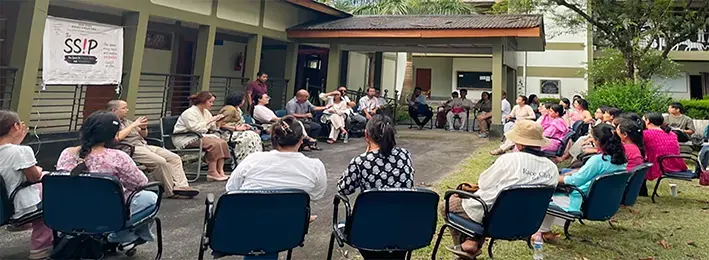
RONO HILLS, 26 Sep: The Social Science Research Scholars' Forum (SSRSF) of Rajiv Gandhi University (RGU) hosted the third session of its informal discussion series, 'SS!P (Space for Sharing Ideas and Perspectives)' on the lawn area of RGU's Arunachal Institute of Tribal Studies on Friday.
The session, titled 'Rethinking Insurgency and Counter-Insurgency in the Northeast: The Growing Tentacles of Insurgency in TCL, Arunachal Pradesh', brought together faculty members, research scholars, and students from various disciplines.
The session was led by RGU's National Security Studies HoD Dr Suaihiampou Kamei. Drawing on his expertise in insurgency and counter-insurgency in the post-AFSPA period, Dr Kamei offered critical perspectives on the nature of armed insurgency in the Northeast, with particular focus on the Tirap, Changlang and Longding (TCL) region of Arunachal Pradesh.
The speaker began by discussing the emergence of insurgency in the Naga Hills, identifying ethnic diversity, historical, geographical and political isolation, economic backwardness, porous borders, and the role of external elements as some of the key factors contributing to the emergence and persistence of insurgency in the region.
Speaking on the presence of multiple factions of insurgent organisations, including the NSCN, in the TCL region, Dr Kamei described the area as a transit route. He further highlighted the emergence of indigenous insurgent outfits in recent years, pointing to a new dimension of insurgency in the state.
The speaker also spoke on the principal counter-insurgency approaches historically adopted by the government, including the proportionate use of force, peace and negotiation, and structural changes.
Emphasising the continued presence of insurgent elements in the Northeast, Dr Kamei underscored the importance of understanding the nature and dynamics of conflict, particularly in an ethnically diverse region. He also stressed the role of counter-propaganda as a mechanism available to the state in addressing insurgency and countering narratives associated with extreme forms of ethnic nationalism.
Dr Kamei further highlighted the dual dynamics of counter-insurgency measures, such as the Armed Forces (Special Powers) Act (AFSPA) and their implications for civilian populations.
He stressed that the fight against insurgency should be viewed as a national concern, given its potential to adversely affect the socioeconomic and political stability of the Northeast.
The discussion concluded with active participation of faculty members, research scholars, and students. Participants shared their insights, personal experiences, and observations on the issue of insurgency and counter-insurgency in the region.