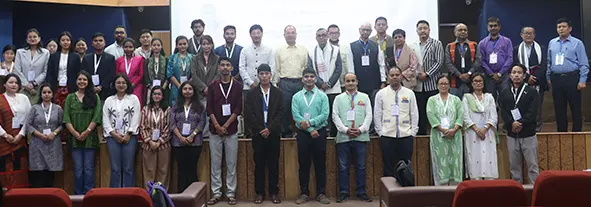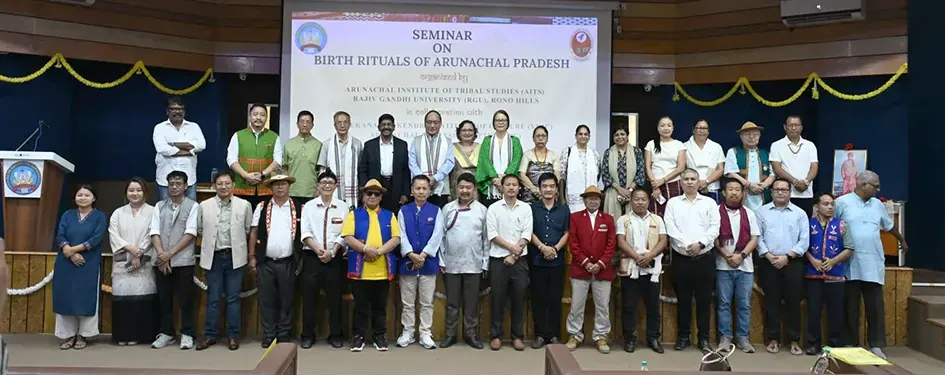
RONO HILLS, 29 Sep: A seminar on 'Birth Rituals of Arunachal Pradesh' was organised at Rajiv Gandhi University (RGU) here, with focus on community-led documentation and preservation of the state's diverse cultural practices.
The seminar was organised by the Arunachal Institute of Tribal Studies (AITS), RGU, in collaboration with the Vivekananda Kendra Institute of Culture (VKIC), Arunachal chapter.
In her address, AITS Director Prof Jumyir Basar said the seminar featured presentations by community members who may not have formal training in research but possess extensive knowledge of their cultural traditions and offer important "emic" perspectives.
She said such knowledge should not be viewed merely as ethnographic material but recognised as living intellectual and cultural heritage.
RGU Vice-Chancellor Prof Shivaraj appreciated the organisers for highlighting an important aspect of Arunachal Pradesh' heritage. He said that the birth of a child is not merely a family event but one that brings the wider community together.
Prof Shivaraj stressed that communities should be encouraged to explain their practices in their own words, and urged researchers to look beyond the sequence of rituals to understand their meanings and significance. He also called for giving elders and women a central role in documenting birth-related traditions.
He observed that education, migration and improved access to healthcare are bringing changes in the way families observe traditional birth rituals. At the same time, he said, communities should decide how their knowledge is carried forward while ensuring the wellbeing of mothers and children.
The vice-chancellor also emphasised the need to document local terminology, oral accounts and variations in practices among different communities, with the consent of knowledge holders and due acknowledgement.
In his keynote address, VKIC NE-Guwahati chairman Dr Joram Begi underlined the urgency of documenting and preserving the tribal cultures of Arunachal, particularly in the absence of written scriptures in many indigenous traditions.
He said that the VKIC follows a community-based participatory research approach similar to that of the AITS, involving communities through seminars and consultations before publishing its findings. He said birth rituals were selected as the focus of the seminar as the subject has received comparatively little attention.
Speaking on the Nyishi community, Dr Begi highlighted the taboos observed by both the father and mother before, during and after childbirth, as well as practices associated with establishing the child's identity and ownership immediately after birth.
He also dismissed claims that the namlos of the Tani tribes are based on borrowed cultural practices, pointing to the thread-tying ritual associated with childbirth as a tradition followed for generations.
Dr Begi also recalled that the AITS was established around three decades ago under the Arunachal University Act with the mandate of promoting cultural studies in the state.
A total of 17 papers covering different communities of Arunachal were presented during the seminar. The presentations explored themes ranging from beliefs concerning the creation of the universe to birth rituals in contemporary times, tracing both continuity and changes in traditional practices.