Siang Upper Multipurpose Project
Ringside View
[ Tongam Rina ]
Border communities, because of their geographical location, have to sacrifice much more than the rest of the country. Their land is becoming inaccessible to them because it has become a boundary between nations.
The mountains and rivers that sustain border communities can become their burden. These populations risk becoming mere tools, rather than living people - treated as geopolitical collateral. Sometimes, what is right for the nation, its interests, and its security may not necessarily be what the communities living in its borderlands want. This contradiction is often overlooked or misunderstood by decision-makers who act on their behalf without their consent. They do not necessarily understand the deep relationship that indigenous people have with their land and rivers.
Why is an indigenous community willing to sacrifice everything for the sake of their river?
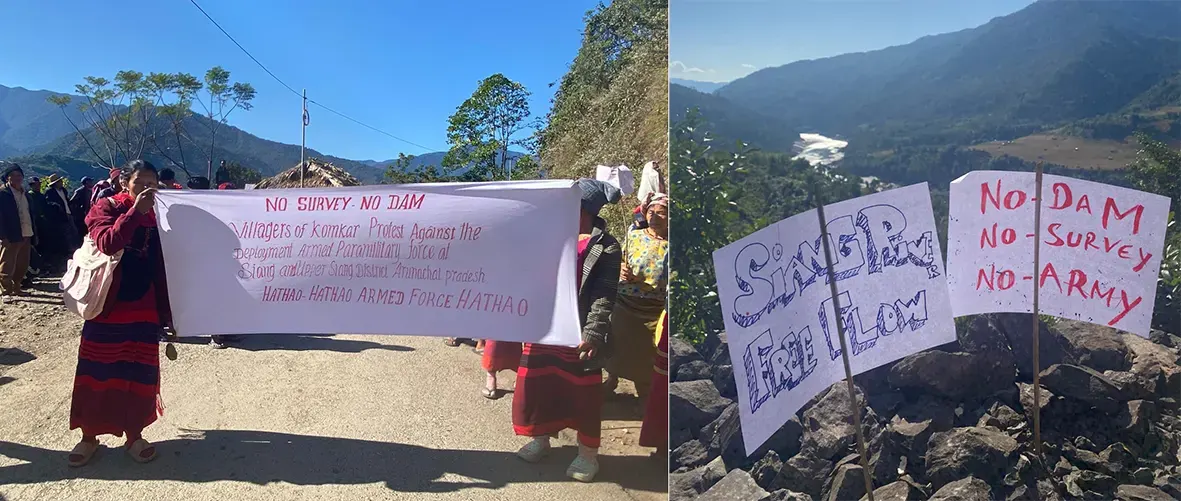
An ideal example would be the recent violence in Siang that has left ugly scenes of state violence and telltale signs of state oppression, using militarisation to spread panic, fear, and physical violence in equal measure as people continue to resist the state's plan to dam the Siang River.
The government has been extremely provocative and violent in the face of the intensifying opposition to the massive Siang Upper Multipurpose Project (SUMP), estimated to be a planned capacity between 11,000 MW to 12,500 MW. People have been protesting peacefully against the pre-feasibility report study through rallies, meetings, and guarding their land, more so in the last four years in the face of the state's aggressive plans. But now, government provocation is such that the villagers are forced to respond to violence with resistance. If someone enters a village forcefully, without the will and permission of the people, it is up to the people to guard their village. Faced with such humiliation, disrespect, and disregard, with the government daring people to be violent, one must give it to the people for holding it back for so long.
The government need not force the people to choose violence, but it is what the government wants, so that they can fully utilise their violent force to gain entry into their villages and the river.
The chief minister may not have witnessed how men, women, and young people took to the streets in Yingkiong, waving Indian flags and forcing him and his colleagues to retreat into a safe corner during his recent ill-advised visit to the area. He was compelled to confine himself to the guesthouse of a government construction agency, instead of meeting the public. Such humiliation is hard to accept for a chief minister, and losing face is indeed difficult for anyone, let alone a leader. However, an ambitious politician needs a magnanimous heart and an open mind to accept reality as it is.
At this point, how is the government going to handle more confrontations? It cannot afford to.
Engaging in dialogue with the Siang Indigenous Farmers Forum (SIFF) is critical because the elected representatives of Siang no longer truly represent the people. Although citizens voted for them to voice their firm opposition to the SUMP before the government, these representatives have betrayed the public's trust. Instead, they are prioritising their own interests alongside the agendas of Prime Minister Narendra Modi and Chief Minister Pema Khandu.
Talking to them will not yield any decent outcome, but talking to the SIFF will help the government understand why people are opposed and what will be the future course of action.
The government has said the PFR is just a study and whether to build the dam or not will be decided later. Why are the chief minister and the government contradicting themselves if it's just a study? People don't want it; don't do it if it's just a study. Why bring in forces against the people and weave the narrative of protecting national interest if it's just a study? Why waste money and time for it if it's just a study? Most of all, why militarise and terrorise the communities?
It is not just a study, and the people know it. The people know that militarisation is warning the people that the government will not mind inflicting physical violence on the people, apart from the psychological violence it's currently inflicting on the people by parading armed forces in combat gear.
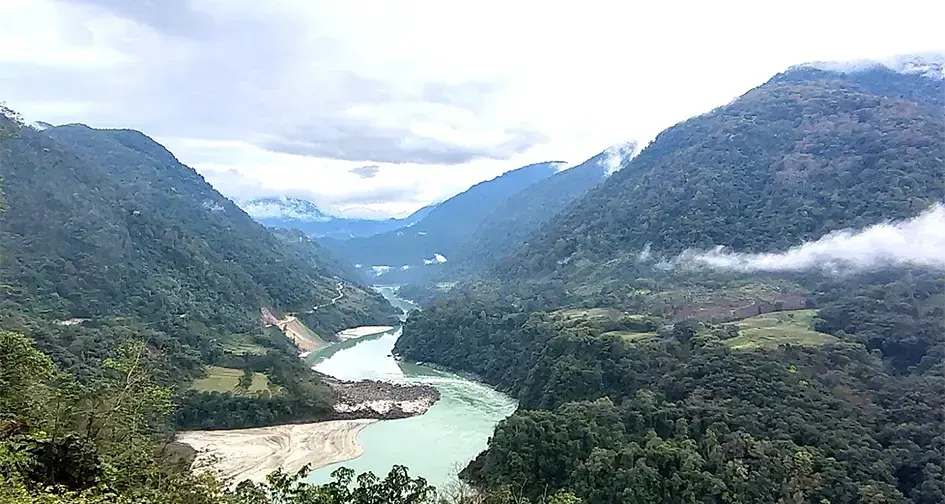
Siang has demonstrated that the state will be met with resistance because Siang isn't just a river. Adi traditional folk, as well as modern ones, refer to the Siang River as a witness to the cycles of life. Even promises are made with the Siang as their witness.
It is not difficult to understand why there is such massive resistance against state operation, which is being carried out in the name of national security to dam a river that the local people hold so dear.
Daily conversations are centred around it. It's revered, it's feared, and it's loved, and it is the anchor that gives meaning to the very existence and identity of the people, binds them together, and gives them hope.
Now, the Siang is witness to a fearless resistance that it has seen in the last four decades. For now, the Siang flows free as always, as witness to state oppression and resistance by an indigenous community.
For now, the majestic Siang continues to guard and guide its people. How long and how far it can do so, only the river will know - for it is, and always will be, their lifeline.