
[Badak Yomgam]
When Deputy Chief Minister Chowna Mein officially declared the Siang River as a premier world adventure tourism and ecotourism hub on 2 January, 2026, following an expansive promotional rafting expedition to welcome the New Year, the announcement explicitly positioned the region around a modern, community driven definition of tourism.
Rather than viewing adventure as just an isolated sport, this official designation formally incorporated the principles of ecological sustainability, biodiversity protection, and environmental preservation, while directly linking the initiative to the socio-economic empowerment of local indigenous participants and their long-term earnings through homestays, guiding, and hospitality.
This comprehensive vision sought to establish the Siang River destination as a landmark ecotourism hub, where the pristine wilderness, unique riverine ecosystems, and rich tribal heritage would be protected and celebrated as irreplaceable global assets.
The Siang River is globally recognised by professional kayakers and rafters as one of the most formidable, high volume river running destinations on Earth, carving a dramatic path through the Eastern Himalayas with roaring, untamed waters that offer unmatched Class IV to Class VI rapids.
For decades, international expeditions have travelled to this remote Northeastern corner of India to test their skills against legendary rapids such as the crushing big volume drops, the technical narrow passages, and the dauntingly remote stretches of the isolated Marmong gorge. This deep canyon ecosystem, where the river narrows between towering vertical cliffs of dense jungle, represents the absolute peak of wilderness expedition rafting, requiring elite navigation skills, precise team coordination, and immense physical endurance to survive the heavy hydraulic pressures and massive whirlpools.
The unique geography of the Siang, fed by immense glacial runoff from Tibet before it eventually forms the main stem of the Brahmaputra River in the plains of Assam, means its water volume can fluctuate dramatically, creating unpredictable, massive standing waves and deep holes that attract the world’s most daring river runners.
However, this high profile declaration by Mein in early January 2026 quickly transformed from a celebratory tourism milestone into an intense, highly complex political dilemma for the state administration. By legally and economically binding the river’s future to a dedicated ecotourism hub, community-led livelihood protection, and environmental preservation, the official glorification of the Siang’s pristine state created an immediate, inherent conflict with the government’s longstanding, aggressive push to construct the massive 11,000 megawatt Siang Upper Multipurpose Project. This proposed mega dam, slated to be India’s largest hydroelectric installation, is viewed by New Delhi and the state leadership as an indispensable strategic asset designed for major power generation, flood mitigation, and crucial water storage to counter China’s massive upstream dam building activities on the Yarlung Tsangpo.
For years, local indigenous communities along the riverbanks have mounted a determined opposition against this hydro project, organising widespread protests under unified local groups to protect their ancestral lands and cultural heritage. The protestors realised that the government’s official recognition of the Siang as a world adventure and ecotourism hub served as an incredibly powerful legal and ideological shield for their movement, allowing them to leverage the state’s own promotional rhetoric in environmental courts and public debates by pointing out the absolute conflicting policy of declaring a river an irreplaceable global heritage asset while simultaneously planning to submerge its entire ecosystem under a massive reservoir.
This structural policy clash directly exposes the fragile link between environmental conservation and human resource sustainability. For a tourism ecosystem to thrive long term, the preservation of nature’s raw biodiversity must be completely synchronised with the protection of the human capital that safeguards it. The indigenous communities are not merely passive service providers but the literal custodians of the riverine ecology, whose traditional knowledge, river tracking expertise, and community-driven hospitality form the backbone of the region’s sustainable economy.
When a government defines an area as a sustainable ecotourism hub, it explicitly links the health of the natural habitat – its forests, aquatic species, and free flowing waters – to the survival and financial security of its people, proving that true conservation cannot exist if the local populations are displaced or economically hollowed out. By treating the natural and human resources of the Siang valley as co-dependent assets, the local resistance constructed a defensive argument that was nearly impossible to break in public panels, demonstrating that drowning the valley would not just erase a rare natural landscape but would systematically eliminate the sustainable human livelihoods built around its preservation.
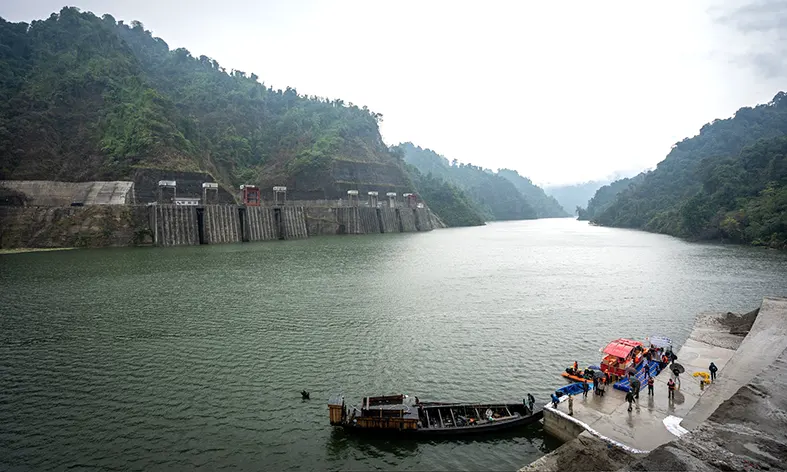
Faced with this deepening strategic dilemma, where every effort to market the Siang’s spectacular rafting, local participant earnings, and biodiversity only strengthened the legal arguments of the anti-dam protestors, the administration executed a swift strategic shift by quietly withdrawing its heavy promotional focus from the Siang and shifting the entire world adventure hub narrative to the Subansiri River instead. On the Subansiri River, the longstanding political battles over mega dams are entirely a thing of the past because the highly controversial 2,000 megawatt Subansiri Lower Hydroelectric Project is already fully constructed and operational, meaning the natural riverine landscape has already been permanently altered and the massive reservoir is already filled. By rerouting global adventure tourism investments, high-speed river safaris, luxury eco-resorts, and water sports infrastructure to the pre-existing Subansiri reservoir, the state government found a politically risk-free alternative that allows it to showcase a positive narrative of sustainable hydropower and post dam economic rehabilitation without the danger of complicating future infrastructure plans.
This tactical relocation of the adventure tourism spotlight effectively deprives the wild Siang River of large=-scale state backed development funds and downplays its pristine status in official records, gradually undermining the conservation-based defence used by the indigenous protestors who continue to stand firm against the 11,000 megawatt project in their determination to keep the historic, roaring rapids of the Siang flowing free. (The writer is a research scholar and an Incredible India tourist facilitator)