
[ Prem Chetry ]
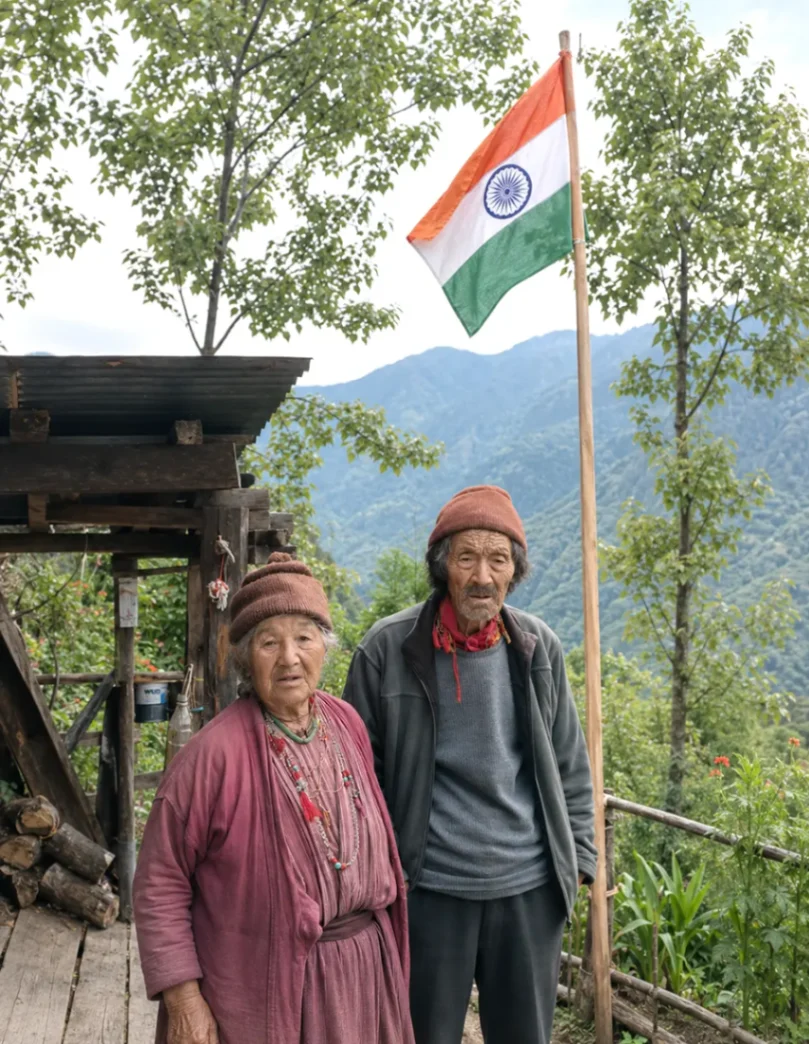
TAWANG, 14 Aug: Eighty-six-year-old Tsering Sangey of Jangda village in Tawang district has shown the true spirit of patriotism by proudly hoisting the tricolour at his home as part of the Har Ghar Tiranga campaign.
A witness to the 1962 Sino-Indian War, Sangey unfurled the national flag, inspiring citizens with his memories of the war and the difficult days he and his fellow villagers endured during the Chinese invasion of Tawang.
Emphasising the importance of freedom, Sangey recalled that when the war broke out in 1962, he was working with fellow villagers from Rho-Jangda on construction of a seven-room government building at the site where the tourist lodge in Tawang stands today.
"The sky was clear, and we could clearly hear the gunshots and the loud roar of bombardment when Chinese troops entered Tawang through Bumla," he recalled.
He said villagers had already heard reports a year earlier that Chinese troops were entering through Zemithang.
"We were frequently called back home by our parents nearly a month before the Chinese invasion through Bumla. I was 22 years old then, and around 70-80 of us were engaged in the construction work," Sangey recalled.
At that time, there were only two Indian Army camps in the area - one at Bomdir Supply and the other in Tawang. He recalled that five to six days before the invasion, rations were airdropped by helicopters.
When Chinese troops entered Tawang, Sangey and his fellow villagers rushed back to Jangda.
He also recalled an incident in which around 60 Chinese soldiers who had entered the village monastery and taken shelter there were killed by 11 Indian Army personnel after the troops were alerted and assisted by village GB Mem Nay.
For his assistance to the Army, the GB was later awarded a monthly allowance of Rs 40, Sangey said.
Fleeing the Chinese advance, Sangey, along with his family and other villagers, trekked down to West Kameng district. The journey took nearly two days, after which they stayed at Chug village for about six months.
While travelling on foot, the villagers were advised by the Indian Army to walk along existing tyre tracks to avoid possible landmines.
Following negotiations between the two countries, Sangey, his family and fellow villagers eventually returned to Jangda. They later completed the construction of the government building, for which they were paid Rs 11,000.
"It was indeed a huge sum for us in those days, and each one of us received a good share of it," Sangey said, recalling the moment with a sense of joy and pride.
Today, decades later, Sangey's devotion to hoist the tricolour carries a deeper meaning. For him, the national flag represents not only the country but also the freedom and security that generations have witnessed and fought to preserve.
He urged people to take pride in being citizens of India and stand firmly with the nation and its armed forces.
"We believe in our government and our Army. We must stand with the Army whenever the nation demands it, and be proud Indians by hoisting our national flag. Jai Hind," he said.