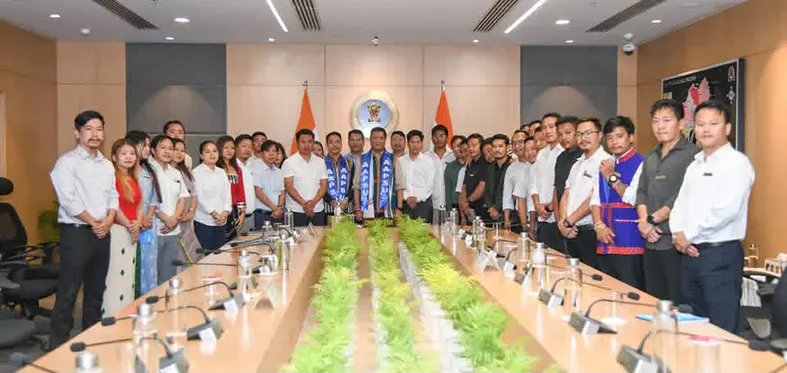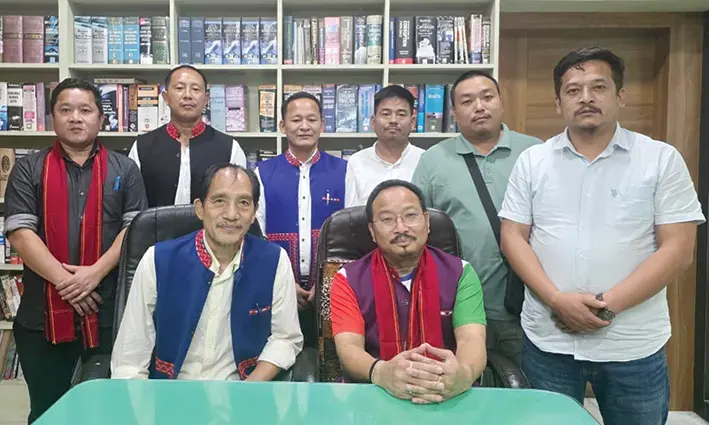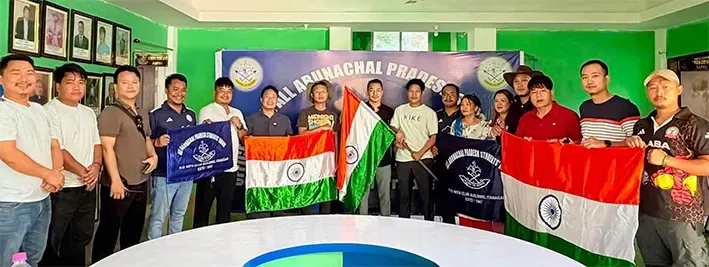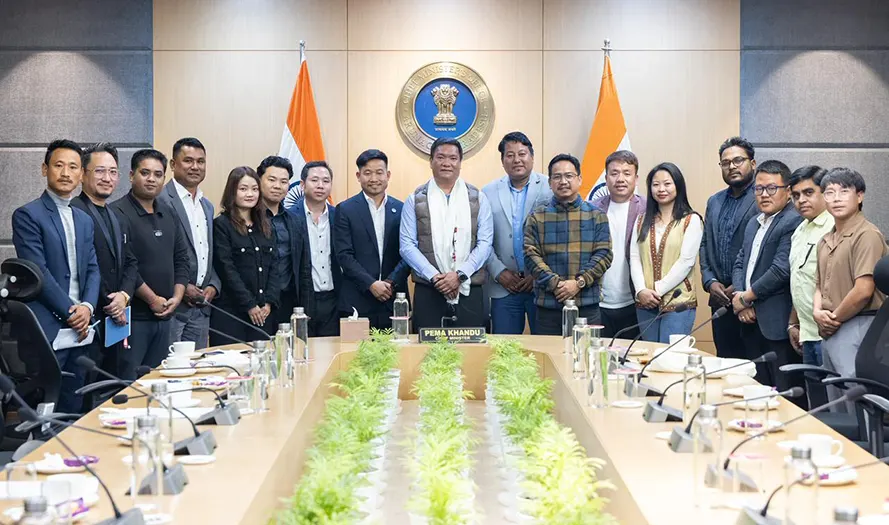

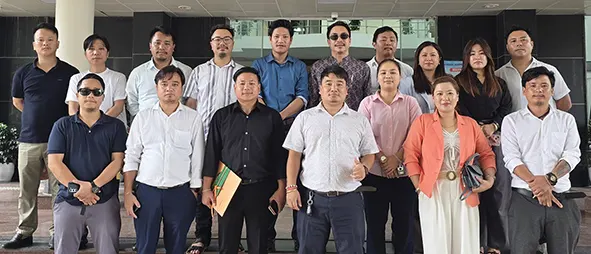
ITANAGAR, 21 May: A delegation of the All Arunachal Pradesh Students’ Union (AAPSU), led by its president Meje Taku, called on Education Minister PD Sona here on Wednesday and submitted a 27-point comprehensive memorandum, seeking urgent educational reforms across all levels – from primary schools in remote villages to universities and professional institutions – in Arunachal.
The 27-point representation, the union said, “reflects the lived realities of students across all 26 districts of the state and covers government schools, degree colleges, and higher educational institutions without distinction.”
In the domain of school education – which directly affects the largest number of students and families across the state – the AAPSU raised a series of pressing concerns. The union informed the minister that approximately 52 of the state’s government schools, out of 109 higher secondary and 189 secondary schools, are functioning without a regular principal or vice principal, leaving thousands of students without proper institutional leadership. “An in-charge arrangement,” the AAPSU said, “cannot substitute for a full-time head empowered to take binding academic and administrative decisions.”
It sought immediate filling of all principal, vice principal, and headmaster posts in a time-bound basis. The union simultaneously pressed for a statewide recruitment drive to fill all teachers’vacancies at the PRT, TGT, and PGT levels, reiterating that every child in every village of Arunachal has a constitutional right to a qualified teacher.
The AAPSU also raised the widespread absence of physical education and music teachers across government schools, citing the explicit mandate of the National Education Policy 2020, which under Para 4.6 directs states to appoint trained teachers in physical education and arts in every school, besides the RTE Act, 2009. The absence of these teachers, the union said, is not merely a staffing gap but a failure to honour a national policy commitment and a loss to the physical wellbeing and rich cultural heritage of Arunachal’s diverse communities.
The union further demanded strict implementation of the RTE Act across remote and tribal areas; regular and accountable delivery of the midday meal scheme, free uniforms, and textbooks; a uniform fee structure in all government schools to end arbitrary collection of fees; and a statewide funded programme for the revamping of school infrastructure, with special focus on border and remote areas.
At the level of government degree colleges, the AAPSU demanded an urgent recruitment drive to fill all vacant assistant professor and associate professor posts, noting that colleges across the state are running on a fraction of their sanctioned teaching strength. The union also called for introduction of new departments in psychology, mass communication, commerce, sociology, anthropology, botany, physics, chemistry, and zoology in colleges where these disciplines are currently absent, arguing that the academic profile of many government colleges has remained frozen for decades, “failing to reflect the aspirations of today’s students or the developmental needs of the state.”
Turning to higher education, the AAPSU demanded immediate appointment of a regular vice-chancellor at the Arunachal Pradesh University (APU) in Pasighat, as the APU has been without a permanent head since February 2026, despite the post having been advertised since August 2025.
The early passage of the APU academic ordinance in the Legislative Assembly was also pressed, along with the filling of faculty posts as per UGC norms, introduction of new departments, construction of staff residential quarters, hostel facilities for students, dedicated power supply, and water treatment plantsfor the campuses.
A dedicated state research fellowship for APST PhD scholars at the APU and RGU was also demanded, with the AAPSU pointing out that Arunachal remains one of the very few states in India without such a scheme, while neighbouring states have long supported their indigenous doctoral scholars.
On Rajiv Gandhi University in Doimukh, the AAPSU demanded expeditious appointment of a regular vice-chancellor, along with accelerated construction of residential hostel facilities and a water treatment plant.
On the NERIST in Nirjuli, the union raised three concerns: a critical shortage of girls’ hostel accommodation for UG, PG, and PhD students; the need for a foot overbridge between the institute’s north and south campuses to address a serious daily safety hazard; and the installation of a water treatment plant.
On Jawaharlal Nehru College in Pasighat, the AAPSU called for structural separation of PG and UG academic environments, a comprehensive infrastructure overhaul, and immediate action against reported encroachments on the college’s campus land.
Among broader reform demands, the union sought establishment of professional colleges in agriculture, horticulture, medicine, and nursing within the state, noting that students are currently compelled to migrate to other states at great cost. The introduction of free foreign language courses – particularly Japanese and German – along with structured overseas career guidance was also pressed to prepare Arunachali youths for global employment opportunities.
Cutting across all institutions, the AAPSU urged the government to take up with the Ministry of Tribal Affairs the persistent problem of delayed disbursements under the umbrella scholarship scheme. “Delays often stretch months beyond the start of the academic year,” the union said, “forcing students studying far from home – in institutions across the country – to borrow, drop out, or return to their villages mid-semester, permanently ending the educational journeys of many first-generation learners.”
The minister assured the AAPSU of his personal attention to the demands raised. The union said it would closely follow up and expect concrete, time-bound responses from the government on each point.