

[ Gedak Taipodia ]
Introduction: The imperative for institutional metamorphosis
The architecture of law enforcement in the Republic of India is fundamentally a state subject, as enshrined within the 7th Schedule of the Constitution, thereby granting state governments and their respective administrative apparatuses the absolute prerogative to design, maintain, and modernise their police forces. Arunachal Pradesh, a state defined by its highly sensitive geopolitical location, profoundly difficult topography, and rapidly shifting demographic and urban landscapes, is currently positioned at a critical historical juncture. The capital region, encompassing Itanagar and Naharlagun, has witnessed rapid and unprecedented urbanisation, bringing with it the complex socioeconomic challenges typical of growing metropolitan areas, including a discernible and troubling rise in sophisticated urban crime.
Simultaneously, the state’s porous borders and unique statutory protections, specifically the Bengal Eastern Frontier Regulation (BEFR) of 1873, necessitate a highly vigilant, incorruptible, and modern police force capable of managing both localised law and order and broader state security against unauthorised infiltration.
Despite the unyielding dedication of the Arunachal Pradesh Police (APP) force, there is a growing and undeniable consensus among civic stakeholders, policymakers, and administrative observers that the prevailing law enforcement framework requires a comprehensive, top-to-bottom overhaul. The traditional methodologies of policing – rooted heavily in colonial-era statutes such as the Police Act of 1861 – are increasingly misaligned with the demands of contemporary, democratic governance.
The archaic separation of duties, stagnant career progression pathways that demoralise highly educated recruits, outdated physical equipment that hinders tactical mobility, and localised lapses in institutional integrity have collectively generated an urgent need for systemic reform.
This exhaustively detailed research report serves as a formal, data-driven appeal directed primarily at the apex decision-makers: the Government of Arunachal Pradesh, the home minister, and the director general of police (DGP). It evaluates a highly specific, five-pillar reform proposition designed to modernise the state’s policing apparatus.
The current administration under Chief Minister Pema Khandu has already demonstrated a robust appetite for sweeping institutional reforms, evidenced by the recent implementation of the Arunachal Pradesh Public Examination (Measures for Prevention of Unfair Means in Recruitment) Rules, 2026, the digitalisation of the Inner Line Permit (ILP) system, and stringent austerity measures. Building upon this momentum for progressive governance, this report provides a deeply nuanced roadmap for transforming the APP into a more agile, meritocratic, and public-centric institution.
The five core areas of proposed institutional modernisation analysed herein include the democratisation of the promotion ecosystem for graduate constables, the structural integration of siloed police units into a unified cadre, the tactical implementation of a digitised beat system akin to the Delhi Police model, the ergonomic modernisation of uniforms for field personnel, and the establishment of uncompromising disciplinary frameworks to eradicate corruption related to narcotics and the ILP regime.
Pillar 1: Democratising the promotion ecosystem and career progression
Historically, the recruitment parameters for the constabulary in India, including the nascent forces of Arunachal during its early developmental phases, were predicated almost entirely on physical endurance, stature, and basic literacy. During these early days, due to a severe lack of educated youths in remote regions, constables were frequently recruited without mandatory higher school certificates or collegiate degrees; the satisfaction of rigorous physical standards was the primary, and often sole, necessity.
However, a profound demographic and educational paradigm shift has occurred over the last two decades. Today, a significant and growing proportion of newly recruited constabulary possesses undergraduate and postgraduate college degrees – educational qualifications that are entirely identical to the rigorous prerequisites required to sit for the Union Public Service Commission (UPSC) civil services examination, which recruits the elite Indian Police Service (IPS).
Despite this equalisation in baseline educational qualifications, the internal progression matrix within the state police remains highly stratified, archaic, and heavily biased towards direct officer-level recruitment. The Indian Police Service functions as an All India Service, creating a rigid top-down leadership structure where direct recruits occupy the apex echelons of state and central police organisations immediately following their training at the Sardar Vallabhbhai Patel National Police Academy. Meanwhile, State Police Service (SPS) officers join via the State Public Service Commission at the gazetted level of deputy superintendent of police (DSP). Consequently, a college-educated, highly capable constable often faces an impenetrable institutional glass ceiling, rarely ascending beyond the rank of sub-inspector or inspector before reaching the age of superannuation. This structural bottleneck wastes vast reserves of on-ground experiential intelligence, ignores the intellectual capacity of the modern recruit, and breeds systemic demoralisation within the lower ranks.
To optimise the human capital within the APP and ensure that the leadership understands the granular realities of street-level policing, it is essential to look towards international law enforcement paradigms. In these systems, the constabulary serves as the foundational talent pool for the entire organisational hierarchy, allowing the most capable individuals to rise to the highest echelons based on merit, continuous education, and performance.
The United Kingdom policing model represents the gold standard for meritocratic internal progression. In the UK, the policing hierarchy is built entirely from the ground up; every single officer, regardless of their ultimate strategic trajectory or educational background, begins their career at the entry level as a police constable (PC). The College of Policing oversees a highly structured National Police Promotion Framework (NPPF), which facilitates a rigorous four-step promotion process for officers seeking elevation to the supervisory ranks of sergeant and inspector. Through demanding departmental examinations, continuous operational performance evaluations, and specialised leadership training, a constable can theoretically and practically ascend through the ranks of chief inspector, superintendent, chief superintendent, and commander, eventually reaching the position of commissioner of the Metropolitan Police – the absolute highest rank in UK policing.
This architecture guarantees that top-tier strategic leadership possesses decades of localised, street-level operational experience, preventing the disconnect often seen between direct-recruit upper management and the frontline workforce. Furthermore, the UK system intelligently separates the rank hierarchy from specialised operational roles; a detective constable in plain clothes is not inherently senior in rank to a uniformed constable, ensuring that investigative specialisation does not artificially inflate administrative rank.
The French Police Nationale provides another robust framework for internal vertical mobility, specifically within the Corps d’encadrement et d’application (CEA), which constitutes the first steps of the career ladder. An entry-level peacekeeper, known as a gardien de la paix, is not destined to remain at the bottom of the hierarchy. They can advance to the ranks of brigadier-chef and major de police through highly structured internal pathways governed by strict decrees. Notably, the French system heavily incentivises and rewards the acquisition of advanced technical and legal skills. A gardien de la paix who studies for and passes rigorous examinations to earn the officier de police judiciaire (OPJ) qualification is granted superior investigative authority under Article 16 of the Code of Criminal Procedure, fundamentally altering their career trajectory and allowing them to operate as lead directors of investigations.
Promotion to the supervisory rank of brigadier-chef is achievable via multiple distinct routes, including specific, accelerated tracks for those serving in priority sectors and units (SUEP), which strategically rewards officers undertaking high-stress, complex assignments in difficult areas with faster career mobility.
Similarly, the Australian state police forces, such as the New South Wales (NSW) Police Force and the South Australia Police, offer extensive and transparent vertical mobility that integrates directly with broader civil service structures. An officer begins as a student or probationary constable and can move progressively through the ranks of constable, senior constable, sergeant, senior sergeant, inspector, chief inspector, and superintendent.
Crucially, the Australian system addresses the disparity in civil service prestige by mapping these police ranks directly to equivalent public sector administrative clerk grades. For instance, a constable is structurally equated to a clerk 3-4 grade, an inspector is mapped to a clerk 9/10 grade, and a superintendent holds parity with a highly senior clerk 11/12 grade. This explicit equivalency integrates police ranks seamlessly into the broader government administrative framework, ensuring absolute parity in pay scales, retirement benefits, and administrative authority across the entire public sector.
Strategic policy recommendations for the state government and DGP
The Government of Arunachal Pradesh, acting through the Home Department, possesses the statutory and constitutional authority to reform its state police cadre rules. To capitalise on the highly educated nature of the modern constabulary, the state must institute a fast-track, competitive departmental examination system specifically designed to elevate capable graduate constables.
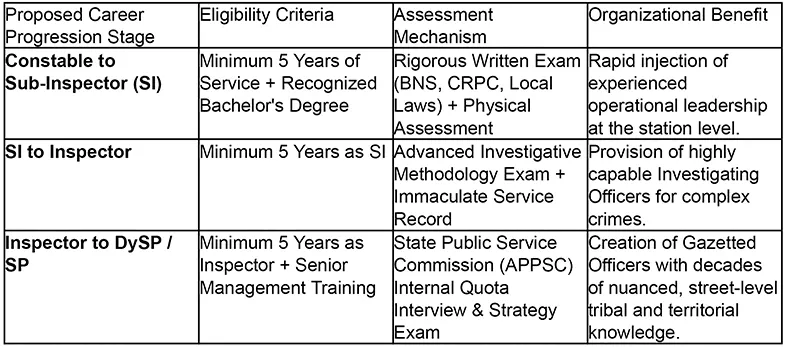
Therefore, constables should possess the institutional pathway to be promoted up to DSP and SP ranks within their service tenure. This singular reform will drastically improve policing outcomes because the resulting officer will possess direct experiential knowledge of every rank’s operational duties, which will intrinsically help in managing complex policing situations, ranging from riot control to advanced homicide investigations. Promoting capable, graduate-level constables up to the rank of DSP and SP would simultaneously fill the highly necessary and critical mid-management strength gap with proven efficiency.
In many extreme cases involving local tribal dynamics, terrain navigation, and grassroots intelligence gathering, a seasoned promoted officer could prove far more effective than a direct-recruited officer who lacks localised experiential memory.
Pillar 2: Structural integration
The organisational blueprint of Indian police forces heavily features a stark, permanent division between the civil police (responsible for daily law and order, investigations, traffic management, and community policing) and state Armed Police Battalions (often titled Provincial Armed Constabulary, or in this context, the Arunachal Armed Police Battalion and India Reserve Battalions). The Armed Battalions act as a heavy, mobile armed reserve under the direct command of high-ranking officers, maintaining key guard posts and participating in anti-terrorist operations.
Crucially, they are generally isolated from daily public contact, deployed primarily during extreme civil unrest, violent riots, sensitive election security details, and complex disaster relief operations.
This bifurcated system is a direct descendant of colonial-era administration, specifically designed by the British to maintain a heavily armed, insulated force capable of suppressing large-scale anti-colonial uprisings without developing sympathetic or familiar ties to the local civilian populace.
In the context of modern, democratic governance in Arunachal, maintaining strict, lifelong silos between battalion personnel, civil police, and specialised units like traffic police creates severe operational inefficiencies and uneven distributions of labour. Under the current framework, the recruitment of APP is fractured. An officer recruited directly into a battalion may spend their entire career in armed reserve duty. Because battalion deployments require young, physically elite police personnel to effectively control hostile crowds or violent riot situations, aging officers within these battalions inevitably experience severe physical burnout.
Conversely, police stations desperately need experienced, intelligent, and legally astute police personnel to serve as investigating officers (IOs) handling technical works, evidence collection, and court testimonies. Furthermore, the traffic situation in rapidly expanding urban centres requires highly trained traffic police capable of managing complex vehicular flows. When an officer is permanently locked into a single silo from recruitment to retirement, the state cannot dynamically allocate its human resources based on the evolving physical and cognitive capabilities of its personnel.
The case for a unified common APP cadre
To rectify this structural inefficiency, the recruitment of the APP should be entirely unified as a ‘Common Arunachal Police’ force, officially scrapping the fragmented recruitment specific to battalions, civil, or traffic units.
A unified, rotational cadre system addresses the physiological and cognitive lifecycle of a police officer logically and compassionately. Therefore, all recruited police personnel should be comprehensively trained at the Police Training Centre for absolutely every situation. This unified curriculum must include advanced tactical crowd control and riot control, urban traffic management, standard protocols for maintaining law and order, and an exhaustive, in-depth knowledge of the newly implemented Bharatiya Nyaya Sanhita (BNS), the Code of Criminal Procedure (CrPC), and other necessary local and national law books.
Following their successful graduation from the academy, the deployment lifecycle of every single officer should follow a strictly experience-based trajectory.
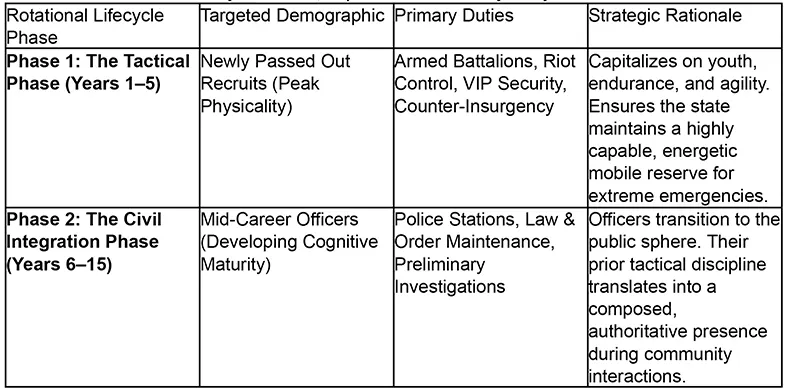
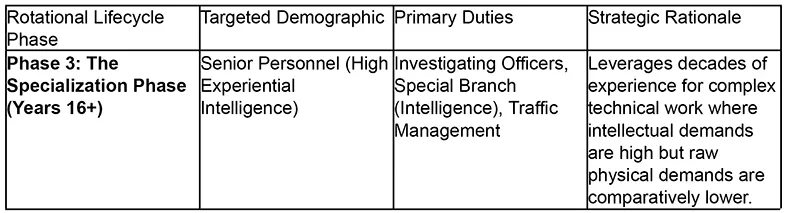
They should be posted in the battalions immediately after passing out, capitalising on the peak physical condition. Further along their careers, they should be rotated to other units after gaining the experience of practical, disciplined policing. Ultimately, they should be posted across all units like Police stations, the Special Branch, Battalions, and Traffic divisions entirely as per the state’s requirement and the individual officer’s proven efficiency and aptitude. This holistic approach guarantees that the force remains perpetually dynamic, preventing the physical stagnation of older personnel in Battalion roles while continuously injecting highly disciplined, physically fit younger officers into the tactical reserves.
Pillar 3: Tactical urban policing
The demographic and infrastructure expansion in the capital region of Itanagar and Naharlagun has been exponential. However, this rapid urban growth has brought about a corresponding and concerning escalation in urban crimes, with criminals becoming increasingly organised and mobile. Traditional, reactive policing models – where law enforcement remains stationed at a central precinct and responds only after a crime has been committed and formally reported via the emergency helpline – are fundamentally inadequate for densely populated, sprawling urban centres. As crimes and criminals are increasing in Itanagar and Naharlagun, setting up highly decentralised beat systems is urgently needed to control the environment effectively and proactively.
The Delhi Police beat system paradigm
To understand the optimal structure for micro-territorial management, the DGP and the state government must evaluate the beat system utilised by the Delhi Police, which represents a highly sophisticated, data-driven approach to urban crime control. In the Delhi beat system, every geographical area falling under the jurisdiction of a police station is divided into many small, highly manageable parts, referred to as ‘beats’. A dedicated team of police officers is assigned permanently to every part. The structure typically features an assistant sub-inspector (ASI) or sub-inspector (SI) taking on a supervisory role over specific beats, with several constables operating under their direct command. These localised teams are completely responsible for keeping, monitoring, and maintaining law and order on a 24/7 basis within their specific beat.
The efficacy of the Delhi beat system relies heavily on several modernised, technological pillars that the APP must urgently adapt and implement:
Digitization and e-beatbook: Historically, beat officers maintained physical, paper-based registers containing crucial intelligence about local criminals, geography, and demographics. The Delhi Police completely transformed this localised intelligence gathering by deploying the ‘e-beatbook’ application on digital screens and smartphones. This digital database allows officers to continuously update vital information regarding key establishments like schools and colleges, as well as vulnerable demographics such as senior citizens. When an officer is transferred or their beat changes, the digital repository is seamlessly handed over to their successor, ensuring absolutely zero loss of institutional memory.
Community integration and specialised apps: The beat system fosters deep community engagement. Specialised applications, such as the Senior Citizen app, automatically alert the specific beat officer and the station house officer (SHO) during emergencies via GPS tracking. Furthermore, officers utilise these tools to discreetly contact informers through social media, bypassing the highly visible and dangerous practice of physically meeting them in the field. Inter-police station communication is streamlined, allowing officers in one beat to access live CCTV footage from market welfare bodies to help neighbouring stations track fleeing suspects.
Ecological and tactical patrolling: To navigate narrow, highly congested urban lanes and bylanes where mechanised vehicles find it impossible to reach or maintain a steady presence, the Delhi Police introduced tactical bicycle patrols. This green initiative ensures a continuous, unobtrusive police presence in heavily congested areas, particularly useful during odd hours and night patrols since bicycles are silent and less disturbing to resting residents.
Strategic application for Arunachal For Itanagar and Naharlagun, the implementation of a similar beat system is non-negotiable for effective crime deterrence. The hilly terrain and tightly packed residential colonies of the capital region mimic the narrow bylanes of Delhi’s older districts.
The Home Department must mandate that every area under a police station be officially divided into micro-beats. The assigned constables and ASI/SIs must be held directly accountable for the crime metrics within their zone. They must transition from riding in centralised patrol vehicles to walking and cycling their specific beats, establishing direct, face-to-face relationships with local shopkeepers, resident welfare associations, and youth leaders. By establishing this 24/7 hyper-local monitoring framework, the APP will drastically reduce reaction times, deter petty street crimes through omnipresence, and build a massive, decentralised intelligence network capable of pre-empting larger criminal conspiracies.
Pillar 4: Ergonomic and operational uniform modernisation
The visual identity of Indian law enforcement has been completely synonymous with the colour ‘khaki’ since the mid-19th century. The term itself, tracing its origins to the Persian word ‘khak’, meaning dirt or dust, was originally adopted during the British Raj in the 1860s when colonial soldiers dyed their pristine white uniforms with muddy water or tea to camouflage themselves in the hostile, dusty terrains of the subcontinent. For over a century, the standard uniform for state police forces across the nation has comprised a stiff terry cotton shirt, highly formal trousers, a restrictive web belt, and heavy leather shoes or boots.
While the traditional khaki dress is undoubtedly the best for the police as an official, ceremonial dress due to its immense historical prestige and psychological authority, it is fundamentally anti-ergonomic and highly restrictive for modern, high-intensity field operations. The rigid terry cotton fabric restricts biomechanical mobility, provides exceptionally poor ventilation in the humid, subtropical conditions of Arunachal’s lower belts, and utterly lacks the functional utility required by modern officers who must carry an array of tactical equipment. For commandos, battalions, and patrolling personnel who are constantly on the move, engaging in physical pursuits or navigating steep mountainous inclines, a more flexible dress is desperately needed.
The national shift towards tactical utility apparel
Across India, progressive police departments are currently overhauling their archaic dress codes to reflect the harsh physical realities of street-level policing, moving away from colonial aesthetics towards tactical utility.
The Delhi Police is currently in the advanced stages of executing a sweeping, historic uniform reform for personnel ranking from constable up to inspector. Following over two years of intensive deliberation by a dedicated committee at the police headquarters, the force is set to replace the traditional terry cotton shirt and trousers with customised polo T-shirts and tactical cargo pants.
The rationale is purely functional: cargo pants provide multiple deep pockets essential for carrying diaries, mobile phones, body-worn cameras, and extra ammunition seamlessly. The polo T-shirts offer the stretchability and breathability crucial for officers deployed in harsh weather for traffic regulation, street patrols, and crowd management.
Importantly, while the design is being modernised for extreme comfort, the formal ‘khaki’ colour is being strictly retained to preserve the undeniable identity of the force.
Similarly, the Kerala Police Association recently submitted a memorandum demanding a comprehensive review of the uniform due to the severe operational difficulties of wearing rigid fabrics during disaster management. During the devastating Wayanad landslides, police personnel were severely hindered by their trousers and were compelled to carry out rescue work wearing khaki shirts paired with lungis or dhotis.
Recognising this critical failure in operational gear, the Kerala state police chief issued official orders, introducing a completely new uniform pattern for Armed Police Battalion recruits, establishing a highly functional ‘sports/games dress’ comprising dark navy blue track pants, a khaki polo T-Shirt with the battalion insignia, and all-white sports shoes for rigorous training and tactical operations.
The global and historical trend is clear. The evolution of police uniforms from ceremonial to tactical is an operational necessity. Even the Mumbai Police underwent a significant uniform transition in 1981, discarding their historical, billowy blue half-pants (which severely restricted movement during pursuits and mockingly earned them the moniker ‘Pandu mama’) in favour of full khaki trousers to command better respect and mobility. Today, the shift towards cargo pants and polo shirts represents the next necessary evolutionary step.
Recommendations for the APP
Given the state’s highly challenging topography – which requires officers to frequently navigate steep inclines, dense jungles, and highly unpredictable weather conditions – the APP must urgently adopt a modernised dual-uniform policy.
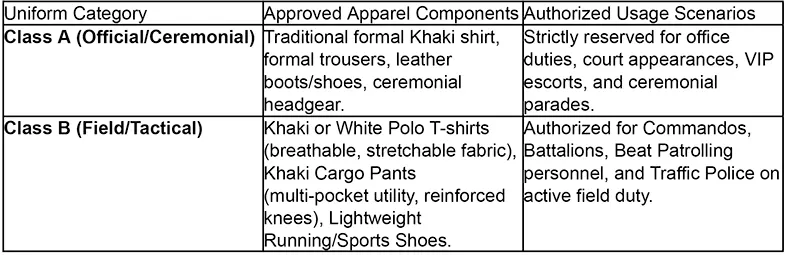
Shoes which will help officers run easily are a critical necessity, replacing heavy, restrictive leather boots that cause extreme foot fatigue during long patrols. Cargo pants are infinitely more flexible for running, climbing, and other rapid tactical movements. Ultimately, it will provide much more flexibility and operational efficiency if polo T-shirts are authorised instead of the formal khaki shirt for everyday wear in field duty.
Pillar 5: Enforcing strict disciplinary guidelines and action against corruption
The foundational bedrock of any effective law enforcement agency is absolute public trust.
When the custodians of the law devolve into its primary violators, the institutional legitimacy of the entire state apparatus is severely, sometimes irreparably, compromised. In recent times, it must be acknowledged with deep concern, the image of the APP has not been good. The force has sustained significant reputational damage due to high-profile instances of corruption, malfeasance, and blatant criminal complicity among its own ranks. Two primary vectors of corruption have emerged as critical threats to state security and social harmony: the direct involvement of police personnel in illicit narcotics trade, and the treasonous facilitation of illegal immigration through Inner Line Permit (ILP) check gate bribery.
The narcotics epidemic and internal complicity: Arunachal is currently battling a severe and devastating drug menace that is destroying its youths. Tragically, members of the police force have been directly implicated in facilitating this crisis. In a highly shocking and widely publicised incident in Lower Subansiri district (Ziro), an active-duty police constable, identified as Pangam Pangsa, was allegedly caught red-handed purchasing drugs directly from peddlers. The situation was so egregious that vigilant local citizens had to intercept the officer themselves, confronting him and verifying online money transfer records that confirmed his financial dealings with the drug network.
Furthermore, recent anti-narcotics operations have led to major busts, including the arrest of a suspected drug supplier operating from within the highly secure civil secretariat premises in Itanagar, yielding over 44 grams of heroin. Another recent operation led by the SDPO in Naharlagun resulted in the arrest of a peddler with 140 grams of heroin.
The fact that many cases of drug peddling by police personnel have been seen by the public represents an absolute failure of institutional integrity. Law enforcement personnel cannot be permitted to operate within the very networks they are sworn to dismantle.
The ILP security breach: The Bengal Eastern Frontier Regulation (BEFR) of 1873 strictly mandates that all non-residents obtain an ILP before entering Arunachal, a vital legal apparatus designed explicitly to protect the indigenous tribal demographic and prevent illegal infiltration from neighbouring regions and countries. However, this vital security wall has been heavily compromised by check-gate bribery. Taking bribes to allow entry at check gates without valid ILPs has increasingly come to the knowledge of the public.
Recent intensified enforcement drives have laid bare these massive vulnerabilities. In Lower Dibang Valley district alone, police detected 73 ILP violators in a mere three days, leading to their swift externment. More distressingly, a massive fake ILP racket involving the forgery of over 1,300 permits by a government employee was recently busted, highlighting deep systemic rot.
In response to severe lapses and widespread bribery allegations, DGP Dr SD Singh Jamwal issued strict directives to enforce ILP regulations, resulting in the suspension of three police personnel, including the in-charge of the crucial Hollongi check gate, pending high-level inquiries.
The mandate for draconian disciplinary action
Suspension, administrative transfers and ‘punishment postings’, or standard, protracted departmental inquiries are woefully insufficient deterrents for officers participating in organised drug syndicates or compromising the sovereign borders of the state for petty bribes. Such leniency only fosters a culture of untouchability and impunity.
The Arunachal Cabinet has recently demonstrated the intense political will required to enact rigorous governance reforms, successfully passing strict anti-paper leak rules for recruitment examinations and dismissing a senior IAS officer over historical corruption charges, proving that no official is above the law. To eliminate the human element of bribery at the borders, the Cabinet has also brilliantly approved the transition to a fully digital, QR-based eILP system at all check gates, integrated with Aadhaar authentication and mandatory police verification.
However, technological upgrades must be matched by unyielding human accountability. Therefore, strict disciplinary action must be codified and executed without mercy. For any officer caught engaging in drug peddling or facilitating illegal entry at check gates, the punishment must be nothing short of absolute termination from service.
Furthermore, administrative termination is not enough; these corrupt police officers and drug peddlers must be actively prosecuted and jailed as per the appropriate sections of the law, including the strictest provisions of the Narcotic Drugs and Psychotropic Substances (NDPS) Act and the Bharatiya Nyaya Sanhita (BNS).
By ensuring that the penalty for corruption equates to immediate professional destruction and severe incarceration, the state will successfully purge rogue elements and restore the APP to a position of unassailable honour.
Conclusion: A call to action
The complexities of 21st-century governance, urban expansion, and border security in Arunachal dictate that its law enforcement apparatus can no longer operate on the archaic, inflexible methodologies of the past. The state government, the home minister, and the director general of police hold the immense responsibility and the constitutional authority to reshape the destiny of this vital institution.
The five pillars of reform detailed in this comprehensive appeal represent a highly synergistic blueprint for modernisation. Democratising the promotion system to allow graduate constables to reach DSP and SP ranks will unlock a massive reservoir of experiential intelligence and solve mid-level leadership crises. Scrapping the siloed permanent unit systems in favour of a rotational ‘Common Arunachal Police’ cadre will ensure that the force remains dynamically balanced between tactical physical readiness and investigative maturity.
Implementing a digitised, 24/7 beat system like Delhi’s will bring hyper-local accountability to the expanding streets of Itanagar and Naharlagun, stopping urban crime at its grassroots. Modernising the uniform to include polo T-shirts, cargo pants, and running shoes will drastically improve the biomechanical efficiency and comfort of officers deployed in the state’s unforgiving terrain.
Finally, establishing a zero-tolerance policy of termination and imprisonment for officers involved in the drug trade and ILP bribery will forcefully restore the shattered public trust.
The time for incremental changes has passed. The comprehensive implementation of these much-needed police reformations will not merely improve daily policing metrics; it will fundamentally secure the demographic integrity, territorial sovereignty, and civic harmony of Arunachal for generations to come. The citizens look toward the state government and the police leadership to enact these bold, transformative policies with immediate and unwavering resolve. (The writer is a constable in the Delhi Police)