Editor,
There is a profound difference between a crime that takes a life and a crime that destroys a generation. While heinous acts such as burglary, assault, murder, and abuse inflict unimaginable sorrow and trauma upon individual victims and their families, the drug trade is an insidious cancer that metastasizes to consume entire communities. It does not merely steal the peace of a single household; it slowly poisons the very foundation of our society and extinguishes the bright future of our youth.
As the saying goes, “A thief steals your wealth, but a drug peddler steals your tomorrow.” Because they deal in the mass destruction of human potential, the punishment for drug peddlers should be the absolute highest penalty available in the book of law. For a crime this devastating, the constitution of every nation should prescribe the death sentence without hesitation.
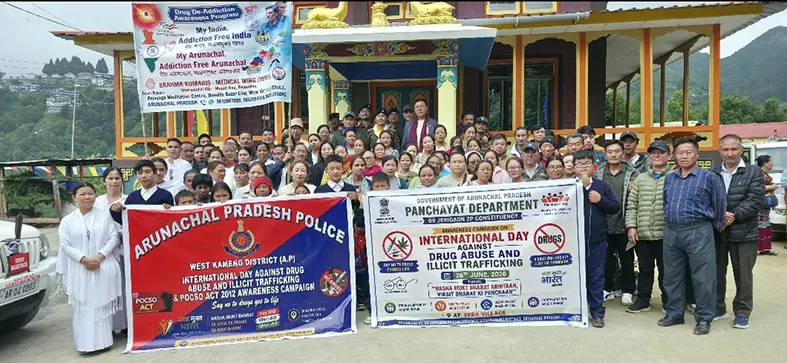
In Arunachal Pradesh, the drug addiction among our youth has already reached apocalyptic proportions. The number of peddlers is increasing day by day, and what is most alarming is the waning of public trust, especially amid disturbing allegations that some rogue police personnel are complicit in this syndicate.
In this prevailing darkness, activists like Mr. Gumin Mize have emerged not merely as crusaders, but as true messiahs for the people of Arunachal Pradesh. It is a testament to his sheer dedication that he has managed to track down and expose drug peddlers without access to sophisticated electronic surveillance, wiretapping, or the vast resources of the police force. One must ask: how is it that a civilian activist has proven to be exponentially more effective at dismantling these networks than the state police machinery?
This brings us to the deeply unfortunate and recent arrest of Mr. Mize. While it is a universally accepted democratic principle that no one should take the law into their own hands, we are fighting an unconventional war. In cases of drug trafficking-where the state apparatus is widely perceived as inefficient, the moral compass of the law must adapt. Those who put their lives on the line to save our children should be given the shield of legality and the unconditional support of the public.
Furthermore, the drug mafia respects no state borders; therefore, those who combat them shouldn’t be hampered by restrictive jurisdictions. Anti-drug crusaders from Arunachal Pradesh, Assam, or any other neighboring state should be granted a stronger, collaborative mandate to confront these cartels wherever they operate. When the house is on fire, we do not ask the firefighters which district they belong to.
We cannot win this war with tied hands. The heroes walking among us must be empowered to snap the supply chains and destroy the drug syndicates once and for all. Let the law reflect the severity of the crime, and let the highest punishment fall upon those who sell poison to our children.
Musa, Guwahati