[ Prafulla Kaman ]
PASIGHAT, 19 Sep: Arunachal Pradesh is facing deficit rainfall this year, and the water deficiency is increasing the risk of soil moisture stress, particularly in rainfed agricultural areas like East Siang district and other parts of the state.
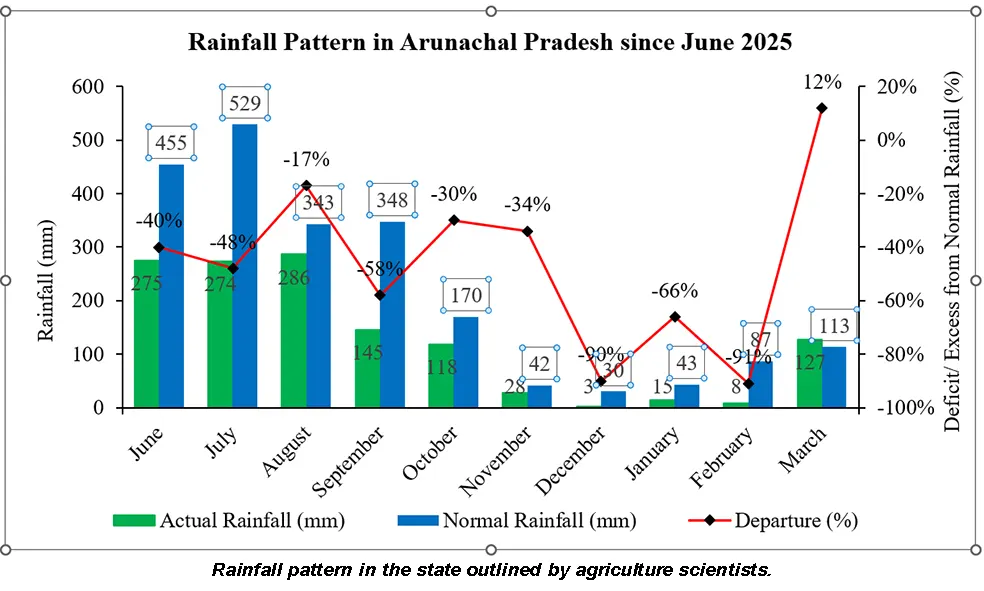
As per a report, the state received 900.4 mm rainfall against the normal rainfall of 1,535.6 mm during 1 June to 16 September, showing a 41% rainfall deficit. The average rainfall received during 1-16 September was 87.3 mm, against the normal 196.1 mm, which also indicates a 55% deficit.
Last year too, the region witnessed severe rainfall deficit in the monsoon season and post-monsoon period. The drought-like situation in the Siang belt and other parts of central Arunachal invited contingency crop plans, including cultivation of cash crops and weather-resilient cereal crops to bring a little respite for the rural farmers.
Agriculture scientists have said that deficit rainfall in the region may affect the growth of kharif crops,including maize, pulses, sesame and winter vegetables, and impair flowering and grain/seed filling at different growth stages.
Prolonged moisture stress caused by scanty rainfall may affect flowering, fruit setting, fruit retention and fruit size, with potential implications for Khasi mandarin and other fruit crops, especially young orchards without supplemental irrigation. As such, reduced rainwater may lower fodder availability and affect livestock production.
It is feared that reduced agriculture production causedby scanty rainfall in the post-monsoon period may affect farm-based income, food security and rural livelihoods. Lack of rainwater may also increase expenditure on irrigation and inputs.
The scientists observed that prolonged rainfall deficiency may reduce the availability of drinking water sources like streams and other community sources, particularly in rural and remote areas. The declining water availability may also put pressure on community drinking water sources and increase the need for attention to water quality, sanitation, hygiene and nutrition.
Assistant Professor at Pasighat-based College of Horticulture and Forestry, Dr Dinesh Kumar,emphasised that the prevailing situation calls for rainwater harvesting, mulching and soil-moisture conservation, supplemental irrigation at critical crop growth stages, protection of horticultural plantations, adoption of stress-tolerant and short-duration crop varieties, and strengthened weather-based agrometeorological advisories.
According to Kumar, the rainfall deficit should not be directly interpreted as an equivalent percentage of crop loss, as the actual impact would depend on district-wise rainfall distribution, crop stage, soil-moisture status, irrigation availability and prevailing field conditions.