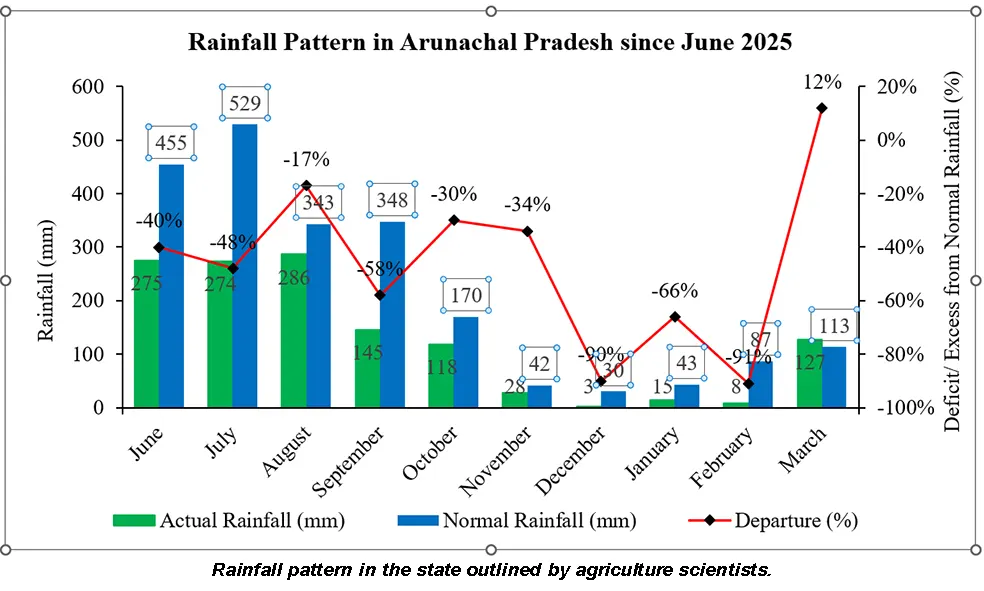
Arunachal Pradesh is facing a significant rainfall deficit.
Between 1 June and 16 September, the state received 900.4 mm of rainfall, compared with the normal 1,535.6 mm.
This represents an overall 41% rainfall deficit during the period.
Rainfall during 1-16 September was only 87.3 mm, against the normal 196.1 mm, resulting in a 55% deficit. Arunachal also experienced severe rainfall deficiency last year, affecting both the monsoon and post-monsoon periods.
With changing weather patterns, an unpredictable monsoon has severely impacted agriculture, with many forced to abandon their fields. With several families dependent on agriculture for sustenance, their situation has been precarious, forcing them to look for alternative livelihood options or altogether give up on traditional agriculture.
The government should support farmers in climate adaptation and best practices.
With the climate set to change drastically, the state should also look at sustainable agricultural practices that align with traditional practices, which are known to be conservation-based. State-sponsored commercial cropping has rarely had the reach in the state, leaving many out of the support system.
A large section relies on jhum, which is known to be more conservation-friendly. This needs to be explored because food security will be an issue at the rate at which the climate is drastically changing.