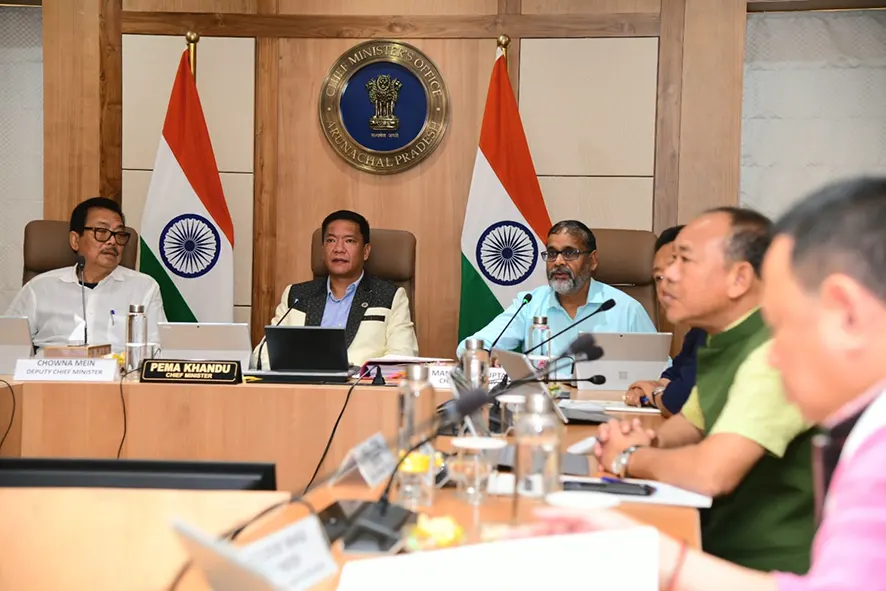

ITANAGAR, 16 Jun: The Arunachal Pradesh government has undertaken a major deregulation drive aimed at improving the ease of doing business by reducing compliance requirements across 51 reform areas under the Centre’s Business Reforms Action Plan (BRAP), according to an official statement issued on Tuesday.
Of the 51 reforms, 16 priority measures have already been implemented and approved by the Centre, the statement said.
The reforms, undertaken under the Department for Promotion of Industry and Internal Trade (DPIIT) framework, cover sectors such as land management, urban development, labour, environmental clearances, building approvals, education infrastructure and utility services.
A key initiative is the proposed Arunachal Pradesh MSME Facilitation Ordinance, 2026, which introduces a simplified regulatory system for small businesses.
The ordinance provides for self-certification, a three-year exemption from routine inspections, and conditional approvals for eligible enterprises, with the aim of reducing procedural hurdles for MSMEs.
The government has also introduced a series of measures to improve industrial infrastructure and land use.
Building norms for industrial plots have been revised by rationalising floor area ratio (FAR), ground coverage, parking requirements, height limits and minimum plot sizes to ensure better utilisation of available land.
In the environment sector, the state has simplified pollution control procedures by allowing third-party certification for obtaining consent to establish and consent to operate.
Self-declaration and auto-renewal systems have also been introduced, while green and white category industries will benefit from longer validity periods linked to the life of the unit.
In February, 32 more industries were added to the white category, removing the requirement for prior pollution control consent.
The state has also launched a fully digital online building permission system for approvals of building plans, completion certificates and occupancy certificates. The platform integrates no-objection certificates from multiple departments into a single process and permits third-party inspections for low and medium-risk buildings.
As part of reforms in the education sector, the government has removed minimum land ownership requirements for setting up private schools and universities.
It has also decided not to impose infrastructure or equipment norms beyond those prescribed under the Right to Education Act, 2009, and the relevant central regulatory authorities, a move aimed at encouraging private investment in education, the statement said.
To improve investor access to industrial infrastructure, all 17 industrial estates and parks in the state have been linked to the GIS-based India Industrial Land Bank portal, allowing entrepreneurs to check land availability online.
The government has further expanded online services by making trade licence issuance and renewal completely digital with minimal paperwork.
Online systems for electricity and water connections are also operational, while industries in the state are exempt from seeking separate permission for groundwater extraction.
According to the statement, the reforms are intended to create a transparent, efficient and investor-friendly business environment while safeguarding the state’s ecological, cultural and tribal heritage. (PTI)