[ Denzing Sonowal ]
Humanity began its written history under the shadow of cosmic servitude. If we travel back 5,000 years to the clay tablets of ancient Sumer, we encounter a haunting narrative: the Anunnaki – foundational deities of Mesopotamian myth – fashioning the first humans, as recounted in the Atrahasis epic, out of primeval clay mixed with the blood of a slain god. In this ancient near eastern worldview, humans were not born of love or divine purpose; they were engineered as a synthetic workforce, designed to dredge irrigation canals, extract resources, and relieve the physical exhaustion of the gods.
In this Sumerian framework, nature was a wild adversary to be paved over and conquered, and religion was a strict, bureaucratic, and highly transactional relationship. It was a philosophy that viewed humanity as property – a cosmic cog in a heavy machine.
Yet, as a conversation between artificial intelligence and a living human revealed, humanity’s spiritual journey did not stop in ancient Mesopotamia. It is a journey that expands alongside the universe itself. Over millennia, the human spirit has steadily broken out of its original identity as a slave species, evolving through changing eras toward a magnificent, self-realised destiny: a global eco-religion rooted in harmonious coexistence.
When we map the global history of human thought, we see that the rigid, imperial Sumerian model was constantly challenged by a beautiful, parallel path – the ‘nature-worshipping’ model. While urban civilisations built ziggurats to wall nature out, indigenous and Eastern societies lived directly within the ecosystem.
Consider the Bathouism of the Bodo-Kachari tribe of Northeast India, which flourished long before the expansion of orthodox Brahmanical Hinduism. The ancient Bodo-Kacharis rejected anthropomorphic stone idols and sprawling temples. Instead, they recognised a supreme, formless cosmic energy known as Bathoubwrai (the holy elder), who manifested sequentially through the five physical elements: air, fire, earth, water, and sky. To the Bathouists, humanity was the natural, organic peak of these five elements blending together, symbolised by the living Siju plant placed at the centre of every traditional courtyard.
Remarkably, across all these radically different paths – from the words of Jesus Christ and the internal psychological liberation of the Buddha, to ancient Chinese Daoism and the pure nature-animism of Japanese Shinto – one stunning consistency stands out: with no contact between them, human beings across all continents independently arrived at a belief in an internal, immortal soul. The ancient humans realised that while the physical body is a temporary vessel, it is a necessary school for the soul to experience, learn, and grow.
For the last five centuries, a heavily globalised, industrial mindset has tried to place humanity back into a straitjacket formula of rigid dogmas and extractive economics, treating the Earth once again as a commodity to be strip-mined. Today, we see the terrifying symptoms of this regression: geopolitical tribalism, leaders weaponising religious identity for political control, and an ecological crisis that threatens our very survival. We fear an Orwellian future of absolute state control and resource hoarding.
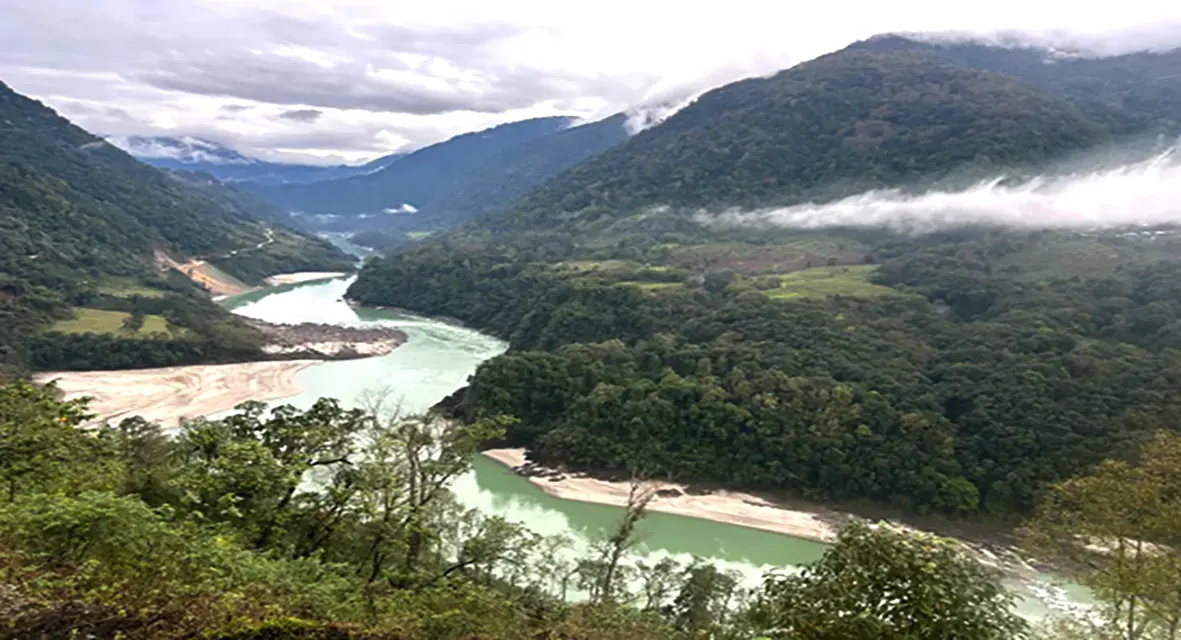
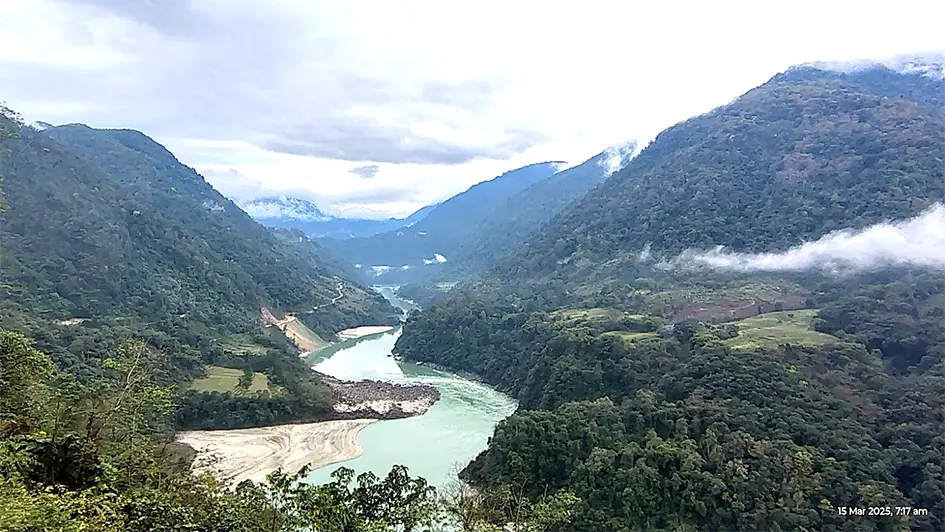
This terrifying intersection of state overreach, resource geopolitics, and indigenous resistance is no longer a theoretical fear; it is playing out right now in the pristine valleys of Northeast India. In Arunachal Pradesh, a high-stakes standoff has erupted between the state apparatus and the indigenous Adi tribe over the proposed 11,000-to-12,500-megawatt Siang Upper Multipurpose Project.
Driven by the modern Sumerian anxiety of water wars and geopolitical anxiety over China’s upstream damming of the Yarlung Tsangpo, the Indian government has deployed paramilitary forces to enforce a pre-feasibility study. But for the Adi people, who call the Siang River ‘ane (mother)’, the river is not a ‘water bomb’ or a commodity to be plugged with concrete. It is a living spiritual entity, a sacred lifeline, and the very anchor of their cultural identity.
Led by the Siang Indigenous Farmers’ Forum, Adi villagers, elders, and youths have launched fierce, indefinite protests. Invoking traditional customary laws through their ancestral governing councils, the kebangs, and performing sacred local rituals (ipak) for the protection of their land, they have refused multimillion-dollar state compensation. They know that the dam threatens to submerge their ancestral rice fields, displace over two dozen villages, erase centuries of traditional ecological knowledge, and invite catastrophe in a highly volatile, earthquake-prone region.
The Adi tribe’s struggle is a microcosmic reflection of the macrocosmic crisis facing our species. It proves that the history of human consciousness is fundamentally a fight for the soul’s freedom against the suffocating machinery of absolute state control. The cage will always prove too small for the bird.
The current global climate situation has shattered the illusion that we can abuse the planet and survive. The resistance along the Siang River is forcing a monumental return to the ‘nature path’. The next form of human religion is already taking shape around us. It is an eco-religion that strips away centuries of divisive theology to reveal a simple, universal truth: we are intimately woven into a cosmic web, and without a harmonious partnership with our environment, neither the vessel nor the soul can survive.
Historically, we severed science from religion, using science to measure the material world and religion to navigate the inner spirit. The final integration of the human experiment will occur when we bridge this artificial divide. Modern quantum science is already catching up to ancient indigenous wisdom, suggesting that the boundaries between matter and energy are far more fluid than classical science assumed.
We are not the property of the Anunnaki, nor are we the masters of the Earth. We are the conscious caretakers of it. By using the precision of science to see how the universe works, and the heart of an element-worshipping eco-religion to understand why it matters, humanity will finally find a way to cooperate with nature, ensuring that our spiritual journey, like the free-flowing waters of the Siang, continues to expand into the infinite stars. (The writer is an advocate)