ITANAGAR, 11 Jul: Governor KT Parnaik said the future of democracy depends on making ballot access more inclusive, accessible and meaningful for every eligible citizen while firmly safeguarding the integrity and credibility of the electoral process.
He emphasised the need to harness the transformative power of technology to enhance transparency, efficiency and public confidence in elections, while remaining alert to emerging challenges.
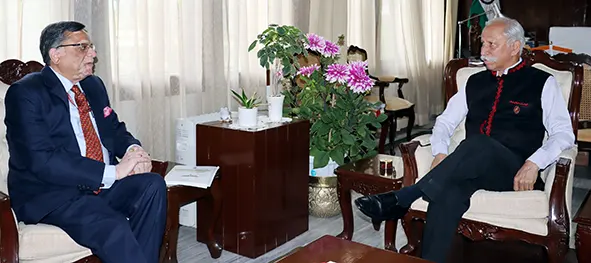
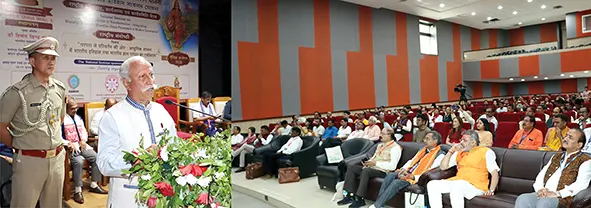
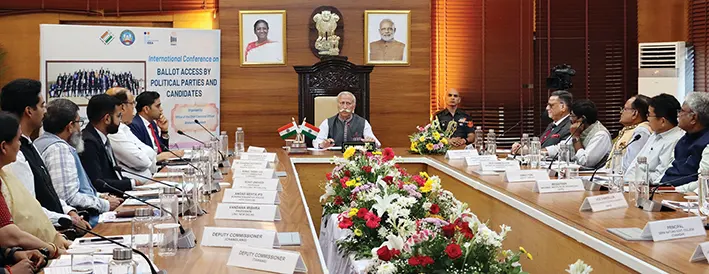
Participating in a virtual international conference on the theme ‘Ballot Access by Political Parties and Candidates’ from the Lok Bhavan on Friday, the governor described the conference as more than a professional forum and called it “a celebration of democracy’s enduring values.”
The conference, he said, reinforced the collective commitment to ensuring that every eligible citizen can participate in the democratic process, every genuine political voice is heard, and democratic institutions remain fair, transparent and inclusive.
The conference was organised by the state chief electoral office under the guidance of India International Institute of Democracy and Election Management (IIIDEM), and in collaboration with Raj Gandhi University, Rono Hills.
The governor emphasised that a clear understanding of existing challenges enables the formulation of more effective reforms and responsive policies. He urged all stakeholders to approach issues with sensitivity, empathy, and an inclusive perspective, ensuring that governance remains people-centric and responsive to the needs of every citizen.
He said that his long years in public service have taught him that institutions remain strong not because of authority alone, but because of their willingness to learn, adapt and improve.
“The most respected institutions are those that remain open to new ideas, learn from experience, and embrace constructive change,” he said.
Highlighting the Election Commission of India’s proactive approach, the governor appreciated the IIIDEM for bringing together election practitioners, technology experts, academicians, media professionals and international partners to address emerging challenges in a rapidly changing technological landscape. He also commended the involvement of all 36 chief electoral officers in thematic research on election management.
Stressing that every democracy offers valuable lessons, he said collaboration and dialogue help strengthen democratic institutions worldwide.
Referring to India’s role as the world’s largest democracy, he noted initiatives such as the ‘Atlas of Democracies of the World’ and the ‘ECI-Net’ as examples of India’s commitment to innovation and global cooperation.
He added that holding these deliberations in Arunachal Pradesh is significant, as the state’s rich cultural diversity and ongoing electoral roll revision covering nearly 8.9 lakh electors reflect its deep democratic commitment.
The governor also stressed the importance of creating greater opportunities for women, youths, indigenous communities, persons with disabilities and other underrepresented groups to participate fully in democratic life, noting that their aspirations, talents and perspectives are vital for building stronger, more representative and vibrant societies.
Underscoring the importance of global cooperation, the governor said that election management bodies must work closely by sharing knowledge, exchanging best practices and learning from one another’s experiences.
“While challenges may vary across nations,” he noted, “the commitment to democratic values is universal.”
“Such collaboration can help build institutions that are resilient, innovative and responsive to the needs of the people,” the governor said.
He called upon all stakeholders to reaffirm their commitment to preserving public trust and ensuring that democracy remains a powerful force for peace, dignity, progress and inclusive development.
Chief Electoral Officer Pawan Kumar Sain, Joint Chief Electoral Officer Liken Koyu, Administrative Reforms Commission Chairman Pramod K Jain, and Prof SK Nayak from RGU also shared their thoughts on the occasion.
East Kameng Deputy Commissioner Yashaswani B and Prof Chandrachur Singh from Hindu College, Delhi delivered a presentation on ‘Trust and Democratic Resilience Electoral Management and Political Representation’.
Longding Deputy Commissioner Kunal Yadav and Prof Rohit Dwivedi from IIM, Shillong provided a presentation on ‘Diagnosing and Institutionalising Electoral Resilience, from Democratic Stress Points to Model Standards’.
Keyi Panyor SP Angad Mehta and Prof Vandana Mishra from JNU, Delhi gave a presentation on ‘Strengthening Electoral Democracy International Norms, Comparative Practices and Standards for Inclusive Participation’.
There were open discussions and interaction with the participants.
A large number of participants from various countries, including representatives from South Africa, chief electoral officers of all states of India and district election officers (DEOs) participated in the conference virtually. Many DEOs were physically present at the conference. (Lok Bhavan)