Authored by:
Prof. Anga Padu
Department of Education
Rajiv Gandhi University
Rono Hills, Doimukh – 791112
Arunachal Pradesh, email: anga.padu@rgu.ac.in
Co-authored by:
Dr. Minu Sono
Department of Education
Binni Yanga Government Women’s College, Poma
Papum Pare, Arunachal Pradesh
India, as a democratic republic, is constitutionally committed to ensuring equality of status and opportunity for all its citizens. However, achieving this goal requires a deeper understanding of the country’s cultural, geographical, environmental, educational, health, and socio-economic diversity, as well as the varied needs of persons with disabilities. According to the 2011 Census, Arunachal Pradesh has 26,734 persons with disabilities. Further, the UDISE+Report (2023-2024) indicates that 2,989 Children with Special Needs (CWSN) are enrolled in the schools across the state, supported by only 188 special educators. These figures clearly demonstrate that the state’s overall development cannot be achieved if this significant section of the population continues to lag behind in accessing quality and equitable education.
It is an undeniable fact that our country has made remarkable efforts towards inclusive education since independence. To mention a few, elementary education has been made a fundamental right for all children between the ages of 6 to 14 years without discrimination. Augmenting this provision, the Rights of Persons with Disabilities (RPwD) Act, 2016 provides that every child with a benchmark disability between the ages of 6 and 18 years shall have the right to free education in a neighborhood school or a special school of his or her choice. The Act further provides that, at the higher education level, 5% of the total admission seats shall be reserved for persons with disabilities (PwDs). The New India Literacy Programme (NILP), also known as ULLAS (Understanding Lifelong Learning for All in Society), is aligned with the National Education Policy (NEP) 2020. It aims to provide foundational literacy and numeracy, critical life skills, vocational skills, basic education, and continuing education to non-literate individuals, including Divyangjans(persons with disabilities), in the 15-45 age group. The programme is implemented through a community-based, volunteer-driven model.
Although the transfer of education to the concurrent list through the 42nd constitutional Amendment Act, 1976, empowered both the Central and State governments to legislate on educational matters, any contextual changes in education should not override central mandates, such as the zero-denial policy for the admission of children with disabilities at the entry level in government and government-aided schools and the provision of a 5% reservation for persons with Disabilities (PwDs) in higher education, particularly in government and government-aided higher education institutions.
Inclusive education is not a new concept in India, as the country’s first official step towards inclusive education began with the launch of the Integrated Education for Handicapped Children (IEDC) Scheme in 1974. However, despite such a significant scheme, states such as Arunachal Pradesh continue to lag far behind in the implementation of inclusive education. A lack of awareness and inadequate funding are believed to be the primary reasons for this gap.
In view of the Rights of Persons with Disability (RPWD) Act, 2016, inclusive education refers to a system of education in which all students with and without disabilities learn together in a common educational setting. In such a system, the teaching-learning process is appropriately adapted to meet the diverse learning needs of students with disabilities. Further, the Right of Children to Free and Compulsory Education (RTE) Act, 2009, guarantees free and compulsory education to all children between the ages of 6 and 14 years irrespective of their gender, religion, caste, race, language, socio-economic status, disability, or any other background. In additions, the RPWD Act, 2016 extends this right by ensuring free education up to the age of 18 years for every child with a benchmark disability in a neighborhood school, or in a special school, of his or her choice. Thus, inclusive education in India implies providing equitable learning opportunities to all children between 6 and 14 years for children without disabilities and 6 and 18 years for children with benchmark disabilities irrespective of their gender, religion, caste, race, language, socio-economic status, disability, or any other background.
Although, at the policy level, the concept of inclusive education is very broad, in practice we are still largely following an integrated model of education at both the school and higher education levels. Comparison of inclusive education between the school and higher education level, shows that at least at the school level, the situation is relatively better. At the school level, there is one special school, namely the Donyi-Polo Mission School for the Hearing and Visually Impaired at Chimpu, Itanager, which caters to children with severe and profound disabilities in the 6 – 18 years age group by adapting the curriculum to meet the diverse learning needs of enrolled Children with Special Needs (CWSN). In addition, government and government-aided general education schools follow a policy of zero denial of admission for children with benchmark disabilities aged 6 – 18 years under the Right of Persons with Disabilities (RPWD) Act, 2016, and for all children aged 6 – 14 years without discrimination under the Right to Education (RTE) Act, 2009. Together, the provisions of these two Acts ensure that children with special needs (CWSN) have the right to free and compulsory education at the elementary level, either in special schools or in existing government and government-aided schools, depending on their educational needs and the support required.
However, the only special school in the state provides education only up to Class X. Unfortunately, students enrolled in Class X are required to appear for examinations conducted by the National Open Schooling (NIOS) rather than the CBSE Board due to the availability of Braille facilities in NIOS, as informed by a teacher from the school during a telephonic conversation. She further stated that, for students from low socio-economic backgrounds, Class X often becomes the terminal stage of their education because there is no special educational institution in the state offering higher secondary or higher education. Furthermore, although the RPWD Act, 2016, promotes an inclusive education system by requiring education institutions to provide reasonable accommodation, individualized support, and accessible learning environment for students with disabilities, there are hardly any general educational institutions in the state that are fully equipped to accommodate students with diverse disabilities, including those with severe or profound disabilities.
At the higher education level, the model followed for inclusive education remains more integrated than inclusive. Apart from the 5% quota for students with disabilities (PwD) in admissions and limited infrastructural adaptations, which are largely restricted to the provision of ramps, few measures to promote inclusive education are being implemented.
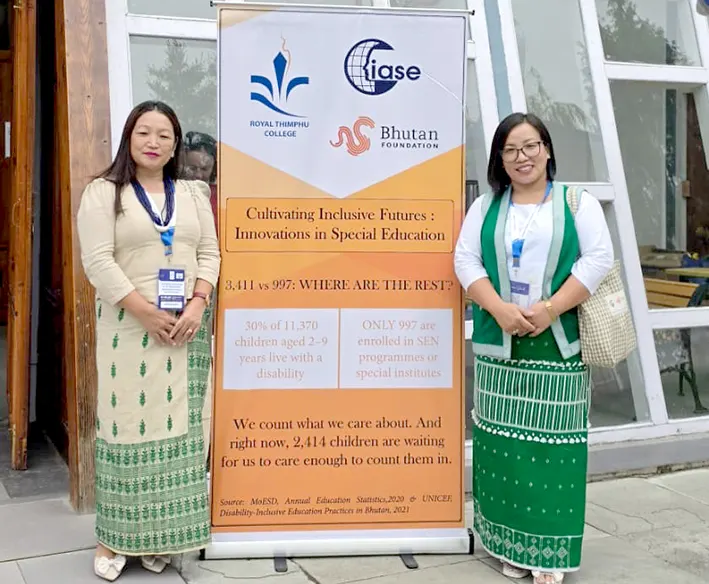
The authors’ participation in the recent six-day conference on “Cultivating Inclusive Futures: Innovations in Special Education,” organized by the International Association for Special Education (IASE) in collaboration with the Royal Thimphu College and held on its campus from 21-26 June 2026, provided valuable insights into various models of inclusive education practiced around the world. Among these, the model adopted in Bhutan appears to effectively support children with special needs (CWSN) by enabling them not only to access general education at the school level but also to lead fulfilling and independent lives through skills development and vocational training.
In Bhutan, two types of schools are designated to educate children with special needs: Special Schools and Inclusive Schools. Special Schools are specialized institutions established to provide intensive educational, therapeutic, and support services for students whose needs cannot be adequately met in the mainstream schools, particularly those with severe, profound, multiple, or sensory disabilities. In contrast, Inclusive Schools are regular mainstream schools that have been adapted to educate students with and without disabilities together in the same learning environment by providing appropriate accommodations, individualized support, and accessible learning facilities.
Bhutan classifies children with special needs into three categories: mild, moderate, and severe disabilities. Children with mild disabilities are taught alongside their peers without disabilities using the general school curriculum with accommodation, adaptation and modifications. However, children with moderate disabilities are educated in the same school environment through a partial inclusion model, participating in mainstream classroom activities where appropriate while spending a significant portion of their school day in Special Educational Needs (SEN) classrooms receiving individualized instruction, functional literacy and numerary, life-skills education, and pre-vocational training. Children with severe disabilities are also enrolled in the same school environment but receive individualized instruction primarily in specialized SEN classrooms. While they participate in the broader school community whenever appropriate, their educational programme focuses on functional literacy and numeracy, life skills education and activities of daily living rather than the mainstream academic curriculum.
Learning about the different models of inclusive education adopted by various countries around the world, particularly Bhutan, the authors believe that our state still has a very long way to go in achieving genuine inclusion. To translate the existing inclusive education policies into effective practice, several future initiatives need to be undertaken. These include spreading awareness among the public about the various types of disabilities, the educational needs of children with special needs (CWSN), and the educational policies and programmes designed for them; identifying school going and out-of-school CWSN; improving the existing lone special school in terms of curriculum, human resources, teaching-leaning materials, and infrastructural facilities; establishing more special educational institutions to provide both school and higher education for children with moderate, severe, and profound disabilities; equip all existing general schools, as well as general, professional, technical, and engineering colleges and universities, to accommodate children with special needs (CWSN); and training not only special educators but also teachers and non-teaching staff in general, professional, technical, and engineering institutions on the principles and practices of inclusive education.
To conclude, as the saying goes, “Rome was not built in a day,” achieving the goal of inclusion will undoubtedly take time, but it is not impossible. Let us, therefore, make collective efforts, step by step, to build a truly inclusive Arunachal Pradesh where every individual has equal opportunities to learn, participate, and thrive.