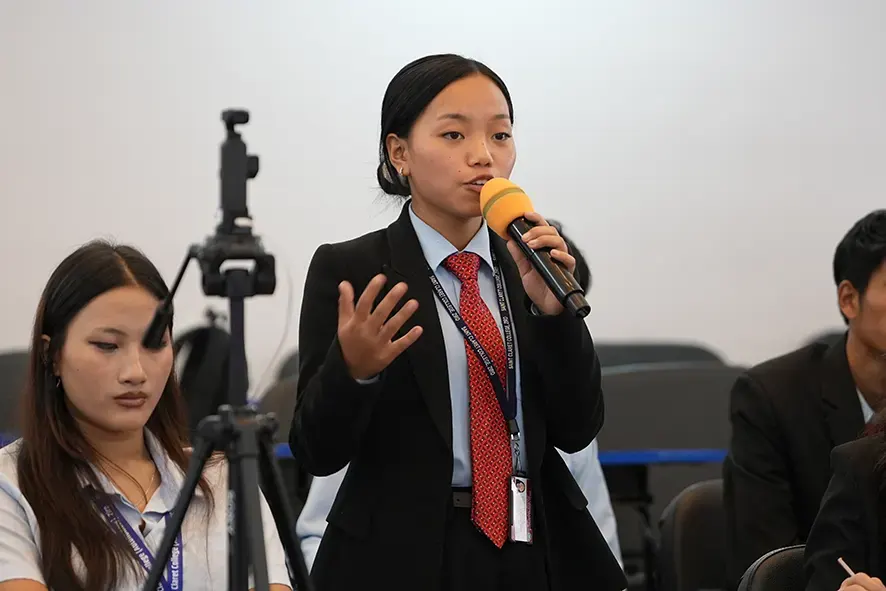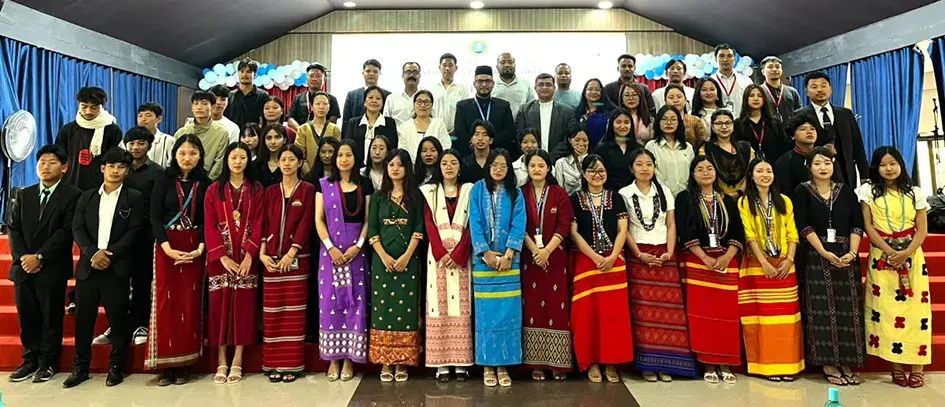
ZIRO, 7 Sep: A national-level workshop on opportunities in open-source technologies and an awareness programme on the 'FOSSEE Project' of the Indian Institute of Technology (IIT), Bombay was organised by Saint Claret College, Ziro (SCCZ), in collaboration with the FOSSEE Project, IIT Bombay (Mumbai), on Monday at the college campus here in Lower Subansiri district.
The programme was organised under the aegis of the National Mission on Education through Information and Communication Technology (NMEICT). Students and faculty members of SCCZ and Nealam Taram Government College, Yachuli, participated in person, while other participants joined online.
Among the attendees were Lower Subansiri Deputy Commissioner Oli Perme and Rajiv Gandhi University Environmental Sciences Dean Prof Sailajananda Saikia.
The workshop featured experts from IIT Bombay who introduced the participants to the various opportunities available through the FOSSEE Project. Dr Mohamed Kasim Khan, national coordinator, space and geospatial, NMEICT, highlighted internship opportunities linked with IIT Bombay through the FOSSEE Project.
Dr Khan highlighted that SCCZ is the first institute in Arunachal Pradesh to organise a FOSSEE programme, marking an important step towards promoting open-source technologies and knowledge-sharing in Northeast India.
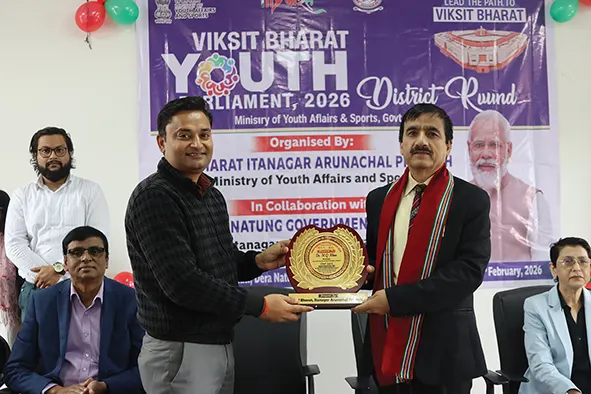
He also announced the recognition received by SCCZ at the National Geospatial Awards 2026,Edition 3. The awards were jointly organised by the FOSSEE Project, IIT Bombay, and the Rural Data Research and Analysis (RuDRA) Lab under NMEICT.
The jury and the organising committee conferred the 'Best College National Award (Outreach)' on SCCZ for its exemplary outreach and capacity-building efforts in Arunachal.
SCCZ Geography HoD (PG) Dr Vajana Thakuria was also conferred the National Geospatial Faculty Fellow Award (Geospatial Outreach).
Dr Khan also announced a national geospatial internship opportunity for the students of SCCZ, subject to the prescribed screening process.
The technical sessions provided participants with hands-on exposure and insights into a wide range of open-source technologies. FOSSEE principal investigator Prof Prabhu Ramachandran presented an overview of the FOSSEE Project, while FOSSEE senior project manager Usha Viswanathan spoke on FOSSEE activities and opportunities through the Knowledge Centre Connect.
Other technical sessions covered open source hardware, IoT, and Arduino on Cloud, presented by Rajesh Kushalkar; Python programming by Nalina Venkataramani; and open source animation, free and open source creative art library by Kushal Singh Rajput.
Sessions on scilab scientific computing and e-Sim (open source electronic simulation) were conducted by Vineeta Parmar, while open FOAM (computational fluid dynamics) was presented by Payel Mukerjee.
Madhulika Goyal conducted a session on Koha library automation, and Dr Khan led the session on space and open-source geospatial technologies.
The workshop provided students and faculty members with exposure to practical applications of open-source technologies, along with opportunities for internships, capacity building, academic collaboration and skill development.