
Batons And Barricades
By Poonam I Kaushish
Power has a peculiar addiction. The longer it stays in office, the more it mistakes conformity for patriotism and dissent for treason. It begins believing every slogan against it is an attack on the nation, every protest a conspiracy and every questioning citizen an enemy.
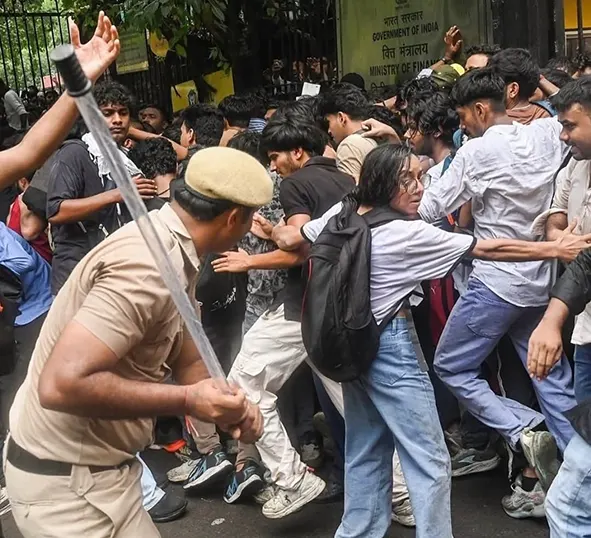
When Gen Z-led Cockroach Janata Party poured onto streets demanding quality education, transparency and accountability, they ran into Government’s favourite vocabulary: barricades, lathi charges, pellets guns, detentions and a police force that too often appears to treat opposition as a law-and-order problem rather than a democratic right and a Government confident to listen.
The script never changes and the images are painfully familiar. Citizens protest, police crackdown, Government defends, internet shutdowns and an inquiry is announced. Headlines fade. Nothing changes. The cycle repeats. The Administration has perfected a dangerous ritual. Be it students, farmers, social activists, PSU employees etc, the policing template remains consistent.
Worse, the anger is not the use of force or that excesses occur. Police do need force as democracies cannot function without maintaining public order. The real outrage is the complete absence of accountability when force becomes excessive and nobody is ever held guilty.
For decades, successive Governments have praised police bravery while refusing to confront police impunity. Every Party in Opposition become agents of oppression and demand accountability, but once in power it discovers virtues of “maintaining law and order.” The result is predictable: Police sees crowds before seeing citizens’, it sees threats before grievances, wants obedience before observing rights.
Alas, police continues to function under a colonial mindset inherited from the Police Act 1861, a legislation designed by the British not to serve citizens but to control subjects. Independent India replaced the Union Jack but never dismantled the architecture of coercion. Whereby, the baton has become the State’s punctuation mark!
Questionably, have any officers lost their jobs because they ordered unnecessary lathi charge? How many faced criminal prosecution after disproportionate action against peaceful demonstrators? How many command-level decisions have been independently reviewed? How many victims have received compensation because police crossed Constitutional limits? How many Home Ministers have apologised because policing crossed Constitutional lines? The answers expose the rot. Almost none.
Undeniably, accountability travels only downward. Constables become convenient scapegoats while those issuing instructions remain untouched. Government denies involvement. (Ask the District Magistrate) Senior officers defend subordinates (RAF use of pellet guns). Internal inquiries become exercises in institutional self-protection.
Months later everyone moves one except, those carrying broken bones or busted faith. The message reaches every officer with brutal clarity: Risks of using excessive force are minimal risks of refusing questionable orders are enormous. That is how impunity becomes institutional culture.
Thus, notwithstanding public scrutiny, institutional accountability remains stubbornly missing. Video evidence may ignite outrage but it rarely produces reform. Not due to shortage of reports but shortage of courage. Committees have written reports, experts have produced blueprints, Supreme Court judgments have repeatedly underscored police reforms, operational independence and insulation from political interference only to be dumped in dustbins of history.
Besides, implementation across States has been partial, reluctant or cosmetic. Nothing fundamentally changes because no Government willingly surrenders instruments of control. Why? Because Governments, regardless of ideology, find an unreformed police force politically convenient.
At the crux: Who should control police? State Government or independent body? A Catch-22 question, for our power-greedy netas to honestly answer and us to stupidly expect.
Unfortunately, even as a Government promises reform, it doesn’t want to surrender control. Police reforms don’t die, they are murdered by political convenience and forgotten. Every committee writes the obituary; every Government attends the funeral.
An independent accountable police may refuse illegal instructions, expose administrative failures instead of masking them. A professional police may insist on evidence over political expediency which threatens every ruling Establishment and explains why police reforms remain India’s favourite unfinished project.
Is police more sinned against than sinning? Are politicians the main culprit? The truth is mid-way. All work in tandem in furthering their own interest. Politicians need a compliant police force to enforce their writ, police need political patronage for prized postings, promotions and protection. The result is a toxic symbiosis in which loyalty to Government often eclipses loyalty to the Constitution.
Consequently, the system becomes self-perpetuating. Over the years, the threatened political elite have given more and more powers to police to get their way and have their say. Their merit and investigative skills don’t really matter. What counts is loyalty and trustworthiness to the leader.
Any wonder mass transfers take place in police department with every change in Ministers. Bihar’s prisons are notorious for criminals rushing to surrender after committing crimes as they have a nexus with police who provide protection in jail.
Shockingly, Status of Policing in India Report 2025 finds caste, religion and political affiliation play a decisive role in shaping police perceptions and influencing actions. Over 27% justified mob violence in cases of sexual harassment, kidnapping effectively legitimising vigilantism. In arrests only 41% “always followed” procedures, 21% “rarely” or “never” complied with them.
Case in point: Complainant goes to file FIR. SHO refuses to record complaint if it pertains to netas, rich and powerful or demands money, threatens and shoos him away. A woman complainant is molested and raped, specially in notorious Bihar. A recent report shows conviction rate is as low as 1% in the past 10 years.
Where lies’ India’s salvation? With citizenry hooting for answerability and accountability from netagan it is imperative we get our priorities right. Simultaneously there is need for new-age policeman who is more professional, better motivated, equipped and trained with latest technology and tactics.
Clearly, Gen Z’s protests should become the catalyst for police reforms, Governments have postponed for over seven decades. We need an independent Police Complaints Authority with real teeth, not ornamental powers. Every allegation of excessive force during protests must trigger an automatic, time-bound investigation by an agency outside the police hierarchy.
Fixed tenures to reduce arbitrary political interference, body cameras should become mandatory for crowd-control units and time-bound disciplinary proceedings against officers found guilty of misconduct. If an unlawful crackdown occurs, accountability must replace convenient scapegoating.
If excessive force is systemic, accountability must travel upward, not downward. Until then every promise of reform will remain another exercise in political theatre. The Government proclaims nobody is above the law. The real test is whether that principle applies to those empowered to enforce it.
Citizens do not need better policing, they need policing that remembers a simple Constitutional truth: A citizen is not the State’s adversary, he is the sovereign. The baton exists to defend that sovereignty, not silence it. Time our politicians stop hiding behind the convenient fiction: “Police acted independently.” Nobody believes that fairy tale anymore.
Clearly, democracy cannot coexist indefinitely with impunity. A police that serves power before law ultimately serves neither. And a Republic where the baton enjoys greater immunity than a citizen enjoys liberty is not displaying strength. It is advertising insecurity. Remember, a Government that fears peaceful protesters eventually fears its own people. It needs to answer one question: Will police be guided by law of the land only or by Government of the day? — INFA